-
Redis数据结构之——hash
写在前面
以下内容是基于Redis 6.2.6 版本整理总结
一、Redis 数据结构hash的编码格式
Redis中hash数据类型使用了两种编码格式:ziplist(压缩列表)、hashtable(哈希表)
在redis.conf配置文件中,有以下两个参数,意思为:当节点数量小于512并且字符串的长度小于等于64时,会使用ziplist编码。
hash-max-ziplist-entries 512 hash-max-ziplist-value 64- 1
- 2
二、压缩链表(ziplist)
ziplist 我们整理在下一篇文章。
三、哈希表(hashtable)
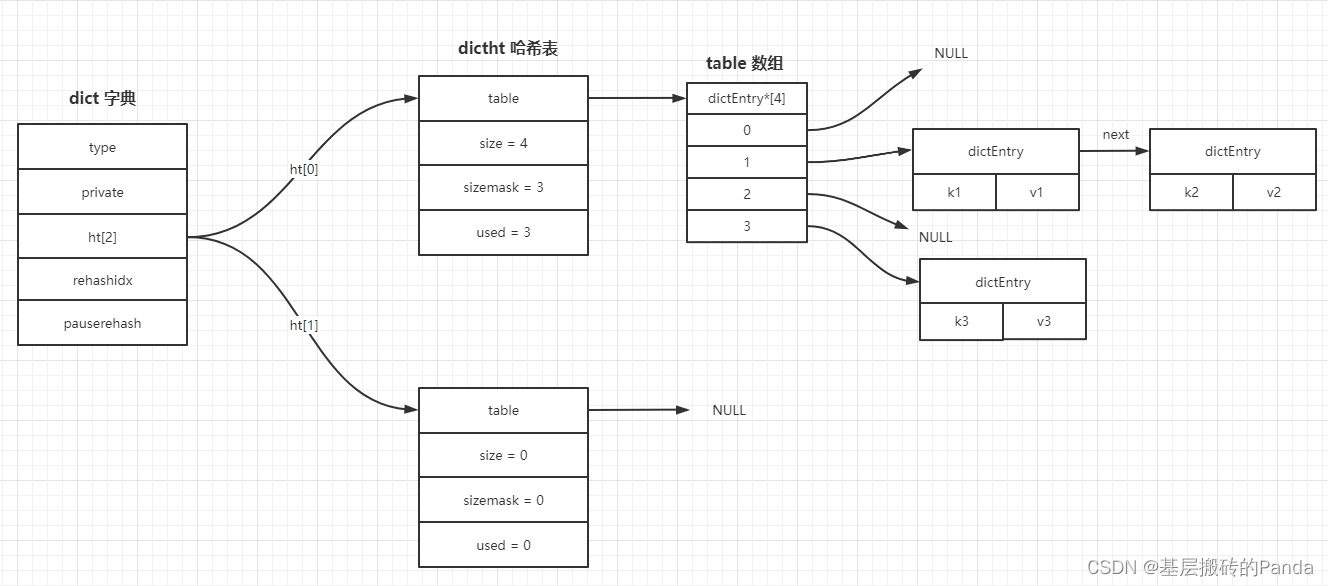
Redis中的字典(dict)使用哈希表作为的底层实现,一个哈希表里可以有多个哈希表的节点,每个节点保存字典中的一个键值对。
哈希表结构定义如下:
typedef struct dictht { dictEntry **table; // 哈希表数组 每个元素都是 dictEntry 的指针,指向 dictEntry; unsigned long size; // 哈希表大小 unsigned long sizemask; // 用来计算索引值 always: sizemask = size - 1 unsigned long used; // 哈希表已有节点的数量 } dictht;- 1
- 2
- 3
- 4
- 5
- 6
哈希表节点定义如下:
哈希表节点使用 dictEntry 结构表示,每个 dictEntry 结构都保存着一个键值对和冲突后的链表的下一个节点。typedef struct dictEntry { void *key; union { void *val; uint64_t u64; int64_t s64; double d; } v; struct dictEntry *next; // 保存下一个 dictEntry 的地址,形成链表 } dictEntry;- 1
- 2
- 3
- 4
- 5
- 6
- 7
- 8
- 9
- 10
其中,value 是一个联合体,可以保存多种数据类型。当value类型为 uint64_t 、int64_t 或 double时可以直接存储。其他类型需要在其他位置申请一段空间来存放,并用val指向这段空间来使用。
字典结构定义如下:
// location: dict.h typedef struct dict { dictType *type; // 指向 dictType 结构的指针 void *privdata; // 存储私有数据的指针,在 dictType 里面的函数会用到 dictht ht[2]; // 两个哈希表,扩容时使用,后面会结合源码详细说明 long rehashidx; // 值为-1时,表示没有进行rehash,否则保存rehash执行到那个元素的数组下标 int16_t pauserehash; // >0 表示rehash暂停,<0 表示编码错误 } dict;- 1
- 2
- 3
- 4
- 5
- 6
- 7
- 8
dictType 结构定义如下
dictType 结构体定义了一系列操作key-value键值对的方法的函数指针,在实际运行时传入指定函数,就能实现预期的功能,有点运行时多态绑定的味道。
// 操作特性键值对的函数簇 typedef struct dictType { uint64_t (*hashFunction)(const void *key); // 计算哈希值的函数 void *(*keyDup)(void *privdata, const void *key); // 复制key的函数 void *(*valDup)(void *privdata, const void *obj); // 复制value的函数 int (*keyCompare)(void *privdata, const void *key1, const void *key2); // 对比key的函数 void (*keyDestructor)(void *privdata, void *key); // 销毁key的函数 void (*valDestructor)(void *privdata, void *obj); // 销毁value的函数 int (*expandAllowed)(size_t moreMem, double usedRatio); // 扩容 } dictType;- 1
- 2
- 3
- 4
- 5
- 6
- 7
- 8
- 9
- 10
字典整体结构可以用下图来描述:
3.1 hash冲突
当两个或两个以上的键被分配到哈希数组的同一个索引上面时,我们称这些键发生了冲突。Redis的哈希表使用拉链法解决hash冲突。
3.2 负载因子
负载因子 = used / size ; used 是哈希数组存储的元素个数,size 是哈希数组的长度。
负载因子越小,冲突越小;负载因子越大,冲突越大。3.3 rehash
随着命令的不断执行,哈希表保存的减值对会逐渐增加或者减少,为了让哈希表的负载因子维持在一个合理的范围内,当哈希表中的键值对过多或过少时,需要对哈希表的大小进行相应的扩展和收缩。而哈希表的扩展和收缩可以通过rehash来执行。rehash 就是将 ht[0] 中的节点,通过重新计算哈希值和索引值放到 ht[1] 哈希表指定的位置上。
扩容
- 如果负载因子大于1,就会触发扩容,扩容的规则是每次翻倍;
- 如果正在fork,执行持久化则不会扩容,但是,如果负载因子大于5,会立马扩容。
缩容
如果负载因子小于0.1,就会触发缩容。缩容的规则是:恰好包含used的2^n。3.4 渐进式rehash
当哈希表中的元素过多时,如果一次性rehash到ht[1],庞大的计算量,可能导致redis服务在一段时间不可用。为了避免rehash对服务器带来的影响,redis分多次、慢慢的将ht[0]哈希表中的键值对rehash到ht[1]哈希表,这就是渐进式rehash。
核心思想:将整个rehash过程均摊到每次命令的执行中。
rehash的详细步骤:
- 为 ht[1] 哈希表分配空间,此时字典同时拥有ht[0] 和 ht[1] 两个字典
- 将字典中的rehashidx设置为0,表示开始rehash
- 在rehash期间,每次对字典的增删改查,除了执行指定的命令外,还会顺带将ht[0] 中 rehashidx 索引上的所有键值对都rehash到ht[1]中,执行完rehash,rehashidx属性加一。注意:新增的键值对只能插入到ht[1]哈希表中,保证ht[0]的键值对只减不增。
- 随着操作的不断进行,最终ht[0]哈希表中的所有键值对都被rehash到ht[1]中。此时,将ht[0]释放掉,让ht[0] 指向ht[1],并设置rehashidx 为 -1,表示rehash完成。
四、字典常用 API
// 创建字典 dict *dictCreate(dictType *type, void *privDataPtr); // 将键值对 key-val 插入到字典 int dictAdd(dict *d, void *key, void *val); // 删除字典中指定 key 的键值对 int dictDelete(dict *d, const void *key); // 获取指定key的value值 void *dictFetchValue(dict *d, const void *key); // 将键值对 key-val 插入到字典,如果该key已经存在,则只更新val int dictReplace(dict *d, void *key, void *val);- 1
- 2
- 3
- 4
- 5
- 6
- 7
- 8
- 9
- 10
五、Rehash源码分析
5.1 添加元素步骤
// 1. 通过hash函数得到hash值 hash = dict->type->hashFunction(key); // 2. 将hash值与对应哈希表的sizemask 进行 & 操作得到index index= hash & d->ht[x].sizemask; // x = 0 or 1 // 3. 创建 dictEntry 节点,头插法插入到对应哈希表的index的位置 entry = zmalloc(sizeof(*entry)); entry->next = ht->table[index]; ht->table[index] = entry;- 1
- 2
- 3
- 4
- 5
- 6
- 7
- 8
添加元素源码分析
redis使用 dictAdd() 方法往哈希表中添加元素。dictAdd 调用的是 dictAddRaw 方法,它会先通过_dictKeyIndex() 函数计算出table的index;再通过头插法将该节点插入到目标位置。
dictAdd() 函数
/* Add an element to the target hash table */ int dictAdd(dict *d, void *key, void *val) { dictEntry *entry = dictAddRaw(d,key,NULL); if (!entry) return DICT_ERR; // 将 val 保存到 entry 节点 dictSetVal(d, entry, val); return DICT_OK; }- 1
- 2
- 3
- 4
- 5
- 6
- 7
- 8
- 9
- 10
- 11
- 12
dictAddRaw() 函数
dictEntry *dictAddRaw(dict *d, void *key, dictEntry **existing) { long index; dictEntry *entry; dictht *ht; if (dictIsRehashing(d)) _dictRehashStep(d); /* Get the index of the new element, or -1 if * the element already exists. */ // 计算index if ((index = _dictKeyIndex(d, key, dictHashKey(d,key), existing)) == -1) return NULL; /* Allocate the memory and store the new entry. * Insert the element in top, with the assumption that in a database * system it is more likely that recently added entries are accessed * more frequently. */ ht = dictIsRehashing(d) ? &d->ht[1] : &d->ht[0]; entry = zmalloc(sizeof(*entry)); // 头插法 最快 entry->next = ht->table[index]; ht->table[index] = entry; ht->used++; // 将 key 保存在 entry 节点中 dictSetKey(d, entry, key); return entry; }- 1
- 2
- 3
- 4
- 5
- 6
- 7
- 8
- 9
- 10
- 11
- 12
- 13
- 14
- 15
- 16
- 17
- 18
- 19
- 20
- 21
- 22
- 23
- 24
- 25
- 26
- 27
- 28
- 29
其中,在_dictKeyIndex() 函数计算index的时候,会调用 _dictExpandIfNeeded() 函数判断是否满足扩容的条件。其中有个条件是依赖于 dictTypeExpandAllowed(d) 的返回值。
_dictKeyIndex() 函数
static long _dictKeyIndex(dict *d, const void *key, uint64_t hash, dictEntry **existing) { unsigned long idx, table; dictEntry *he; if (existing) *existing = NULL; /* Expand the hash table if needed */ if (_dictExpandIfNeeded(d) == DICT_ERR) return -1; for (table = 0; table <= 1; table++) { idx = hash & d->ht[table].sizemask; /* Search if this slot does not already contain the given key */ he = d->ht[table].table[idx]; while(he) { if (key==he->key || dictCompareKeys(d, key, he->key)) { if (existing) *existing = he; return -1; } he = he->next; } if (!dictIsRehashing(d)) break; } return idx; }- 1
- 2
- 3
- 4
- 5
- 6
- 7
- 8
- 9
- 10
- 11
- 12
- 13
- 14
- 15
- 16
- 17
- 18
- 19
- 20
- 21
- 22
- 23
- 24
_dictExpandIfNeeded() 函数
/* Expand the hash table if needed */ static int _dictExpandIfNeeded(dict *d) { /* Incremental rehashing already in progress. Return. */ if (dictIsRehashing(d)) return DICT_OK; /* If the hash table is empty expand it to the initial size. */ if (d->ht[0].size == 0) return dictExpand(d, DICT_HT_INITIAL_SIZE); /* If we reached the 1:1 ratio, and we are allowed to resize the hash * table (global setting) or we should avoid it but the ratio between * elements/buckets is over the "safe" threshold, we resize doubling * the number of buckets. */ if (d->ht[0].used >= d->ht[0].size && (dict_can_resize || d->ht[0].used/d->ht[0].size > dict_force_resize_ratio) && dictTypeExpandAllowed(d)) { return dictExpand(d, d->ht[0].used + 1); } return DICT_OK; }- 1
- 2
- 3
- 4
- 5
- 6
- 7
- 8
- 9
- 10
- 11
- 12
- 13
- 14
- 15
- 16
- 17
- 18
- 19
- 20
- 21
- 22
- 23
dictTypeExpandAllowed() 函数
static int dictTypeExpandAllowed(dict *d) { if (d->type->expandAllowed == NULL) return 1; return d->type->expandAllowed( _dictNextPower(d->ht[0].used + 1) * sizeof(dictEntry*), (double)d->ht[0].used / d->ht[0].size); }- 1
- 2
- 3
- 4
- 5
- 6
可以看到,如果 dictType 中没有设置 expandAllowed 函数,则直接返回真;如果设置了expandAllowed 函数,就需要执行完相应的函数才能确定是否可以扩缩容。这就是 dictType 的一个典型的应用场景。
5.2 rehash 源码分析
该函数每次从rehashidx开始的位置,固定扫描 10 个bucket,如果对应的bucket中有数据就 rehash 到 ht[1]中。
static void _dictRehashStep(dict *d) { if (d->pauserehash == 0) dictRehash(d,1); } int dictRehash(dict *d, int n) { int empty_visits = n*10; /* Max number of empty buckets to visit. */ if (!dictIsRehashing(d)) return 0; while(n-- && d->ht[0].used != 0) { dictEntry *de, *nextde; /* Note that rehashidx can't overflow as we are sure there are more * elements because ht[0].used != 0 */ assert(d->ht[0].size > (unsigned long)d->rehashidx); // 跳过空的槽位 while(d->ht[0].table[d->rehashidx] == NULL) { d->rehashidx++; // 如果 经过 n*10 次,还是为空,本次rehash结束 if (--empty_visits == 0) return 1; } // 找到要rehash的bucket de = d->ht[0].table[d->rehashidx]; // 遍历该bucket对应的dictEntry链表 while(de) { uint64_t h; nextde = de->next; // 为该dictEntry 获取在ht[1]中的index h = dictHashKey(d, de->key) & d->ht[1].sizemask; // 头插法 de->next 指向 ht[1].table[h]的第一个元素 (可能为NULL,可能有元素) de->next = d->ht[1].table[h]; // 更新ht[1].table[h]的值指向该 dictEntry d->ht[1].table[h] = de; d->ht[0].used--; d->ht[1].used++; de = nextde; // 更新de,继续遍历,直至为空 } // 将ht[0]中 d->rehashidx 对应的bucket清空 d->ht[0].table[d->rehashidx] = NULL; // 更新rehashidx d->rehashidx++; } // 检查整个ht[0]表,rehash是否完成 if (d->ht[0].used == 0) { zfree(d->ht[0].table); // 释放ht[0] d->ht[0] = d->ht[1]; // 让ht[0] 指向 rehash后的 ht[1] _dictReset(&d->ht[1]); // 重置 ht[0], 以备下次rehash d->rehashidx = -1; return 0; } /* More to rehash... */ return 1; }- 1
- 2
- 3
- 4
- 5
- 6
- 7
- 8
- 9
- 10
- 11
- 12
- 13
- 14
- 15
- 16
- 17
- 18
- 19
- 20
- 21
- 22
- 23
- 24
- 25
- 26
- 27
- 28
- 29
- 30
- 31
- 32
- 33
- 34
- 35
- 36
- 37
- 38
- 39
- 40
- 41
- 42
- 43
- 44
- 45
- 46
- 47
- 48
- 49
- 50
- 51
- 52
- 53
- 54
- 55
- 56
- 57
- 58
- 59
- 60
- 61
-
相关阅读:
【JDK 8 -收集和统计】7.1 collector 收集器
oracle-sql语句解析类型
泰勒多项式
联合作战模式下的信息过滤方法
nvm管理(切换)node版本,方便vue2,vue3+ts开发
科技连接美好未来 | 美格智能5G FWA解决方案持续推进
MySQL是如何保证高可用的
2023年9月18日
数据挖掘神经网络算法,人工神经网络分析方法
力扣每日一题 ---- 2905. 找出满足差值条件的下标 II
- 原文地址:https://blog.csdn.net/weixin_46935110/article/details/127771251
