-
手写死锁检测组件
手写死锁检测组件
前言
本文将从0到1写一个死锁检测组件。源码:deadlock_success.c
组件如何放入自己的项目里?把代码末两个Debug部分删除,在你的项目里添加下面两句代码即可使用死锁检测组件。
init_hook(); start_check();- 1
- 2
本专栏知识点是通过零声教育的线上课学习,进行梳理总结写下文章,对c/c++linux课程感兴趣的读者,可以点击链接 C/C++后台高级服务器课程介绍 详细查看课程的服务。
1. 死锁的现象以及原理
1.1 复现最简单的死锁
线程A占有锁1,线程B占有锁2;此时线程A想要获取锁2,但是锁2已经被线程B占有, 此时线程A会休眠等待线程B释放锁2后,再去获得锁2。可以看到下面的场景,线程B想要获取锁1,结果线程B也休眠去了。这就导致死锁,锁1和锁2永远得不到释放,因为线程A和线程B都在等待另一个锁的释放。
这种僵持的状态,就称为死锁。

正如下面代码所示,这样就引发了死锁void *thread_rountine_1(void *args) { pthread_t selfid = pthread_self(); printf("thread_routine 1 : %ld \n", selfid); pthread_mutex_lock(&mutex_1); sleep(1); pthread_mutex_lock(&mutex_2); pthread_mutex_unlock(&mutex_2); pthread_mutex_unlock(&mutex_1); return (void *) (0); } void *thread_rountine_2(void *args) { pthread_t selfid = pthread_self(); // printf("thread_routine 2 : %ld \n", selfid); pthread_mutex_lock(&mutex_2); sleep(1); pthread_mutex_lock(&mutex_1); pthread_mutex_unlock(&mutex_1); pthread_mutex_unlock(&mutex_2); return (void *) (0); }- 1
- 2
- 3
- 4
- 5
- 6
- 7
- 8
- 9
- 10
- 11
- 12
- 13
- 14
- 15
- 16
- 17
- 18
- 19
- 20
- 21
- 22
- 23
- 24
- 25
- 26
- 27
1.2 从死锁中找出检测死锁的规律
我们来看看下面这张图,线程A想要获取线程B的资源,线程B想要获取线程C的资源,线程C想要获取线程D的资源,线程D想要获取线程A的资源,这其实就构成了一个
有向图的环路

来看看前面介绍的最简单的死锁,发现其本直也是构成了一个有向图的环路

来看看非死锁的场景,只要线程D释放了mutex4,那么线程C就能获得锁,随后线程C释放mutex3和4,那么线程B…可以发现,这个非死锁的场景,它是一个有向图,但这个图没有构成环路。
通过上面三个场景的分析,我们其实就可以把
死锁的问题,转换为 有向图的环路检测。在线程进行加锁前,我们去判断一下所有的线程有没有构成环路,如果有,则说明现在很有可能会进入死锁。2. 检测死锁的前置条件
2.1 有向图的边怎么来?
我们现在已经知道了死锁的问题,就转换为 有向图的环路检测。那么这个有向图怎么构建?在我们对mutex1加锁的时候,我们怎么知道是线程A占有mutex1,在对mutex2加锁的时候,怎么知道它已经被线程B占有了?我们无法知道锁是属于哪个线程的。既然连锁都不知道属于哪个线程,哪有如何构建出有向图呢?换言之,
我们需要解决:知道当前锁被哪个线程占用。我们不知道的原因很简单,就是mutex和pthread_id没有一个对应关系。//锁与线程的信息 struct pair_t { unsigned long int th_id; enum Type type; unsigned long int lock_id; int degress; };- 1
- 2
- 3
- 4
- 5
- 6
- 7
- 8

我们可以做出一个数据结构,在加锁之前,判断这个锁有没有被别的线程使用,如果没有,在加锁之后我们将这个锁与本线程绑定,做一个pair,然后把这个pair存起来。比如说线程线程A和mutex1绑定,线程B和mutex2绑定了。
当线程A再次去尝试对mutex2加锁之前,先判断mutex2是否名花有主?如果有,那有向图的边不就来了吗?不知道读者有没有注意到,这一段话都建立在加锁之前判断 锁 是否名花有主。有一个非常简单粗暴的方法,在加锁之前调用一个函数,加锁之后调用一个函数。读者可以想一下,本文是要实现一个组件,所谓组件,给别人也能用,难道在一个项目里面,想要检测一下死锁,去把lock上下全部加两个函数?这显然不符合我们组件的设想,我们希望不改变别人的代码,就能实现检测。
lock_before(self_id, (unsigned long int) mutex); pthread_mutex_lock(&mutex); lock_after(self_id, (unsigned long int) mutex);- 1
- 2
- 3
要想实现上面的需求,我们可以使用hook。
2.2 hook—>dlsym
hook是什么意思?钩子,简单来说,我们使用hook,可以把系统或第三方库提供的函数,替换成我们写的同名函数,而第三方库的函数则被我们改名,在我们写的同名函数里,可以去调用第三方库原来的函数。
正如下面代码所示,系统提供的pthread_mutex_lock被改名为pthread_mutex_lock_f。那么我们就可以使用pthread_mutex_lock来当作函数名称,如此一来,在别的项目里面,我们通过hook就可以进行死锁检测,而不需要去改代码了。
hook提供了两个接口;1. dlsym()是针对系统的,系统原始的api。2. dlopen()是针对第三方的库。
/* ******* ******************Hook****************** ******* */ typedef int (*pthread_mutex_lock_t)(pthread_mutex_t *mutex); pthread_mutex_lock_t pthread_mutex_lock_f; typedef int (*pthread_mutex_unlock_t)(pthread_mutex_t *mutex); pthread_mutex_unlock_t pthread_mutex_unlock_f; static int init_hook() { pthread_mutex_lock_f = dlsym(RTLD_NEXT, "pthread_mutex_lock"); pthread_mutex_unlock_f = dlsym(RTLD_NEXT, "pthread_mutex_unlock"); } int pthread_mutex_lock(pthread_mutex_t *mutex) { pthread_t self_id = pthread_self(); // lock_before(self_id, (unsigned long int) mutex); pthread_mutex_lock_f(mutex); lock_after(self_id, (unsigned long int) mutex); }- 1
- 2
- 3
- 4
- 5
- 6
- 7
- 8
- 9
- 10
- 11
- 12
- 13
- 14
- 15
- 16
- 17
- 18
- 19
- 20
- 21
- 22
在进程的虚拟内存空间里面,有一块代码段 ,上面代码中,pthread_mutex_lock_f是一个函数指针,实际上,就是把pthread_mutex_lock_f指向代码段里系统函数的入口地址 ,以此来实现偷天换日。
还需要注意一点,这个#define _GNU_SOURCE要写在前面,因为这个就相当于一个开关,在下面的.h文件里面,有#ifdef _GNU_SOURCE的地方。在gcc编译的时候后面加上 -ldl。
#define _GNU_SOURCE #include- 1
- 2
3. 有向图
3.1 有向图的数据结构
下面来看一下结构体的含义

ertex_list的每一项,都是一个顶点,后面链表里面存的,都是边的另一个点。
vlock_list的每一项,存的都是锁与线程的信息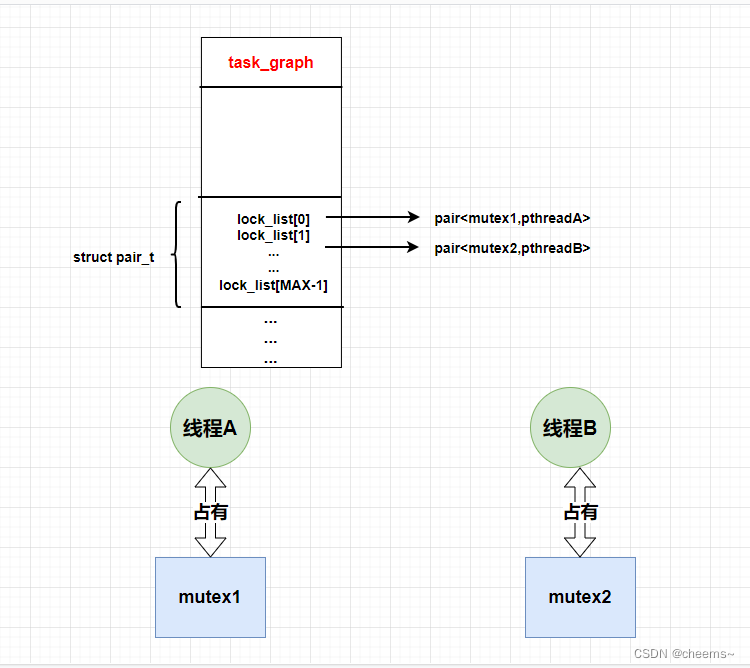
/* ******* ******************Digraph****************** ******* */ enum Type { PROCESS, RESOURCE }; //锁与线程的信息 struct pair_t { unsigned long int th_id; enum Type type; unsigned long int lock_id; int degress; }; //顶点 struct vertex_t { struct pair_t pair; struct vertex_t *next; }; struct task_graph { struct vertex_t vertex_list[MAX]; int vertex_num; struct pair_t lock_list[MAX]; int lock_num; pthread_mutex_t mutex; int path[MAX + 1]; int visited[MAX]; int k; int deadlock; }; struct task_graph *tg = NULL; //创建一个vertex struct vertex_t *create_vertex(struct pair_t pair) { struct vertex_t *tex = (struct vertex_t *) malloc(sizeof(struct vertex_t)); tex->pair = pair; tex->next = NULL; return tex; } //查找vertex在list里面的下标 int search_vertex(struct pair_t pair) { int i = 0; for (i = 0; i < tg->vertex_num; i++) { if (tg->vertex_list[i].pair.type == pair.type && tg->vertex_list[i].pair.th_id == pair.th_id) { return i; } } return -1; } //把vertex添加到vertex_list里面 void add_vertex(struct pair_t pair) { if (search_vertex(pair) == -1) { tg->vertex_list[tg->vertex_num].pair = pair; tg->vertex_list[tg->vertex_num].next = NULL; tg->vertex_num++; } } //添加边,把v添加到u的链表里 int add_edge(struct pair_t u, struct pair_t v) { add_vertex(u); add_vertex(v); struct vertex_t *cnt = &(tg->vertex_list[search_vertex(u)]); while (cnt->next != NULL) { cnt = cnt->next; } cnt->next = create_vertex(v); } //检查边是否存在 int verify_edge(struct pair_t u, struct pair_t v) { if (tg->vertex_num == 0) return 0; int idx = search_vertex(u); if (idx == -1) { return 0; } struct vertex_t *cnt = &(tg->vertex_list[idx]); while (cnt != NULL) { if (cnt->pair.th_id == v.th_id) { return 1; } cnt = cnt->next; } return 0; } //删除边 int remove_edge(struct pair_t u, struct pair_t v) { int idx_u = search_vertex(u); int idx_v = search_vertex(v); if (idx_u != -1 && idx_v != -1) { struct vertex_t *cnt = &tg->vertex_list[idx_u]; struct vertex_t *remove; while (cnt->next != NULL) { if (cnt->next->pair.th_id == v.th_id) { remove = cnt->next; cnt->next = cnt->next->next; free(remove); break; } cnt = cnt->next; } } }- 1
- 2
- 3
- 4
- 5
- 6
- 7
- 8
- 9
- 10
- 11
- 12
- 13
- 14
- 15
- 16
- 17
- 18
- 19
- 20
- 21
- 22
- 23
- 24
- 25
- 26
- 27
- 28
- 29
- 30
- 31
- 32
- 33
- 34
- 35
- 36
- 37
- 38
- 39
- 40
- 41
- 42
- 43
- 44
- 45
- 46
- 47
- 48
- 49
- 50
- 51
- 52
- 53
- 54
- 55
- 56
- 57
- 58
- 59
- 60
- 61
- 62
- 63
- 64
- 65
- 66
- 67
- 68
- 69
- 70
- 71
- 72
- 73
- 74
- 75
- 76
- 77
- 78
- 79
- 80
- 81
- 82
- 83
- 84
- 85
- 86
- 87
- 88
- 89
- 90
- 91
- 92
- 93
- 94
- 95
- 96
- 97
- 98
- 99
- 100
- 101
- 102
- 103
- 104
- 105
- 106
- 107
- 108
- 109
- 110
- 111
- 112
- 113
- 114
- 115
- 116
- 117
- 118
- 119
- 120
- 121
- 122
- 123
- 124
3.2 dfs判断环的方法
现在边也处理好了,锁与线程的关系也处理好了,那么我们如何去判断有没有环呢?我们使用DFS来判断。

/* ******* ******************check cycle****************** ******* */ //打印 void print_deadlock(void) { int i = 0; printf("deadlock : "); for (i = 0; i < tg->k - 1; i++) { printf("%ld --> ", tg->vertex_list[tg->path[i]].pair.th_id); } printf("%ld\n", tg->vertex_list[tg->path[i]].pair.th_id); } void print_locklist(void) { int i = 0; printf("-----------print_locklist----------\n"); for (i = 0; i < tg->lock_num; i++) { printf("threadid : %ld, lockid: %ld\n", tg->lock_list[i].th_id, tg->lock_list[i].lock_id); } printf("-----------------------------------\n"); } int DFS(int idx) { struct vertex_t *ver = &tg->vertex_list[idx]; if (tg->visited[idx] == 1) { tg->path[tg->k++] = idx; print_deadlock(); tg->deadlock = 1; return 0; } tg->visited[idx] = 1; tg->path[tg->k++] = idx; while (ver->next != NULL) { DFS(search_vertex(ver->next->pair)); tg->k--; ver = ver->next; } return 1; } //判断某个顶点是否成环 int search_for_cycle(int idx) { struct vertex_t *ver = &tg->vertex_list[idx]; tg->visited[idx] = 1; tg->k = 0; tg->path[tg->k++] = idx; while (ver->next != NULL) { int i = 0; for (i = 0; i < tg->vertex_num; i++) { if (i == idx) continue; tg->visited[i] = 0; } for (i = 1; i <= MAX; i++) { tg->path[i] = -1; } tg->k = 1; DFS(search_vertex(ver->next->pair)); ver = ver->next; } } //检查是否死锁 void check_dead_lock(void) { printf("-----------check deadlock----------\n"); int i; tg->deadlock = 0; for (i = 0; i < tg->vertex_num; i++) { if (tg->deadlock == 1) { break; } //从每个点都出发一遍 search_for_cycle(i); } if (tg->deadlock == 0) { printf("no deadlock\n"); } printf("----------------------------------\n"); }- 1
- 2
- 3
- 4
- 5
- 6
- 7
- 8
- 9
- 10
- 11
- 12
- 13
- 14
- 15
- 16
- 17
- 18
- 19
- 20
- 21
- 22
- 23
- 24
- 25
- 26
- 27
- 28
- 29
- 30
- 31
- 32
- 33
- 34
- 35
- 36
- 37
- 38
- 39
- 40
- 41
- 42
- 43
- 44
- 45
- 46
- 47
- 48
- 49
- 50
- 51
- 52
- 53
- 54
- 55
- 56
- 57
- 58
- 59
- 60
- 61
- 62
- 63
- 64
- 65
- 66
- 67
- 68
- 69
- 70
- 71
- 72
- 73
- 74
- 75
- 76
- 77
- 78
- 79
- 80
- 81
- 82
- 83
- 84
- 85
- 86
3.3 简单测试一下
可以看到我们的结果与预期一致,说明我们的有向图与判断环完成了,那么下面我们就应该去写上锁前后的函数了。
/* ******* ******************Debug 2****************** ******* */ int main() { tg = (struct task_graph *) malloc(sizeof(struct task_graph)); tg->vertex_num = 0; struct pair_t v1; v1.th_id = 1; v1.type = PROCESS; add_vertex(v1); struct pair_t v2; v2.th_id = 2; v2.type = PROCESS; add_vertex(v2); struct pair_t v3; v3.th_id = 3; v3.type = PROCESS; add_vertex(v3); struct pair_t v4; v4.th_id = 4; v4.type = PROCESS; add_vertex(v4); struct pair_t v5; v5.th_id = 5; v5.type = PROCESS; add_vertex(v5); add_edge(v1, v2); add_edge(v2, v3); add_edge(v3, v4); add_edge(v4, v5); add_edge(v3, v1); add_edge(v5, v1); check_dead_lock(); // search_for_cycle(search_vertex(v1)); }- 1
- 2
- 3
- 4
- 5
- 6
- 7
- 8
- 9
- 10
- 11
- 12
- 13
- 14
- 15
- 16
- 17
- 18
- 19
- 20
- 21
- 22
- 23
- 24
- 25
- 26
- 27
- 28
- 29
- 30
- 31
- 32
- 33
- 34
- 35
- 36
- 37
- 38
- 39
- 40
- 41
- 42
- 43
- 44
root@wxf:/tmp/tmp.d4vz2dOyJP# gcc -o deadlock_success deadlock_success.c -lpthread -ldl root@wxf:/tmp/tmp.d4vz2dOyJP# ./deadlock_success -----------check deadlock---------- deadlock : 1 --> 2 --> 3 --> 4 --> 5 --> 1 deadlock : 1 --> 2 --> 3 --> 1 ---------------------------------- root@wxf:/tmp/tmp.d4vz2dOyJP#- 1
- 2
- 3
- 4
- 5
- 6
- 7
- 8

4. 三个原语操作
现在有向图和hook都有了,那么我们如何把死锁检测出来?换言之,我们怎么使用pthread_mutex_lock和pthread_mutex_unlock构建有向图?
在调用系统提供的lock以前,我们需要检测这个锁有没有被别的线程占用,如果被占用,那么我们就需要往图里面加一条边。
如果没有被占用,那么我们就往里面走。也就是说加锁完,调用系统提供的lock之后, 我们需要告诉后面的线程,这个锁被我占用了,即添加一项pair,供别人lock之前去检测。 如果被占用了,然后锁被释放,本线程获取到了这个以前被占用的锁,那么我们lock之后,需要把原来添加的一条边删除掉,因为这个锁已经属于自己了,并且将锁对应的pair中的th_id改成自己。
在调用系统提供的unlock之后,解锁了一个锁之后,我们去看看还有没有渴望得到这个锁的,如果没有,则将锁对应的pair置空,如果有,则不管pair。
注意:下面三个函数,我对三个函数都加锁了,这里是我的偷懒操作,锁的粒度较大。如果想优化,应该放到serch函数里面,我这里懒得去改了。
int pthread_mutex_lock(pthread_mutex_t *mutex) { pthread_t self_id = pthread_self(); lock_before(self_id, (unsigned long int) mutex); pthread_mutex_lock_f(mutex); lock_after(self_id, (unsigned long int) mutex); } int pthread_mutex_unlock(pthread_mutex_t *mutex) { pthread_t self_id = pthread_self(); pthread_mutex_unlock_f(mutex); unlock_after(self_id, (unsigned long int) mutex); }- 1
- 2
- 3
- 4
- 5
- 6
- 7
- 8
- 9
- 10
- 11
- 12
- 13
- 14
- 15
4.1 lock_before
我们现在把加锁理解为谈恋爱确认关系。在确认关系之前,我们要去看一下这个女生有没有男朋友,如果她没有男朋友,妙哉!那么我们就直接确认关系(lock)吧!如果她有男朋友,那现在还不能和她谈恋爱,我们先与她暧昧暧昧(add_edge),等着她分手。
void lock_before(unsigned long int thread_id, unsigned long int lock) { pthread_mutex_lock_f(&tg->mutex); int idx = search_lock(lock); // printf("[lock_before] self_id:%lu lock:%lu lock idx:%d \n", thread_id, lock, idx); //如果该锁是第一次则什么都不做 if (idx != -1) { //u是想要加锁的线程 struct pair_t u; u.th_id = thread_id; u.type = PROCESS; //把vertex添加到vertex_list里面 add_vertex(u); //v是锁原来的线程 struct pair_t v; v.th_id = tg->lock_list[idx].th_id; tg->lock_list[idx].degress++; v.type = PROCESS; add_vertex(v); if (!verify_edge(u, v)) { add_edge(u, v); // 把v加入到vertex_list的u的链表中 } } pthread_mutex_unlock_f(&tg->mutex); }- 1
- 2
- 3
- 4
- 5
- 6
- 7
- 8
- 9
- 10
- 11
- 12
- 13
- 14
- 15
- 16
- 17
- 18
- 19
- 20
- 21
- 22
- 23
- 24
- 25
- 26
- 27
4.2 lock_after
现在我们加锁完了,也就是谈恋爱确认关系了之后,如果我们是她的初恋,那么我们要向全世界宣布(tg->lock_list[empty_lock_idx]):她,是我的女人!如果不是初恋,她被别人宣布过了,那我们就别搞这么浪漫了,把她给我们的备注改成男朋友就好了(tg->lock_list[idx].th_id = thread_id;),并且我们也不需要暧昧聊天了(remove_edge),因为她已经是我们女朋友了。
void lock_after(unsigned long int thread_id, unsigned long int lock) { pthread_mutex_lock_f(&tg->mutex); int idx = search_lock(lock); // printf("[lock_after ] self_id:%lu lock:%lu ", thread_id, lock); if (idx == -1) { // 第一次加锁,找一个空位lock_list,设置th_id和lock int empty_lock_idx = search_empty_lock(lock); tg->lock_list[empty_lock_idx].th_id = thread_id; tg->lock_list[empty_lock_idx].lock_id = lock; // printf("分配lock_list位置 idx:%d \n", empty_lock_idx); if (empty_lock_idx >= tg->lock_num) { inc(&tg->lock_num, 1); } } else { //u是想要加锁的线程 struct pair_t u; u.th_id = thread_id; u.type = PROCESS; //v是锁原来的线程 struct pair_t v; v.th_id = tg->lock_list[idx].th_id; tg->lock_list[idx].degress--; v.type = PROCESS; //删除边 if (verify_edge(u, v)) { remove_edge(u, v); } //设为本线程 tg->lock_list[idx].th_id = thread_id; // printf("获得 lock idx:%d \n", idx); } pthread_mutex_unlock_f(&tg->mutex); }- 1
- 2
- 3
- 4
- 5
- 6
- 7
- 8
- 9
- 10
- 11
- 12
- 13
- 14
- 15
- 16
- 17
- 18
- 19
- 20
- 21
- 22
- 23
- 24
- 25
- 26
- 27
- 28
- 29
- 30
- 31
- 32
- 33
- 34
- 35
- 36
- 37
4.3 unlock_after
unlock就相当于分手,如果她没有备胎,那么她就恢复单身(pair置空),如果她有备胎,那就随她吧~
void unlock_after(unsigned long int thread_id, unsigned long int lock) { pthread_mutex_lock_f(&tg->mutex); int idx = search_lock(lock); //如果入度为0,说明没有别的线程指向该锁,则把这个idx位置置空 if (tg->lock_list[idx].degress == 0) { tg->lock_list[idx].th_id = 0; tg->lock_list[idx].lock_id = 0; } pthread_mutex_unlock_f(&tg->mutex); }- 1
- 2
- 3
- 4
- 5
- 6
- 7
- 8
- 9
- 10
- 11
- 12
- 13
5. 死锁检测线程的测试
下面我们来测试这个场景。完整代码在目录前言中。

/* ******* ******************Debug 1****************** ******* */ pthread_mutex_t mutex_1 = PTHREAD_MUTEX_INITIALIZER; pthread_mutex_t mutex_2 = PTHREAD_MUTEX_INITIALIZER; pthread_mutex_t mutex_3 = PTHREAD_MUTEX_INITIALIZER; pthread_mutex_t mutex_4 = PTHREAD_MUTEX_INITIALIZER; void *thread_rountine_1(void *args) { pthread_t selfid = pthread_self(); // printf("thread_routine 1 : %ld \n", selfid); pthread_mutex_lock(&mutex_1); sleep(1); pthread_mutex_lock(&mutex_2); pthread_mutex_unlock(&mutex_2); pthread_mutex_unlock(&mutex_1); return (void *) (0); } void *thread_rountine_2(void *args) { pthread_t selfid = pthread_self(); // printf("thread_routine 2 : %ld \n", selfid); pthread_mutex_lock(&mutex_2); sleep(1); pthread_mutex_lock(&mutex_3); pthread_mutex_unlock(&mutex_3); pthread_mutex_unlock(&mutex_2); return (void *) (0); } void *thread_rountine_3(void *args) { pthread_t selfid = pthread_self(); // printf("thread_routine 3 : %ld \n", selfid); pthread_mutex_lock(&mutex_3); sleep(1); pthread_mutex_lock(&mutex_4); pthread_mutex_unlock(&mutex_4); pthread_mutex_unlock(&mutex_3); return (void *) (0); } void *thread_rountine_4(void *args) { pthread_t selfid = pthread_self(); // printf("thread_routine 4 : %ld \n", selfid); pthread_mutex_lock(&mutex_4); sleep(1); pthread_mutex_lock(&mutex_1); pthread_mutex_unlock(&mutex_1); pthread_mutex_unlock(&mutex_4); return (void *) (0); } int main() { init_hook(); start_check(); printf("start_check\n"); pthread_t tid1, tid2, tid3, tid4; pthread_create(&tid1, NULL, thread_rountine_1, NULL); pthread_create(&tid2, NULL, thread_rountine_2, NULL); pthread_create(&tid3, NULL, thread_rountine_3, NULL); pthread_create(&tid4, NULL, thread_rountine_4, NULL); pthread_join(tid1, NULL); pthread_join(tid2, NULL); pthread_join(tid3, NULL); pthread_join(tid4, NULL); return 0; }- 1
- 2
- 3
- 4
- 5
- 6
- 7
- 8
- 9
- 10
- 11
- 12
- 13
- 14
- 15
- 16
- 17
- 18
- 19
- 20
- 21
- 22
- 23
- 24
- 25
- 26
- 27
- 28
- 29
- 30
- 31
- 32
- 33
- 34
- 35
- 36
- 37
- 38
- 39
- 40
- 41
- 42
- 43
- 44
- 45
- 46
- 47
- 48
- 49
- 50
- 51
- 52
- 53
- 54
- 55
- 56
- 57
- 58
- 59
- 60
- 61
- 62
- 63
- 64
- 65
- 66
- 67
- 68
- 69
- 70
- 71
- 72
- 73
- 74
- 75
- 76
- 77
- 78
- 79
- 80
- 81
- 82
- 83
- 84
- 85
- 86

-
相关阅读:
maven父工程
我又开始贩卖焦虑了,机器视觉兄弟们,打工这生意盘不活了?让人逃离北上广深,是毒鸡汤吗?
css_23_多列布局
启动Tomcat报:Failed to initialize connector [Connector[HTTP/1.1-80]
Python 基础记录 - 第4课
SpringBoot 如何使用 Grafana 进行可视化监控
Python中通过socketserver库创建服务端
Python终端输出彩色样式的内容
target is not existed: .page-component__scroll .el-scrollbar__wrap
java中的this引用和对象的构造及初始化
- 原文地址:https://blog.csdn.net/qq_42956653/article/details/126313099


