-
2020-ViT ICLR
2020-ViT ICLR
论文题目: An Image is Worth 16x16 Words: Transformers for Image Recognition at Scale
论文链接: https://arxiv.org/abs/2010.11929
官方的代码: https://github.com/google-research/vision_transformer
别人写的代码: https://github.com/lucidrains/vit-pytorch
视频讲解:https://www.bilibili.com/video/BV15P4y137jb 讲的非常好,看了5遍!!!
1. 简介
1.1 简介
-
ViT挑战了2012年AlexNet以来,在计算机视觉领域的绝对地位,
-
结论: 如果在
足够多的数据上去做预训练,那我们也不需要卷积神经网络,直接使用标准的Transformer 就能把视觉任务做的很好。作者团队证明了脱离神经网络,使用一个
纯的transformer结构也能在图像分类任务上表现的很好。甚至当我们在大规模数据集(google 的JTF300M或者Imagenet21K)上进行预训练然后在小数据集上进行微调时,它的表达效果甚至超过了传统的卷积神经网络。并且随着数据集的扩大vision transformer还
没有出现过饱和的现象。
1.2 解决的问题
ViT能解决的问题?ViT的功能
ViT可以解决CNN难以解决的问题,例如针对一些图片(如遮挡,纹理偏移,对抗贴图,分块排列组合等)
Transformer用到视觉领域的问题
Transformer是处理的是文本信息,是1维的。我们该如何使用Transformer处理图片信息(2维的)Transformer是自己和自己做自注意力,两两做互动,需要的复杂度为 O ( N 2 ) O(N^2) O(N2)。目前硬件设备所支持的大概在几百到一千。BERT模型中Transformer需要的参数是
512。想法1: 直接将2D的图片转换为1D的序列。一般图片的输入为 224 × 224 224\times 224 224×224。如果直接把图片中的每个像素点当做单词来看。这里的 N = 224 × 224 = 50176 N=224\times 224=50176 N=224×224=50176。远远超过了目前硬件设备所能支持的长度。
前人的工作:如何才能把自注意操作用到 计算机视觉领域里来呢???
这些工作都在干一件事。就是图片的序列长度太长。现在的目标就是
减少序列长度,所以有一些前沿工作-
把网络的特征图当做Transformer的输入。(Non-local neural networks)
-
使用轴注意力,对图片的高度,做一个自注意力操作,再对图片的宽度,做一个自注意力操作
-
孤立注意力,一些是取局部的小窗口等。
ViT是怎么处理的呢??
把图片打成patch,把一个图片的 16 × 16 16\times 16 16×16的当成一个元素。
直接对图片进行1/16的下采样。
2. 网络
2.1 总体架构
下面这张图就是 ViT的整体架构
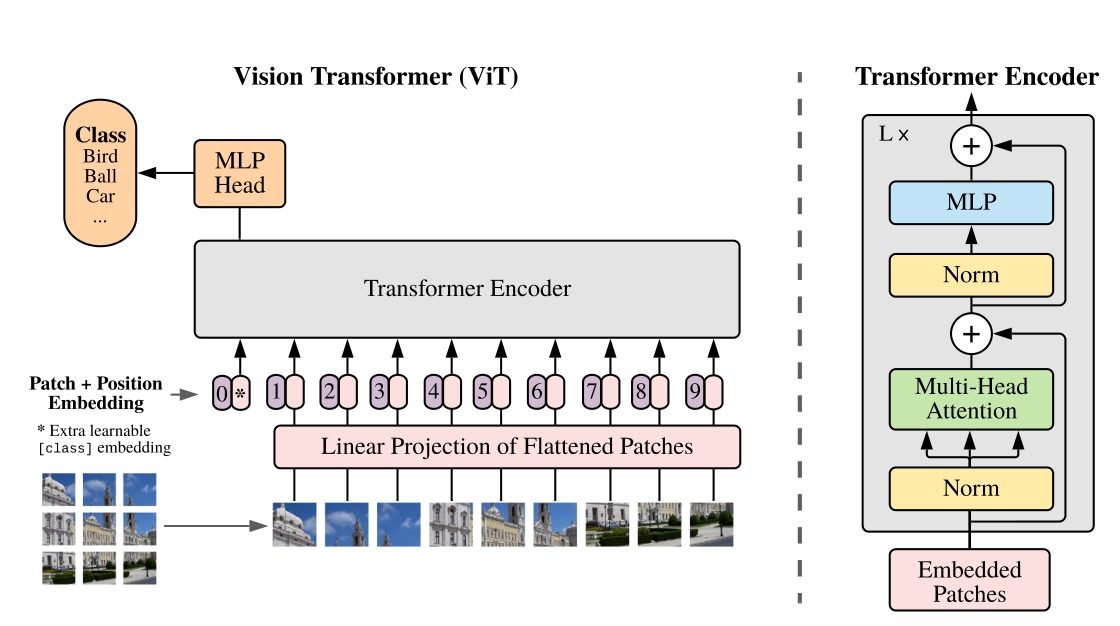
说一下,运行的流程
- Path-embeddings: 将输入为 [H, W, C] 的图像,依照 [P, P, C] 的大小切成 N 份,再通过linear projection 到 D维,输出尺寸变为 [N, D]。
- Append class token embedding: 像 BERT 一样在第0位添加一个可以学习的 embedding 来作为类别的token,输出为 [N+1, D]。
- Concat position-embeddings: 直接用1D的position embeddings,从0开始到N,文中有实验用2D的也差不多,输出为 [N+1, D+1]。
- Concat position-embeddings: 直接用1D的position embeddings,从0开始到N,文中有实验用2D的也差不多,输出为 [N+1, D+1]。
- 做 classification: 在 class token 那个位置上的输出后接 MLP head 用以做分类classification。
一句话讲完
本文中,将图像使用卷积进行分块(14*14=196),再每一块进行展平处理变成序列,然后将这196个序列添加位置编码和cls token,再输入多层Transformer结构中。最后将cls tooken取出来通过一个MLP(多层感知机)用于分类。

2.2 预处理-编码器
首先看一下预处理模块?我们假设图片输入为224*224*3。走一下预处理的流程
标准的transformer的输入是1维的token embedding。
为了处理二维图像,我们将尺寸为 H × W × C H\times W\times C H×W×C的图像reshape为拉平的2维图块,尺寸为 ( N × ( P 2 ⋅ C ) ) (N\times(P^2\cdot C)) (N×(P2⋅C))。
其中, ( P , P ) (P,P) (P,P)为图块的带下, N = H W / P 2 N=HW/P^2 N=HW/P2。 N N N是图块的数量,会影响输入序列的长度。
Transformer在所有图层上使用恒定的隐矢量 D D D,因此我们将图块拉平,并使用可训练的线性投影映射到 D D D的大小,将此投影的输出称为patch embedding。
如果以图像 224 × 224 × 3 224\times 224 \times 3 224×224×3为例。我们将会得到多少的token呢??
N = H W P 2 = 224 × 224 1 6 2 = 196 N=\frac{HW}{P^2}=\frac{224\times 224}{16^2}=196 N=P2HW=162224×224=196。意味着我们会得到196个token 信息。
那么每个token 的维度是多少呢?
16 × 16 × 3 = 768 16\times 16\times 3=768 16×16×3=768。
这样子我们就获得了196个token,每个token 拥有768维度的。就变成了 196 × 768 196\times 768 196×768
具体怎么操作的呢??看一下下面的这个
-
首先需要图片分成 16 × 16 16\times 16 16×16的patch。16倍的下采样
所以分成了 224 16 × 224 16 = 14 × 14 \frac{224}{16}\times \frac{224}{16}=14\times 14 16224×16224=14×14的图像块。
224 × 224 × 3 → 14 × 14 × ( 16 × 16 × 3 ) 224\times 224 \times 3\to 14\times 14\times (16\times 16\times 3) 224×224×3→14×14×(16×16×3)
= 14 × 14 × 768 =14\times 14\times768 =14×14×768
-
然后直接将前两维图片拉平 14 × 14 × 768 → 196 × 768 14\times 14\times768\to 196\times 768 14×14×768→196×768

- 然后加上特殊字符串cls token。最终的维度会变成 196 + 1 = 197 196+1=197 196+1=197。
- 然后在加上位置编码信息。注意是加,是sum。所以呢?最后维度是不变的。维度还是 197 × 768 197\times 768 197×768
- 最终输入到transformer中的维度为 197 × 768 197\times 768 197×768
2.3 Transformer 解码器
前面讲过,一个图片 224 × 224 × 3 224\times 224\times 3 224×224×3,经过一个预处理,处理出来的维度为 197 × 768 197\times 768 197×768。把处理出来的token输入进标准的transformer。
接下来就是一个标准的transformer

Transformer模块主要有两个部分,一个是Muti-head Attention,另一个是MLP。
1) Muti-head Attention
这里讲一下流程,具体操作可以看李宏毅老师的transformer课。还有代码就可以了
输入的维度 197 × 768 197\times 768 197×768。然后呢??这样子就变成3分的k,q,v。
使用多头注意力,如果是Vit-Base版本,头的数目是12,每个输入的维度就是 768 12 = 64 \frac{768}{12}=64 12768=64。所以输入为 197 × 64 197\times 64 197×64。 d i m ( k , q , v ) = 197 × 64 dim(k,q,v)=197\times 64 dim(k,q,v)=197×64
12个头做自注意力操作,每个头出来的维度还是 197 × 64 197\times 64 197×64。然后进行拼接。维度再次变成 197 × 768 197\times 768 197×768
2) MLP
MLP就是一个两层感知机。具体看代码
总结
transformer block输入是 197 × 768 197\times 768 197×768,出来还是 197 × 768 197\times 768 197×768。维度是不变的,所以是transformer block相加多少就加多少
2.4 分类头
分类头很简单,就是取特征层如 197 ∗ 768 197*768 197∗768的第一个向量,即 1 ∗ 768 1*768 1∗768,再对此进行线性全连接层进行多分类即可。
到这里呢?整体的流程就结束了。
3. 代码
""" original code from rwightman: https://github.com/rwightman/pytorch-image-models/blob/master/timm/models/vision_transformer.py """ from functools import partial from collections import OrderedDict import torch import torch.nn as nn """ 说明:本代码关于维度相关的注释,均以vit的base模型为基础 """ def drop_path(x, drop_prob: float = 0., training: bool = False): """ Drop paths (Stochastic Depth) per sample (when applied in main path of residual blocks). This is the same as the DropConnect impl I created for EfficientNet, etc networks, however, the original name is misleading as 'Drop Connect' is a different form of dropout in a separate paper... See discussion: https://github.com/tensorflow/tpu/issues/494#issuecomment-532968956 ... I've opted for changing the layer and argument names to 'drop path' rather than mix DropConnect as a layer name and use 'survival rate' as the argument. """ if drop_prob == 0. or not training: return x keep_prob = 1 - drop_prob shape = (x.shape[0],) + (1,) * (x.ndim - 1) # work with diff dim tensors, not just 2D ConvNets random_tensor = keep_prob + torch.rand(shape, dtype=x.dtype, device=x.device) random_tensor.floor_() # binarize output = x.div(keep_prob) * random_tensor return output class DropPath(nn.Module): """ Drop paths (Stochastic Depth) per sample (when applied in main path of residual blocks). """ def __init__(self, drop_prob=None): super(DropPath, self).__init__() self.drop_prob = drop_prob def forward(self, x): return drop_path(x, self.drop_prob, self.training) class PatchEmbed(nn.Module): """ 2D Image to Patch Embedding,二维图像patch Embedding """ def __init__(self, img_size=224, patch_size=16, in_c=3, embed_dim=768, norm_layer=None): super().__init__() img_size = (img_size, img_size) # 图片尺寸224*224 patch_size = (patch_size, patch_size) # 下采样倍数,一个grid cell包含了16*16的图片信息 self.img_size = img_size self.patch_size = patch_size # grid_size是经过patchembed后的特征层的尺寸 self.grid_size = (img_size[0] // patch_size[0], img_size[1] // patch_size[1]) self.num_patches = self.grid_size[0] * self.grid_size[1] # path个数 14*14=196 # 通过一个卷积,完成patchEmbed self.proj = nn.Conv2d(in_c, embed_dim, kernel_size=patch_size, stride=patch_size) # 如果使用了norm层,如BatchNorm2d,将通道数传入,以进行归一化,否则进行恒等映射 self.norm = norm_layer(embed_dim) if norm_layer else nn.Identity() def forward(self, x): B, C, H, W = x.shape # batch,channels,heigth,weigth # 输入图片的尺寸要满足既定的尺寸 assert H == self.img_size[0] and W == self.img_size[1], \ f"Input image size ({H}*{W}) doesn't match model ({self.img_size[0]}*{self.img_size[1]})." # proj: [B, C, H, W] -> [B, C, H,W] , [B,3,224,224]-> [B,768,14,14] # flatten: [B, C, H, W] -> [B, C, HW] , [B,768,14,14]-> [B,768,196] # transpose: [B, C, HW] -> [B, HW, C] , [B,768,196]-> [B,196,768] x = self.proj(x).flatten(2).transpose(1, 2) x = self.norm(x) return x class Attention(nn.Module): """ muti-head attention模块,也是transformer最主要的操作 """ def __init__(self, dim, # 输入token的dim,768 num_heads=8, # muti-head的head个数,实例化时base尺寸的vit默认为12 qkv_bias=False, qk_scale=None, attn_drop_ratio=0., proj_drop_ratio=0.): super(Attention, self).__init__() self.num_heads = num_heads head_dim = dim // num_heads # 平均每个head的维度 self.scale = qk_scale or head_dim ** -0.5 # 进行query操作时,缩放因子 # qkv矩阵相乘操作,dim * 3使得一次性进行qkv操作 self.qkv = nn.Linear(dim, dim * 3, bias=qkv_bias) self.attn_drop = nn.Dropout(attn_drop_ratio) self.proj = nn.Linear(dim, dim) # 一个卷积层 self.proj_drop = nn.Dropout(proj_drop_ratio) def forward(self, x): # [batch_size, num_patches + 1, total_embed_dim] 如 [bactn,197,768] B, N, C = x.shape # N:197 , C:768 # qkv进行注意力操作,reshape进行muti-head的维度分配,permute维度调换以便后续操作 # qkv(): -> [batch_size, num_patches + 1, 3 * total_embed_dim] 如 [b,197,2304] # reshape: -> [batch_size, num_patches + 1, 3, num_heads, embed_dim_per_head] 如 [b,197,3,12,64] # permute: -> [3, batch_size, num_heads, num_patches + 1, embed_dim_per_head] qkv = self.qkv(x).reshape(B, N, 3, self.num_heads, C // self.num_heads).permute(2, 0, 3, 1, 4) # qkv的维度相同,[batch_size, num_heads, num_patches + 1, embed_dim_per_head] q, k, v = qkv[0], qkv[1], qkv[2] # make torchscript happy (cannot use tensor as tuple) # transpose: -> [batch_size, num_heads, embed_dim_per_head, num_patches + 1] # @: multiply -> [batch_size, num_heads, num_patches + 1, num_patches + 1] attn = (q @ k.transpose(-2, -1)) * self.scale # 矩阵相乘操作 attn = attn.softmax(dim=-1) # 每一path进行softmax操作 attn = self.attn_drop(attn) # [b,12,197,197]@[b,12,197,64] -> [b,12,197,64] # @: multiply -> [batch_size, num_heads, num_patches + 1, embed_dim_per_head] # 维度交换 transpose: -> [batch_size, num_patches + 1, num_heads, embed_dim_per_head] # reshape: -> [batch_size, num_patches + 1, total_embed_dim] x = (attn @ v).transpose(1, 2).reshape(B, N, C) x = self.proj(x) # 经过一层卷积 x = self.proj_drop(x) # Dropout return x class Mlp(nn.Module): """ MLP as used in Vision Transformer, MLP-Mixer and related networks """ def __init__(self, in_features, hidden_features=None, out_features=None, act_layer=nn.GELU, # GELU是更加平滑的relu drop=0.): super().__init__() out_features = out_features or in_features # 如果out_features不存在,则为in_features hidden_features = hidden_features or in_features # 如果hidden_features不存在,则为in_features self.fc1 = nn.Linear(in_features, hidden_features) # fc层1 self.act = act_layer() # 激活 self.fc2 = nn.Linear(hidden_features, out_features) # fc层2 self.drop = nn.Dropout(drop) def forward(self, x): x = self.fc1(x) x = self.act(x) x = self.drop(x) x = self.fc2(x) x = self.drop(x) return x class Block(nn.Module): """ 基本的Transformer模块 """ def __init__(self, dim, num_heads, mlp_ratio=4., qkv_bias=False, qk_scale=None, drop_ratio=0., attn_drop_ratio=0., drop_path_ratio=0., act_layer=nn.GELU, norm_layer=nn.LayerNorm): super(Block, self).__init__() self.norm1 = norm_layer(dim) # norm层 self.attn = Attention(dim, num_heads=num_heads, qkv_bias=qkv_bias, qk_scale=qk_scale, attn_drop_ratio=attn_drop_ratio, proj_drop_ratio=drop_ratio) # NOTE: drop path for stochastic depth, we shall see if this is better than dropout here # 代码使用了DropPath,而不是原版的dropout self.drop_path = DropPath(drop_path_ratio) if drop_path_ratio > 0. else nn.Identity() self.norm2 = norm_layer(dim) # norm层 mlp_hidden_dim = int(dim * mlp_ratio) # 隐藏层维度扩张后的通道数 # 多层感知机 self.mlp = Mlp(in_features=dim, hidden_features=mlp_hidden_dim, act_layer=act_layer, drop=drop_ratio) def forward(self, x): x = x + self.drop_path(self.attn(self.norm1(x))) # attention后残差连接 x = x + self.drop_path(self.mlp(self.norm2(x))) # mlp后残差连接 return x class VisionTransformer(nn.Module): def __init__(self, img_size=224, patch_size=16, in_c=3, num_classes=1000, embed_dim=768, depth=12, num_heads=12, mlp_ratio=4.0, qkv_bias=True, qk_scale=None, representation_size=None, distilled=False, drop_ratio=0., attn_drop_ratio=0., drop_path_ratio=0., embed_layer=PatchEmbed, norm_layer=None, act_layer=None): """ Args: img_size (int, tuple): input image size patch_size (int, tuple): patch size in_c (int): number of input channels num_classes (int): number of classes for classification head embed_dim (int): embedding dimension depth (int): depth of transformer num_heads (int): number of attention heads mlp_ratio (int): ratio of mlp hidden dim to embedding dim qkv_bias (bool): enable bias for qkv if True qk_scale (float): override default qk scale of head_dim ** -0.5 if set representation_size (Optional[int]): enable and set representation layer (pre-logits) to this value if set distilled (bool): model includes a distillation token and head as in DeiT models drop_ratio (float): dropout rate attn_drop_ratio (float): attention dropout rate drop_path_ratio (float): stochastic depth rate embed_layer (nn.Module): patch embedding layer norm_layer: (nn.Module): normalization layer """ super(VisionTransformer, self).__init__() self.num_classes = num_classes # 分类类别数量 self.num_features = self.embed_dim = embed_dim # num_features for consistency with other models self.num_tokens = 2 if distilled else 1 # distilled在vit中没有使用到 norm_layer = norm_layer or partial(nn.LayerNorm, eps=1e-6) # 层归一化 act_layer = act_layer or nn.GELU # 激活函数 self.patch_embed = embed_layer(img_size=img_size, patch_size=patch_size, in_c=in_c, embed_dim=embed_dim) num_patches = self.patch_embed.num_patches self.cls_token = nn.Parameter(torch.zeros(1, 1, embed_dim)) # [1,1,768],以0填充 self.dist_token = nn.Parameter(torch.zeros(1, 1, embed_dim)) if distilled else None self.pos_embed = nn.Parameter(torch.zeros(1, num_patches + self.num_tokens, embed_dim)) self.pos_drop = nn.Dropout(p=drop_ratio) # 按照block数量等间距设置drop率 dpr = [x.item() for x in torch.linspace(0, drop_path_ratio, depth)] # stochastic depth decay rule self.blocks = nn.Sequential(*[ Block(dim=embed_dim, num_heads=num_heads, mlp_ratio=mlp_ratio, qkv_bias=qkv_bias, qk_scale=qk_scale, drop_ratio=drop_ratio, attn_drop_ratio=attn_drop_ratio, drop_path_ratio=dpr[i], norm_layer=norm_layer, act_layer=act_layer) for i in range(depth) ]) self.norm = norm_layer(embed_dim) # layer_norm # Representation layer if representation_size and not distilled: self.has_logits = True self.num_features = representation_size self.pre_logits = nn.Sequential(OrderedDict([ ("fc", nn.Linear(embed_dim, representation_size)), ("act", nn.Tanh()) ])) else: self.has_logits = False self.pre_logits = nn.Identity() # Classifier head(s),分类头,self.num_features=768 self.head = nn.Linear(self.num_features, num_classes) if num_classes > 0 else nn.Identity() self.head_dist = None if distilled: self.head_dist = nn.Linear(self.embed_dim, self.num_classes) if num_classes > 0 else nn.Identity() # Weight init,权重初始化 nn.init.trunc_normal_(self.pos_embed, std=0.02) if self.dist_token is not None: nn.init.trunc_normal_(self.dist_token, std=0.02) nn.init.trunc_normal_(self.cls_token, std=0.02) self.apply(_init_vit_weights) def forward_features(self, x): # [B, C, H, W] -> [B, num_patches, embed_dim] x = self.patch_embed(x) # [B, 196, 768] # cls_token类别token [1, 1, 768] -> [B, 1, 768],扩张为batch个cls_token cls_token = self.cls_token.expand(x.shape[0], -1, -1) if self.dist_token is None: x = torch.cat((cls_token, x), dim=1) # [B, 196, 768]-> [B, 197, 768],维度1上的cat else: x = torch.cat((cls_token, self.dist_token.expand(x.shape[0], -1, -1), x), dim=1) x = self.pos_drop(x + self.pos_embed) # 添加位置嵌入信息 x = self.blocks(x) # 通过attention堆叠模块(12个) x = self.norm(x) # layer_norm if self.dist_token is None: return self.pre_logits(x[:, 0]) # 返回第一层特征,即为分类值 else: return x[:, 0], x[:, 1] def forward(self, x): # 分类头 x = self.forward_features(x) # 经过att操作,但是没有进行分类头的前传 if self.head_dist is not None: x, x_dist = self.head(x[0]), self.head_dist(x[1]) if self.training and not torch.jit.is_scripting(): # during inference, return the average of both classifier predictions return x, x_dist else: return (x + x_dist) / 2 else: x = self.head(x) return x def _init_vit_weights(m): """ ViT weight initialization :param m: module """ if isinstance(m, nn.Linear): # fc层初始化 nn.init.trunc_normal_(m.weight, std=.01) if m.bias is not None: nn.init.zeros_(m.bias) elif isinstance(m, nn.Conv2d): # conv层初始化 nn.init.kaiming_normal_(m.weight, mode="fan_out") if m.bias is not None: nn.init.zeros_(m.bias) elif isinstance(m, nn.LayerNorm): # LayerNorm层初始化 nn.init.zeros_(m.bias) nn.init.ones_(m.weight) def vit_base_patch16_224(num_classes: int = 1000): """ ViT-Base model (ViT-B/16) from original paper (https://arxiv.org/abs/2010.11929). ImageNet-1k weights @ 224x224, source https://github.com/google-research/vision_transformer. weights ported from official Google JAX impl: 链接: https://pan.baidu.com/s/1zqb08naP0RPqqfSXfkB2EA 密码: eu9f """ model = VisionTransformer(img_size=224, patch_size=16, embed_dim=768, depth=12, num_heads=12, representation_size=None, num_classes=num_classes) return model def vit_base_patch16_224_in21k(num_classes: int = 21843, has_logits: bool = True): """ ViT-Base model (ViT-B/16) from original paper (https://arxiv.org/abs/2010.11929). ImageNet-21k weights @ 224x224, source https://github.com/google-research/vision_transformer. weights ported from official Google JAX impl: https://github.com/rwightman/pytorch-image-models/releases/download/v0.1-vitjx/jx_vit_base_patch16_224_in21k-e5005f0a.pth """ model = VisionTransformer(img_size=224, patch_size=16, embed_dim=768, depth=12, num_heads=12, representation_size=768 if has_logits else None, num_classes=num_classes) return model def vit_base_patch32_224(num_classes: int = 1000): """ ViT-Base model (ViT-B/32) from original paper (https://arxiv.org/abs/2010.11929). ImageNet-1k weights @ 224x224, source https://github.com/google-research/vision_transformer. weights ported from official Google JAX impl: 链接: https://pan.baidu.com/s/1hCv0U8pQomwAtHBYc4hmZg 密码: s5hl """ model = VisionTransformer(img_size=224, patch_size=32, embed_dim=768, depth=12, num_heads=12, representation_size=None, num_classes=num_classes) return model def vit_base_patch32_224_in21k(num_classes: int = 21843, has_logits: bool = True): """ ViT-Base model (ViT-B/32) from original paper (https://arxiv.org/abs/2010.11929). ImageNet-21k weights @ 224x224, source https://github.com/google-research/vision_transformer. weights ported from official Google JAX impl: https://github.com/rwightman/pytorch-image-models/releases/download/v0.1-vitjx/jx_vit_base_patch32_224_in21k-8db57226.pth """ model = VisionTransformer(img_size=224, patch_size=32, embed_dim=768, depth=12, num_heads=12, representation_size=768 if has_logits else None, num_classes=num_classes) return model def vit_large_patch16_224(num_classes: int = 1000): """ ViT-Large model (ViT-L/16) from original paper (https://arxiv.org/abs/2010.11929). ImageNet-1k weights @ 224x224, source https://github.com/google-research/vision_transformer. weights ported from official Google JAX impl: 链接: https://pan.baidu.com/s/1cxBgZJJ6qUWPSBNcE4TdRQ 密码: qqt8 """ model = VisionTransformer(img_size=224, patch_size=16, embed_dim=1024, depth=24, num_heads=16, representation_size=None, num_classes=num_classes) return model def vit_large_patch16_224_in21k(num_classes: int = 21843, has_logits: bool = True): """ ViT-Large model (ViT-L/16) from original paper (https://arxiv.org/abs/2010.11929). ImageNet-21k weights @ 224x224, source https://github.com/google-research/vision_transformer. weights ported from official Google JAX impl: https://github.com/rwightman/pytorch-image-models/releases/download/v0.1-vitjx/jx_vit_large_patch16_224_in21k-606da67d.pth """ model = VisionTransformer(img_size=224, patch_size=16, embed_dim=1024, depth=24, num_heads=16, representation_size=1024 if has_logits else None, num_classes=num_classes) return model def vit_large_patch32_224_in21k(num_classes: int = 21843, has_logits: bool = True): """ ViT-Large model (ViT-L/32) from original paper (https://arxiv.org/abs/2010.11929). ImageNet-21k weights @ 224x224, source https://github.com/google-research/vision_transformer. weights ported from official Google JAX impl: https://github.com/rwightman/pytorch-image-models/releases/download/v0.1-vitjx/jx_vit_large_patch32_224_in21k-9046d2e7.pth """ model = VisionTransformer(img_size=224, patch_size=32, embed_dim=1024, depth=24, num_heads=16, representation_size=1024 if has_logits else None, num_classes=num_classes) return model def vit_huge_patch14_224_in21k(num_classes: int = 21843, has_logits: bool = True): """ ViT-Huge model (ViT-H/14) from original paper (https://arxiv.org/abs/2010.11929). ImageNet-21k weights @ 224x224, source https://github.com/google-research/vision_transformer. NOTE: converted weights not currently available, too large for github release hosting. """ model = VisionTransformer(img_size=224, patch_size=14, embed_dim=1280, depth=32, num_heads=16, representation_size=1280 if has_logits else None, num_classes=num_classes) return model if __name__ == '__main__': model = vit_base_patch16_224(num_classes=1000) from thop import profile # from torchstat import stat # d = stat(model, (3, 1024, 2048)) input = torch.randn(1, 3, 224, 224) flops, params = profile(model, inputs=(input,)) print("flops:{:.3f}G".format(flops / 1e9)) print("params:{:.3f}M".format(params / 1e6))- 1
- 2
- 3
- 4
- 5
- 6
- 7
- 8
- 9
- 10
- 11
- 12
- 13
- 14
- 15
- 16
- 17
- 18
- 19
- 20
- 21
- 22
- 23
- 24
- 25
- 26
- 27
- 28
- 29
- 30
- 31
- 32
- 33
- 34
- 35
- 36
- 37
- 38
- 39
- 40
- 41
- 42
- 43
- 44
- 45
- 46
- 47
- 48
- 49
- 50
- 51
- 52
- 53
- 54
- 55
- 56
- 57
- 58
- 59
- 60
- 61
- 62
- 63
- 64
- 65
- 66
- 67
- 68
- 69
- 70
- 71
- 72
- 73
- 74
- 75
- 76
- 77
- 78
- 79
- 80
- 81
- 82
- 83
- 84
- 85
- 86
- 87
- 88
- 89
- 90
- 91
- 92
- 93
- 94
- 95
- 96
- 97
- 98
- 99
- 100
- 101
- 102
- 103
- 104
- 105
- 106
- 107
- 108
- 109
- 110
- 111
- 112
- 113
- 114
- 115
- 116
- 117
- 118
- 119
- 120
- 121
- 122
- 123
- 124
- 125
- 126
- 127
- 128
- 129
- 130
- 131
- 132
- 133
- 134
- 135
- 136
- 137
- 138
- 139
- 140
- 141
- 142
- 143
- 144
- 145
- 146
- 147
- 148
- 149
- 150
- 151
- 152
- 153
- 154
- 155
- 156
- 157
- 158
- 159
- 160
- 161
- 162
- 163
- 164
- 165
- 166
- 167
- 168
- 169
- 170
- 171
- 172
- 173
- 174
- 175
- 176
- 177
- 178
- 179
- 180
- 181
- 182
- 183
- 184
- 185
- 186
- 187
- 188
- 189
- 190
- 191
- 192
- 193
- 194
- 195
- 196
- 197
- 198
- 199
- 200
- 201
- 202
- 203
- 204
- 205
- 206
- 207
- 208
- 209
- 210
- 211
- 212
- 213
- 214
- 215
- 216
- 217
- 218
- 219
- 220
- 221
- 222
- 223
- 224
- 225
- 226
- 227
- 228
- 229
- 230
- 231
- 232
- 233
- 234
- 235
- 236
- 237
- 238
- 239
- 240
- 241
- 242
- 243
- 244
- 245
- 246
- 247
- 248
- 249
- 250
- 251
- 252
- 253
- 254
- 255
- 256
- 257
- 258
- 259
- 260
- 261
- 262
- 263
- 264
- 265
- 266
- 267
- 268
- 269
- 270
- 271
- 272
- 273
- 274
- 275
- 276
- 277
- 278
- 279
- 280
- 281
- 282
- 283
- 284
- 285
- 286
- 287
- 288
- 289
- 290
- 291
- 292
- 293
- 294
- 295
- 296
- 297
- 298
- 299
- 300
- 301
- 302
- 303
- 304
- 305
- 306
- 307
- 308
- 309
- 310
- 311
- 312
- 313
- 314
- 315
- 316
- 317
- 318
- 319
- 320
- 321
- 322
- 323
- 324
- 325
- 326
- 327
- 328
- 329
- 330
- 331
- 332
- 333
- 334
- 335
- 336
- 337
- 338
- 339
- 340
- 341
- 342
- 343
- 344
- 345
- 346
- 347
- 348
- 349
- 350
- 351
- 352
- 353
- 354
- 355
- 356
- 357
- 358
- 359
- 360
- 361
- 362
- 363
- 364
- 365
- 366
- 367
- 368
- 369
- 370
- 371
- 372
- 373
- 374
- 375
- 376
- 377
- 378
- 379
- 380
- 381
- 382
- 383
- 384
- 385
- 386
- 387
- 388
- 389
- 390
- 391
- 392
- 393
- 394
- 395
- 396
- 397
- 398
- 399
- 400
- 401
- 402
- 403
- 404
- 405
- 406
- 407
- 408
- 409
- 410
- 411
- 412
- 413
- 414
- 415
- 416
- 417
- 418
- 419
- 420
- 421
- 422
- 423
- 424
- 425
- 426
- 427
- 428
- 429
- 430
- 431
- 432
- 433
- 434
- 435
- 436
- 437
- 438
- 439
- 440
- 441
- 442
- 443
- 444
- 445
- 446
- 447
- 448
- 449
- 450
- 451
- 452
- 453
- 454
- 455
- 456
- 457
- 458
- 459
- 460
- 461
- 462
- 463
- 464
- 465
4. 结果
4.1 ViT更需要预训练
ViT的模型整体参数量是较大的,一个ViT-base的预训练权重就高达400M,相较于MobileNet-v2的13M和ResNet34的85M,超出较多。所以,ViT模型相较于CNN网络更加需要大数据集的预训练。文中做了一个实验,使用不同规模的ImageNet和JFT数据集,进行预训练,比较其与CNN模型的性能。如图7所示。
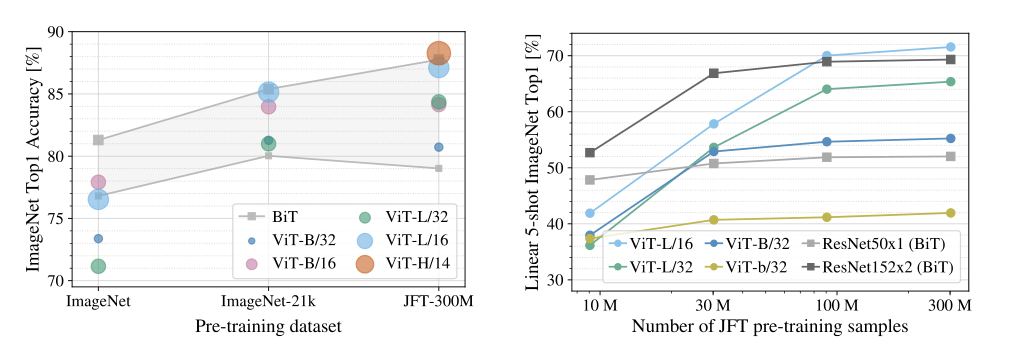
如果训练的数据不够多,ViTs是不如传统的ResNet。只有在足够多的数据下,ViT的效果是拔群的
4.2 ViT模型更容易泛化到下游任务
我们知道,对于CNN网络,即使有预训练权重,当使用这个网络泛化到其他下游任务时,也需要训练较长时间才能达到较好的结果。但是,对于ViT模型来说,当拥有ViT的预训练权重时,只需要训练几个epoch既可以拥有很好的性能。
我曾做过实验,无论是使用小模型和轻量化模型AlexNet、MobileNetv2,还是使用大模型ResNet50,要达到较好预测,都要训练30-50epoch甚至更高。而使用ViT模型仅需要2-3个epoch便可达到更优秀的性能。这部分实验的文章稍后会写。
在文章关于此部分的实验结果如图8所示,可以看出训练7个epoch时,ViT类的模型相较于CNN模型,效果更好。

参考代码
ViT论文及代码解读-ICLR2021:Transformer用于视觉分类也有很好的性能 - 知乎 (zhihu.com)
-
-
相关阅读:
Kafka 厉害的几点!
go中的channel通道
git实操gitee
回归啦!!!
Linux编程:获取时间戳
SpringBoot中使用LocalDateTime踩坑记录
[每周一更]-(第21期):什么是RPC?
机器学习训练,没有机器怎么办
leetcode-07-[344]反转字符串[541]反转字符串II[卡码网54]替换数字
[附源码]SSM计算机毕业设计基于社区生鲜配送系统JAVA
- 原文地址:https://blog.csdn.net/wujing1_1/article/details/125554766
