-
机器学习笔记 九:预测模型优化(防止欠拟合和过拟合问题发生)
1.需要实现的功能

利用水库水位的变化来预测从大坝流出的水量:
- 正则化线性回归代价函数的实现
- 绘制学习曲线
- 将特征变换为多项式特征
- 绘制验证集曲线
1.1 优化流程
1.1.1 线性回归
首先,通过线性回归拟合出一条直线,并绘制出学习曲线:
原始数据图像:

线性回归拟合图像: 可以看出拟合效果并不好,所以还需要用多项式回归进行拟合,找到更加合适的拟合数据,这里先不急,一步一步来。
线性回归的学习曲线:

训练集误差和交叉验证集(cv)误差: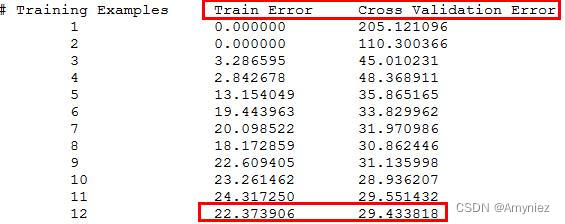
从学习曲线的角度来看,线性回归拟合的也并不好,存在很大的误差,约为30,所以需要进行优化。1.1.2 正则化线性回归的代价函数的使用
用正则化线性回归的代价函数对线性回归方程进行一定程度的惩罚,减小线性回归的误差(防止过拟合):
J ( θ ) = 1 2 m ( ∑ i = 1 m ( h θ ( x ( i ) ) − y ( i ) ) 2 ) + λ 2 m ( ∑ j = 1 n θ j 2 )J(θ)=2m1(i=1∑m(hθ(x(i))−y(i))2)+2mλ(j=1∑nθj2)1.1.3 正则化的线性回归梯度
相当于求正则化线性回归代价的偏导数,公式为:
∂ J ( θ ) ∂ θ 0 = 1 m ∑ i = 1 m ( h θ ( x ( i ) ) − y ( i ) ) x j ( i ) for j = 0 ∂ J ( θ ) ∂ θ j = ( 1 m ∑ i = 1 m ( h θ ( x ( i ) ) − y ( i ) ) x j ( i ) ) + λ m θ j for j ≥ 1
∂θ0∂J(θ)=m1∑i=1m(hθ(x(i))−y(i))xj(i)∂θj∂J(θ)=(m1∑i=1m(hθ(x(i))−y(i))xj(i))+mλθj for j=0 for j≥11.1.4 找到偏置和方差的平衡点
通过构建学习曲线,帮助我们调试算法,需要使用训练集X的子训练集进行迭代,和全部交叉验证集,来得出训练集和交叉验证集的误差。
通过trainLinearReg()函数得出最优的 θ \theta θ,然后计算代价,需要注意的是,此时计算的代价不考虑正则化,即 λ = 0 \lambda=0 λ=0:
J train ( θ ) = 1 2 m [ ∑ i = 1 m ( h θ ( x ( i ) ) − y ( i ) ) 2 ]Jtrain (θ)=2m1[i=1∑m(hθ(x(i))−y(i))2]1.1.5 进行多项式回归
线性回归的缺点就是太简单了,很容易发生欠拟合的情况(偏差过大),所以通过增加特征数(polyFeatures函数),使得达到更好的拟合数据。
h θ ( x ) = θ 0 + θ 1 ∗ x + θ 2 ∗ x 2 + ⋯ + θ p ∗ x p
hθ(x)=θ0+θ1∗x+θ2∗x2+⋯+θp∗xp这个过程要将训练集 X:m*1,扩大至 X:m*n(将特征提高至更高维度):第1列保存X的原始值,第2列保存X的平方,第3列保存为X的立方,并以此类推。
如果直接在数据集上运行扩展函数,将不能很好地运行,因为特性会被严重地扩展,所以还需要进行归一化,归一化之后的X训练集(扩展到了第8维):

多项式拟合效果非常完美,0误差,但是存在过拟合的问题,所以需要加入正则项进行相应的惩罚:


1.1.6 正则项中 λ \lambda λ的确定
正则项中 λ \lambda λ会很大程度上绝对曲线拟合的好坏,所以需要确定一个合适的 λ \lambda λ值。

由图可知, λ = 3 \lambda=3 λ=3时,最合适。

2. 数据集介绍
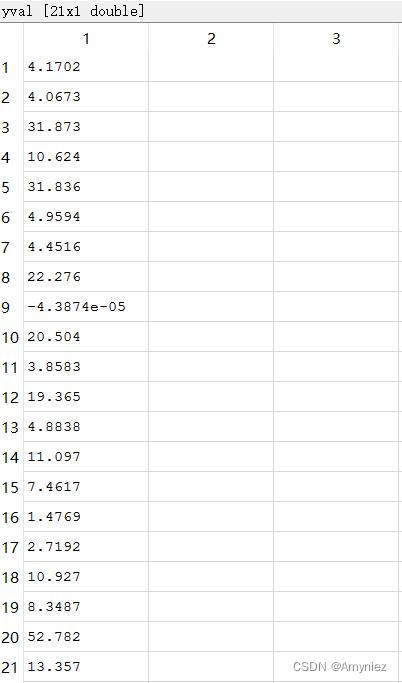
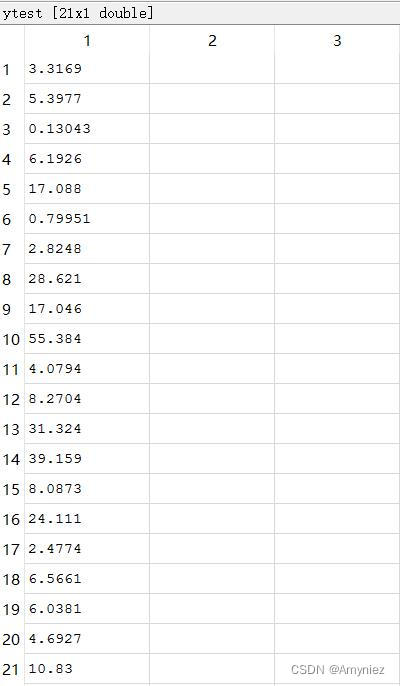
一共包括3部分:训练集,验证集,测试集,其中,水位为X,流出的水量为y;

训练集:X、y(12*1)

交叉验证集:Xval、yval(21*1)

测试集:Xtest、ytest(21*1)

3. 主程序
%% Initialization clear ; close all; clc %% =========== Part 1: Loading and Visualizing Data ============= % Load Training Data fprintf('Loading and Visualizing Data ...\n') % You will have X, y, Xval, yval, Xtest, ytest in your environment load ('ex5data1.mat'); % m是样本个数 m = size(X, 1); % 绘制训练集train set plot(X, y, 'rx', 'MarkerSize', 10, 'LineWidth', 1.5); xlabel('Change in water level (x)'); ylabel('Water flowing out of the dam (y)'); fprintf('Program paused. Press enter to continue.\n'); pause; %% =========== Part 2: Regularized Linear Regression Cost ============= % 初始化theta theta = [1 ; 1]; J = linearRegCostFunction([ones(m, 1) X], y, theta, 1); fprintf(['Cost at theta = [1 ; 1]: %f '], J); fprintf('Program paused. Press enter to continue.\n'); pause; %% =========== Part 3: Regularized Linear Regression Gradient ============= theta = [1 ; 1]; % X矩阵前插入一列1,使得X:12*1---> X:12*2 [J, grad] = linearRegCostFunction([ones(m, 1) X], y, theta, 1); fprintf(['Gradient at theta = [1 ; 1]: [%f; %f] '], grad(1), grad(2)); fprintf('Program paused. Press enter to continue.\n'); pause; %% =========== Part 4: Train Linear Regression ============= % Write Up Note: The data is non-linear, so this will not give a great fit. % Train linear regression with lambda = 0 lambda = 0; [theta] = trainLinearReg([ones(m, 1) X], y, lambda); % Plot fit over the data plot(X, y, 'rx', 'MarkerSize', 10, 'LineWidth', 1.5); xlabel('Change in water level (x)'); ylabel('Water flowing out of the dam (y)'); hold on; plot(X, [ones(m, 1) X]*theta, '--', 'LineWidth', 2) hold off; fprintf('Program paused. Press enter to continue.\n'); pause; %% =========== Part 5: Learning Curve for Linear Regression ============= lambda = 0; [error_train, error_val] = ... learningCurve([ones(m, 1) X], y, ... [ones(size(Xval, 1), 1) Xval], yval, ... lambda); plot(1:m, error_train, 1:m, error_val); title('Learning curve for linear regression') legend('Train', 'Cross Validation') xlabel('Number of training examples') ylabel('Error') axis([0 13 0 150]) fprintf('# Training Examples\tTrain Error\tCross Validation Error\n'); for i = 1:m fprintf(' \t%d\t\t%f\t%f\n', i, error_train(i), error_val(i)); end fprintf('Program paused. Press enter to continue.\n'); pause; %% =========== Part 6: Feature Mapping for Polynomial Regression ============= % One solution to this is to use polynomial regression. % Complete polyFeatures to map each example into its powers % p = 8; % Map X onto Polynomial Features and Normalize X_poly = polyFeatures(X, p); [X_poly, mu, sigma] = featureNormalize(X_poly); % Normalize X_poly = [ones(m, 1), X_poly]; % Add Ones % Map X_poly_test and normalize (using mu and sigma) X_poly_test = polyFeatures(Xtest, p); X_poly_test = bsxfun(@minus, X_poly_test, mu); X_poly_test = bsxfun(@rdivide, X_poly_test, sigma); X_poly_test = [ones(size(X_poly_test, 1), 1), X_poly_test]; % Add Ones % Map X_poly_val and normalize (using mu and sigma) X_poly_val = polyFeatures(Xval, p); X_poly_val = bsxfun(@minus, X_poly_val, mu); X_poly_val = bsxfun(@rdivide, X_poly_val, sigma); X_poly_val = [ones(size(X_poly_val, 1), 1), X_poly_val]; % Add Ones fprintf('Normalized Training Example 1:\n'); fprintf(' %f \n', X_poly(1, :)); fprintf('\nProgram paused. Press enter to continue.\n'); pause; %% =========== Part 7: Learning Curve for Polynomial Regression ============= % Now, you will get to experiment with polynomial regression with multiple % values of lambda. The code below runs polynomial regression with % lambda = 0. You should try running the code with different values of % lambda to see how the fit and learning curve change. % lambda = 0; [theta] = trainLinearReg(X_poly, y, lambda); % Plot training data and fit figure(1); plot(X, y, 'rx', 'MarkerSize', 10, 'LineWidth', 1.5); plotFit(min(X), max(X), mu, sigma, theta, p); xlabel('Change in water level (x)'); ylabel('Water flowing out of the dam (y)'); title (sprintf('Polynomial Regression Fit (lambda = %f)', lambda)); figure(2); [error_train, error_val] = ... learningCurve(X_poly, y, X_poly_val, yval, lambda); plot(1:m, error_train, 1:m, error_val); title(sprintf('Polynomial Regression Learning Curve (lambda = %f)', lambda)); xlabel('Number of training examples') ylabel('Error') axis([0 13 0 100]) legend('Train', 'Cross Validation') fprintf('Polynomial Regression (lambda = %f)\n\n', lambda); fprintf('# Training Examples\tTrain Error\tCross Validation Error\n'); for i = 1:m fprintf(' \t%d\t\t%f\t%f\n', i, error_train(i), error_val(i)); end fprintf('Program paused. Press enter to continue.\n'); pause; %% =========== Part 8: Validation for Selecting Lambda ============= % You will now implement validationCurve to test various values of % lambda on a validation set. You will then use this to select the % "best" lambda value. % [lambda_vec, error_train, error_val] = ... validationCurve(X_poly, y, X_poly_val, yval); close all; plot(lambda_vec, error_train, lambda_vec, error_val); legend('Train', 'Cross Validation'); xlabel('lambda'); ylabel('Error'); fprintf('lambda\t\tTrain Error\tValidation Error\n'); for i = 1:length(lambda_vec) fprintf(' %f\t%f\t%f\n', ... lambda_vec(i), error_train(i), error_val(i)); end fprintf('Program paused. Press enter to continue.\n'); pause;- 1
- 2
- 3
- 4
- 5
- 6
- 7
- 8
- 9
- 10
- 11
- 12
- 13
- 14
- 15
- 16
- 17
- 18
- 19
- 20
- 21
- 22
- 23
- 24
- 25
- 26
- 27
- 28
- 29
- 30
- 31
- 32
- 33
- 34
- 35
- 36
- 37
- 38
- 39
- 40
- 41
- 42
- 43
- 44
- 45
- 46
- 47
- 48
- 49
- 50
- 51
- 52
- 53
- 54
- 55
- 56
- 57
- 58
- 59
- 60
- 61
- 62
- 63
- 64
- 65
- 66
- 67
- 68
- 69
- 70
- 71
- 72
- 73
- 74
- 75
- 76
- 77
- 78
- 79
- 80
- 81
- 82
- 83
- 84
- 85
- 86
- 87
- 88
- 89
- 90
- 91
- 92
- 93
- 94
- 95
- 96
- 97
- 98
- 99
- 100
- 101
- 102
- 103
- 104
- 105
- 106
- 107
- 108
- 109
- 110
- 111
- 112
- 113
- 114
- 115
- 116
- 117
- 118
- 119
- 120
- 121
- 122
- 123
- 124
- 125
- 126
- 127
- 128
- 129
- 130
- 131
- 132
- 133
- 134
- 135
- 136
- 137
- 138
- 139
- 140
- 141
- 142
- 143
- 144
- 145
- 146
- 147
- 148
- 149
- 150
- 151
- 152
- 153
- 154
- 155
- 156
- 157
- 158
- 159
- 160
- 161
- 162
- 163
- 164
- 165
- 166
- 167
- 168
- 169
- 170
- 171
- 172
- 173
- 174
- 175
- 176
- 177
- 178
- 179
- 180
4.函数实现
4.1 正则化的线性回归的代价函数(linearRegCostFunction)
function [J, grad] = linearRegCostFunction(X, y, theta, lambda) %LINEARREGCOSTFUNCTION Compute cost and gradient for regularized linear %regression with multiple variables % [J, grad] = LINEARREGCOSTFUNCTION(X, y, theta, lambda) computes the % cost of using theta as the parameter for linear regression to fit the % data points in X and y. Returns the cost in J and the gradient in grad % Initialize some useful values m = length(y); % number of training examples % You need to return the following variables correctly J = 0; grad = zeros(size(theta)); % ================================================================= % 正则化代价函数计算 hypo = X * theta; % 12*1 Vect_Err = (1/2) .* (hypo-y) .^ 2; reg = (1/2) .* theta(2:end) .^ 2; J = (1/m) * (sum(Vect_Err) + lambda * sum(reg)); % 正则化线性回归梯度计算 grad = X' * (hypo - y); grad_reg = grad(2:end) + lambda .* theta(2:end); grad = (1/m)*[grad(1); grad_reg]; % ========================================================================= grad = grad(:); end- 1
- 2
- 3
- 4
- 5
- 6
- 7
- 8
- 9
- 10
- 11
- 12
- 13
- 14
- 15
- 16
- 17
- 18
- 19
- 20
- 21
- 22
- 23
- 24
- 25
- 26
- 27
- 28
- 29
- 30
- 31
- 32
4.2 学习曲线(learningCurve):训练集误差、交叉训练误差
function [error_train, error_val] = ... learningCurve(X, y, Xval, yval, lambda) %LEARNINGCURVE Generates the train and cross validation set errors needed %to plot a learning curve % [error_train, error_val] = ... % LEARNINGCURVE(X, y, Xval, yval, lambda) returns the train and % cross validation set errors for a learning curve. In particular, % it returns two vectors of the same length - error_train and % error_val. Then, error_train(i) contains the training error for % i examples (and similarly for error_val(i)). % % In this function, you will compute the train and test errors for % dataset sizes from 1 up to m. In practice, when working with larger % datasets, you might want to do this in larger intervals. % % Number of training examples m = size(X, 1); % 12 % You need to return these values correctly error_train = zeros(m, 1); % 12*1 error_val = zeros(m, 1); % 12*1 % ============================================================= % Note: If you are using your cost function (linearRegCostFunction) % to compute the training and cross validation error, you should % call the function with the lambda argument set to 0. % Do note that you will still need to use lambda when running % the training to obtain the theta parameters. for i =1:m, % 首先,取样本集中的第一个样本,带入trainLinearReg函数中,该函数会迭代200次,再给出一个关于 % 样本1的最优theta theta = trainLinearReg(X(1:i, :), y(1:i, :), lambda); % 然后,利用linearRegCostFunction函数,并设置lambda为0,计算最优theta % 在不包含正则项的情况下,样本1的代价函数值error_train(1) [error_train(i) grad_train] = linearRegCostFunction(X(1:i, :), y(1:i, :), theta, 0); % 最后,利用linearRegCostFunction函数,并设置lambda为0,计算最优theta % 在不包含正则项的情况下,cross validation set的代价函数值error_val(1) [error_val(i) grad_val] = linearRegCostFunction(Xval, yval, theta, 0); end % 第二次循环,样本集的样本增加一个,新的样本集包含样本1和样本2 % ========================================================================= end- 1
- 2
- 3
- 4
- 5
- 6
- 7
- 8
- 9
- 10
- 11
- 12
- 13
- 14
- 15
- 16
- 17
- 18
- 19
- 20
- 21
- 22
- 23
- 24
- 25
- 26
- 27
- 28
- 29
- 30
- 31
- 32
- 33
- 34
- 35
- 36
- 37
- 38
- 39
- 40
- 41
- 42
- 43
- 44
- 45
- 46
- 47
- 48
- 49
- 50
- 51
4.3 特征集变换(polyFeatures):扩展特征向量到更高维度
function [X_poly] = polyFeatures(X, p) %POLYFEATURES Maps X (1D vector) into the p-th power % [X_poly] = POLYFEATURES(X, p) takes a data matrix X (size m x 1) and % maps each example into its polynomial features where % X_poly(i, :) = [X(i) X(i).^2 X(i).^3 ... X(i).^p]; % for i = 1:p, X_poly(:,i) = X .^ i; end end- 1
- 2
- 3
- 4
- 5
- 6
- 7
- 8
- 9
- 10
- 11
- 12
- 13
4.4 交叉曲线(validationCurve)
function [lambda_vec, error_train, error_val] = ... validationCurve(X, y, Xval, yval) %VALIDATIONCURVE Generate the train and validation errors needed to %plot a validation curve that we can use to select lambda % [lambda_vec, error_train, error_val] = ... % VALIDATIONCURVE(X, y, Xval, yval) returns the train % and validation errors (in error_train, error_val) % for different values of lambda. You are given the training set (X, % y) and validation set (Xval, yval). % % Selected values of lambda (you should not change this) lambda_vec = [0 0.001 0.003 0.01 0.03 0.1 0.3 1 3 10]'; % Instructions: This function to return training errors in % error_train and the validation errors in error_val. The % vector lambda_vec contains the different lambda parameters % to use for each calculation of the errors, i.e, % error_train(i), and error_val(i) should give % you the errors obtained after training with % lambda = lambda_vec(i) % for i =1:length(lambda_vec), lambda = lambda_vec(i); [theta] = trainLinearReg(X,y,lambda); error_train(i) = linearRegCostFunction(X,y,theta,0); error_val(i) = linearRegCostFunction(Xval,yval,theta,0); end end- 1
- 2
- 3
- 4
- 5
- 6
- 7
- 8
- 9
- 10
- 11
- 12
- 13
- 14
- 15
- 16
- 17
- 18
- 19
- 20
- 21
- 22
- 23
- 24
- 25
- 26
- 27
- 28
- 29
- 30
- 31
- 32
- 33
4.5 特征归一化(featureNormalize)
function [X_norm, mu, sigma] = featureNormalize(X) %FEATURENORMALIZE Normalizes the features in X % FEATURENORMALIZE(X) returns a normalized version of X where % the mean value of each feature is 0 and the standard deviation % is 1. This is often a good preprocessing step to do when % working with learning algorithms. mu = mean(X); X_norm = bsxfun(@minus, X, mu); sigma = std(X_norm); X_norm = bsxfun(@rdivide, X_norm, sigma); % ============================================================ end- 1
- 2
- 3
- 4
- 5
- 6
- 7
- 8
- 9
- 10
- 11
- 12
- 13
- 14
- 15
- 16
- 17
4.6 最小化、最优值(fmincg)(最重要的一个部分)
function [X, fX, i] = fmincg(f, X, options, P1, P2, P3, P4, P5) % Minimize a continuous differentialble multivariate function. Starting point % is given by "X" (D by 1), and the function named in the string "f", must % return a function value and a vector of partial derivatives. The Polack- % Ribiere flavour of conjugate gradients is used to compute search directions, % and a line search using quadratic and cubic polynomial approximations and the % Wolfe-Powell stopping criteria is used together with the slope ratio method % for guessing initial step sizes. Additionally a bunch of checks are made to % make sure that exploration is taking place and that extrapolation will not % be unboundedly large. The "length" gives the length of the run: if it is % positive, it gives the maximum number of line searches, if negative its % absolute gives the maximum allowed number of function evaluations. You can % (optionally) give "length" a second component, which will indicate the % reduction in function value to be expected in the first line-search (defaults % to 1.0). The function returns when either its length is up, or if no further % progress can be made (ie, we are at a minimum, or so close that due to % numerical problems, we cannot get any closer). If the function terminates % within a few iterations, it could be an indication that the function value % and derivatives are not consistent (ie, there may be a bug in the % implementation of your "f" function). The function returns the found % solution "X", a vector of function values "fX" indicating the progress made % and "i" the number of iterations (line searches or function evaluations, % depending on the sign of "length") used. % % Usage: [X, fX, i] = fmincg(f, X, options, P1, P2, P3, P4, P5) % % See also: checkgrad % % Copyright (C) 2001 and 2002 by Carl Edward Rasmussen. Date 2002-02-13 % % % (C) Copyright 1999, 2000 & 2001, Carl Edward Rasmussen % % Permission is granted for anyone to copy, use, or modify these % programs and accompanying documents for purposes of research or % education, provided this copyright notice is retained, and note is % made of any changes that have been made. % % These programs and documents are distributed without any warranty, % express or implied. As the programs were written for research % purposes only, they have not been tested to the degree that would be % advisable in any important application. All use of these programs is % entirely at the user's own risk. % % [ml-class] Changes Made: % 1) Function name and argument specifications % 2) Output display % % Read options if exist('options', 'var') && ~isempty(options) && isfield(options, 'MaxIter') length = options.MaxIter; else length = 100; end RHO = 0.01; % a bunch of constants for line searches SIG = 0.5; % RHO and SIG are the constants in the Wolfe-Powell conditions INT = 0.1; % don't reevaluate within 0.1 of the limit of the current bracket EXT = 3.0; % extrapolate maximum 3 times the current bracket MAX = 20; % max 20 function evaluations per line search RATIO = 100; % maximum allowed slope ratio argstr = ['feval(f, X']; % compose string used to call function for i = 1:(nargin - 3) argstr = [argstr, ',P', int2str(i)]; end argstr = [argstr, ')']; if max(size(length)) == 2, red=length(2); length=length(1); else red=1; end S=['Iteration ']; i = 0; % zero the run length counter ls_failed = 0; % no previous line search has failed fX = []; [f1 df1] = eval(argstr); % get function value and gradient i = i + (length<0); % count epochs?! s = -df1; % search direction is steepest d1 = -s'*s; % this is the slope z1 = red/(1-d1); % initial step is red/(|s|+1) while i < abs(length) % while not finished i = i + (length>0); % count iterations?! X0 = X; f0 = f1; df0 = df1; % make a copy of current values X = X + z1*s; % begin line search [f2 df2] = eval(argstr); i = i + (length<0); % count epochs?! d2 = df2'*s; f3 = f1; d3 = d1; z3 = -z1; % initialize point 3 equal to point 1 if length>0, M = MAX; else M = min(MAX, -length-i); end success = 0; limit = -1; % initialize quanteties while 1 while ((f2 > f1+z1*RHO*d1) || (d2 > -SIG*d1)) && (M > 0) limit = z1; % tighten the bracket if f2 > f1 z2 = z3 - (0.5*d3*z3*z3)/(d3*z3+f2-f3); % quadratic fit else A = 6*(f2-f3)/z3+3*(d2+d3); % cubic fit B = 3*(f3-f2)-z3*(d3+2*d2); z2 = (sqrt(B*B-A*d2*z3*z3)-B)/A; % numerical error possible - ok! end if isnan(z2) || isinf(z2) z2 = z3/2; % if we had a numerical problem then bisect end z2 = max(min(z2, INT*z3),(1-INT)*z3); % don't accept too close to limits z1 = z1 + z2; % update the step X = X + z2*s; [f2 df2] = eval(argstr); M = M - 1; i = i + (length<0); % count epochs?! d2 = df2'*s; z3 = z3-z2; % z3 is now relative to the location of z2 end if f2 > f1+z1*RHO*d1 || d2 > -SIG*d1 break; % this is a failure elseif d2 > SIG*d1 success = 1; break; % success elseif M == 0 break; % failure end A = 6*(f2-f3)/z3+3*(d2+d3); % make cubic extrapolation B = 3*(f3-f2)-z3*(d3+2*d2); z2 = -d2*z3*z3/(B+sqrt(B*B-A*d2*z3*z3)); % num. error possible - ok! if ~isreal(z2) || isnan(z2) || isinf(z2) || z2 < 0 % num prob or wrong sign? if limit < -0.5 % if we have no upper limit z2 = z1 * (EXT-1); % the extrapolate the maximum amount else z2 = (limit-z1)/2; % otherwise bisect end elseif (limit > -0.5) && (z2+z1 > limit) % extraplation beyond max? z2 = (limit-z1)/2; % bisect elseif (limit < -0.5) && (z2+z1 > z1*EXT) % extrapolation beyond limit z2 = z1*(EXT-1.0); % set to extrapolation limit elseif z2 < -z3*INT z2 = -z3*INT; elseif (limit > -0.5) && (z2 < (limit-z1)*(1.0-INT)) % too close to limit? z2 = (limit-z1)*(1.0-INT); end f3 = f2; d3 = d2; z3 = -z2; % set point 3 equal to point 2 z1 = z1 + z2; X = X + z2*s; % update current estimates [f2 df2] = eval(argstr); M = M - 1; i = i + (length<0); % count epochs?! d2 = df2'*s; end % end of line search if success % if line search succeeded f1 = f2; fX = [fX' f1]'; fprintf('%s %4i | Cost: %4.6e\r', S, i, f1); s = (df2'*df2-df1'*df2)/(df1'*df1)*s - df2; % Polack-Ribiere direction tmp = df1; df1 = df2; df2 = tmp; % swap derivatives d2 = df1'*s; if d2 > 0 % new slope must be negative s = -df1; % otherwise use steepest direction d2 = -s'*s; end z1 = z1 * min(RATIO, d1/(d2-realmin)); % slope ratio but max RATIO d1 = d2; ls_failed = 0; % this line search did not fail else X = X0; f1 = f0; df1 = df0; % restore point from before failed line search if ls_failed || i > abs(length) % line search failed twice in a row break; % or we ran out of time, so we give up end tmp = df1; df1 = df2; df2 = tmp; % swap derivatives s = -df1; % try steepest d1 = -s'*s; z1 = 1/(1-d1); ls_failed = 1; % this line search failed end if exist('OCTAVE_VERSION') fflush(stdout); end end fprintf('\n');- 1
- 2
- 3
- 4
- 5
- 6
- 7
- 8
- 9
- 10
- 11
- 12
- 13
- 14
- 15
- 16
- 17
- 18
- 19
- 20
- 21
- 22
- 23
- 24
- 25
- 26
- 27
- 28
- 29
- 30
- 31
- 32
- 33
- 34
- 35
- 36
- 37
- 38
- 39
- 40
- 41
- 42
- 43
- 44
- 45
- 46
- 47
- 48
- 49
- 50
- 51
- 52
- 53
- 54
- 55
- 56
- 57
- 58
- 59
- 60
- 61
- 62
- 63
- 64
- 65
- 66
- 67
- 68
- 69
- 70
- 71
- 72
- 73
- 74
- 75
- 76
- 77
- 78
- 79
- 80
- 81
- 82
- 83
- 84
- 85
- 86
- 87
- 88
- 89
- 90
- 91
- 92
- 93
- 94
- 95
- 96
- 97
- 98
- 99
- 100
- 101
- 102
- 103
- 104
- 105
- 106
- 107
- 108
- 109
- 110
- 111
- 112
- 113
- 114
- 115
- 116
- 117
- 118
- 119
- 120
- 121
- 122
- 123
- 124
- 125
- 126
- 127
- 128
- 129
- 130
- 131
- 132
- 133
- 134
- 135
- 136
- 137
- 138
- 139
- 140
- 141
- 142
- 143
- 144
- 145
- 146
- 147
- 148
- 149
- 150
- 151
- 152
- 153
- 154
- 155
- 156
- 157
- 158
- 159
- 160
- 161
- 162
- 163
- 164
- 165
- 166
- 167
- 168
- 169
- 170
- 171
- 172
- 173
- 174
- 175
4.7 拟合曲线绘制函数(plotFit)
function plotFit(min_x, max_x, mu, sigma, theta, p) %PLOTFIT Plots a learned polynomial regression fit over an existing figure. %Also works with linear regression. % PLOTFIT(min_x, max_x, mu, sigma, theta, p) plots the learned polynomial % fit with power p and feature normalization (mu, sigma). % Hold on to the current figure hold on; % We plot a range slightly bigger than the min and max values to get % an idea of how the fit will vary outside the range of the data points x = (min_x - 15: 0.05 : max_x + 25)'; % Map the X values X_poly = polyFeatures(x, p); X_poly = bsxfun(@minus, X_poly, mu); X_poly = bsxfun(@rdivide, X_poly, sigma); % Add ones X_poly = [ones(size(x, 1), 1) X_poly]; % Plot plot(x, X_poly * theta, '--', 'LineWidth', 2) % Hold off to the current figure hold off end- 1
- 2
- 3
- 4
- 5
- 6
- 7
- 8
- 9
- 10
- 11
- 12
- 13
- 14
- 15
- 16
- 17
- 18
- 19
- 20
- 21
- 22
- 23
- 24
- 25
- 26
- 27
- 28
4.8 训练正则化的线性回归函数(trainLinearReg)
function [theta] = trainLinearReg(X, y, lambda) %TRAINLINEARREG Trains linear regression given a dataset (X, y) and a %regularization parameter lambda % [theta] = TRAINLINEARREG (X, y, lambda) trains linear regression using % the dataset (X, y) and regularization parameter lambda. Returns the % trained parameters theta. % % Initialize Theta initial_theta = zeros(size(X, 2), 1); % Create "short hand" for the cost function to be minimized costFunction = @(t) linearRegCostFunction(X, y, t, lambda); % Now, costFunction is a function that takes in only one argument options = optimset('MaxIter', 200, 'GradObj', 'on'); % Minimize using fmincg theta = fmincg(costFunction, initial_theta, options); end- 1
- 2
- 3
- 4
- 5
- 6
- 7
- 8
- 9
- 10
- 11
- 12
- 13
- 14
- 15
- 16
- 17
- 18
- 19
- 20
- 21
-
相关阅读:
Jvm基础面试题
Effective Modern C++[实践]->理解auto类别推导
justjavac:从辍学到成为Deno核心代码贡献者,我的十年编程生涯
OpenHarmony教程指南—ArkUI中组件、通用、动画、全局方法的集合
【产品新体验】CSDN开发云·云IDE使用教程
如何基于OpenCV和Sklearn算法库开展机器学习算法研究
Android Studio实现一个新闻APP
我被这个浏览了 746000 次的问题惊住了
Python 植物大战僵尸
基于SqlSugar的开发框架循序渐进介绍(4)-- 在数据访问基类中对GUID主键进行自动赋值处理
- 原文地址:https://blog.csdn.net/amyniez/article/details/125497616
