-
C++——类和对象(中)(1)
- #include
- using namespace std;
- class Date
- {
- public:
- void Init(int year, int month, int day)
- {
- _year = year;
- _month = month;
- _day = day;
- }
- void Print()
- {
- cout << _year << "-" << _month << "-" << _day << endl;
- }
- private:
- //只是声明
- int _year;
- int _month;
- int _day;
- };
- int main()
- {
- Date d1;
- Date d2;
- d1.Init(2023, 10, 28);
- d2.Init(2023, 10, 26);
- d1.Print();
- d2.Print();
- return 0;
- }
对于Date类,可以通过 Init 公有方法给对象设置日期,但如果每次创建对象时都调用该方法设置信息,未免有点麻烦,那能否在对象创建时,就将信息设置进去呢?
这时候就要请出构造函数了。
构造函数
概念
构造函数是一个特殊的成员函数,名字与类名相同,创建类类型对象时由编译器自动调用,以保证
每个数据成员都有 一个合适的初始值,并且在对象整个生命周期内只调用一次。构造函数是特殊的成员函数,需要注意的是,构造函数虽然名称叫构造,但是构造函数的主要任务并不是开空间创建对象,而是初始化对象。
构造函数特性
其特征如下:
1.函数名与类名相同
2.无返回值。
3.对象实例化时编译器自动调用对应的构造函数4.构造函数可以重载
构造玩法
无参构造和带参构造
它们俩构造函数形成了重载。
如果Date带参 对象后面跟括号。
如果Date不带参 对象后面不用跟括号。
- #include
- using namespace std;
- class Date
- {
- public:
- //无参构造
- Date()
- {
- _year = 1;
- _month = 1;
- _day = 1;
- }
- //带参构造
- Date(int year, int month, int day)
- {
- _year = year;
- _month = month;
- _day = day;
- }
- void Print()
- {
- cout << _year << "-" << _month << "-" << _day << endl;
- }
- private:
- //只是声明
- int _year;
- int _month;
- int _day;
- };
- int main()
- {
- Date d1;
- d1.Print();
- Date d2(2023, 10, 28);
- d2.Print();
- return 0;
- }

无参构造
- #include
- using namespace std;
- class Date
- {
- public:
- 无参构造
- Date()
- {
- _year=1;
- _month=1;
- _day=1;
- }
- void Print()
- {
- cout << _year << "-" << _month << "-" << _day << endl;
- }
- private:
- //只是声明
- int _year;
- int _month;
- int _day;
- };
- int main()
- {
- Date d1;
- d1.Print();
- return 0;
- }
当是无参构造时定义对象时,后面不需要带括号。

如果带了括号编译器会报错
因为编译器会分不清Date d1是声明还是实例化.


带参构造(缺省值)
- #include
- using namespace std;
- class Date
- {
- public:
- 带参构造 并且给了缺省值
- Date(int year=1, int month=1, int day=1)
- {
- _year = year;
- _month = month;
- _day = day;
- }
- void Print()
- {
- cout << _year << "-" << _month << "-" << _day << endl;
- }
- private:
- //只是声明
- int _year;
- int _month;
- int _day;
- };
- int main()
- {
- Date d1(2023, 10, 28);
- d1.Print();
- Date d2;
- d2.Print();
- return 0;
- }

带参构造(缺省值)和无参构造存在问题
带参构造(缺省值)和无参构造可以形成重载 但不能同时存在 因为调用会存在歧义。
原因:无参的构造函数和全缺省的构造函数都称为默认构造函数,并且默认构造函数只能有一个。
注意: 无参构造函数、全缺省构造函数、我们没写编译器默认生成的构造函数,都可以认为是默认构造函数。
- #include
- using namespace std;
- class Date
- {
- public:
- //无参构造
- Date()
- {
- _year = 1;
- _month = 1;
- _day = 1;
- }
- //带参构造
- Date(int year=1, int month=1, int day=1)
- {
- _year = year;
- _month = month;
- _day = day;
- }
- void Print()
- {
- cout << _year << "-" << _month << "-" << _day << endl;
- }
- private:
- //只是声明
- int _year;
- int _month;
- int _day;
- };
- int main()
- {
- Date d1;
- d1.Print();
- Date d2(2023, 10, 28);
- d2.Print();
- return 0;
- }

编译器默认生成构造
如果类中没有显式定义构造函数,则C++编译器会自动生成一个无参的默认构造函数,用户显式定义编译器将不再生成
- #include
- using namespace std;
- class Date
- {
- public:
- //无参构造
- //Date()
- //{
- // _year = 1;
- // _month = 1;
- // _day = 1;
- //}
- 带参构造
- //Date(int year=1, int month=1, int day=1)
- //{
- // _year = year;
- // _month = month;
- // _day = day;
- //}
- void Print()
- {
- cout << _year << "-" << _month << "-" << _day << endl;
- }
- private:
- //只是声明
- int _year;
- int _month;
- int _day;
- };
- int main()
- {
- Date d1;
- d1.Print();
- return 0;
- }
随机值

栈的构造函数被我们屏蔽掉后,编译器会默认帮我们把Stack初始化吗?
没屏蔽之前
- class Stack
- {
- public:
- Stack(size_t capacity = 3)
- {
- _a = (int*)malloc(sizeof(int) * capacity);
- if (_a == nullptr)
- {
- perror("malloc fail");
- return;
- }
- _capacity = capacity;
- _top = 0;
- }
- private:
- int* _a;
- int _top;
- int _capacity;
- };
- int main()
- {
- Stack st;
- return 0;
- }

屏蔽掉之后
- class Stack
- {
- public:
- /*Stack(size_t capacity = 3)
- {
- _a = (int*)malloc(sizeof(int) * capacity);
- if (_a == nullptr)
- {
- perror("malloc fail");
- return;
- }
- _capacity = capacity;
- _top = 0;
- }*/
- private:
- int* _a;
- int _top;
- int _capacity;
- };
- int main()
- {
- Stack st;
- return 0;
- }
 可以看出,当栈把构造函数屏蔽掉以后,编译器并不会给栈初始化。
那么队列呢?
- class Stack
- {
- public:
- Stack(size_t capacity = 3)
- {
- cout << "Stack(size_t capacity = 3)" << endl;
- _a = (int*)malloc(sizeof(int) * capacity);
- if (_a == nullptr)
- {
- perror("malloc fail");
- return;
- }
- _capacity = capacity;
- _top = 0;
- }
- private:
- int* _a;
- int _top;
- int _capacity;
- };
- class Myqueque
- {
- Stack _push;
- Stack _pop;
- };
- int main()
- {
- Stack st;
- Myqueque qq;
- return 0;
- }


队列竟然被初始了?间接调用了Stack的构造函数完成了初始化。默认构造函数价值
我们给队列加个sz 看看会不会被初始化?


竟然完成了初始化?其实结果是错误的,这是编译器VS2019优化带来的结果。
VS2013的调试结果 其实sz并没有被编译器初始化。

关于编译器生成的默认成员函数,很多童鞋会有疑惑: 不实现构造函的情况下,编译器会生成默认的构造函数。但是看起来默认构造函数又没什么用? d对象调用了编译器生成的默认构造函数,但是d对象 _year/_month/_day,依旧是随机值。也就说在这里编译器生成的默认构造函数并没有什么用? ?
解答: C++把类型分成内置类型(基本类型)和自定义类型。内置类型就是语言提供的数据类型,如: int/char...
自定义类型就是我们使用class/struct/union等自己定义的类型。
默认生成的构造函数:对内置类型不做处理,自定义类型会去调用它的默认构造函数。
C++11中打了个补丁,支持声明给缺省值;
VS2019


总结
1.一般情况下,我们都要自己去写构造函数。
2.成员都是自定义类型or声明时给了缺省值 可以考虑让编译器自己生成一个构造函数。
3.自己写构造函数时推荐使用带参构造(缺省值)。
析构函数
概念
通过前面构造函数的学习,我们知道一个对象是怎么来的,那一个对象又是怎么没呢的?
析构函数:与构造函数功能相反,析构函数不是完成对对象本身的销毁,局部对象销毁工作是由编译器完成的。而对象在销毁时会自动调用析构函数,完成对象中资源的清理工作。
特性
析构函数是特殊的成员函数,其特征如下
1.析构函数名是在类名前加上字符 ~
2. 无参数无返回值类型。
3.一个类只能有一个析构函数。若未显式定义,系统会自动生成默认的析构函数。注意: 析构函数不能重载
4.对象生命周期结束时,C++编译系统系统自动调用析构函数。析构玩法
日期类
- #include
- using namespace std;
- class Date
- {
- public:
- Date(int year=1, int month=1, int day=1)
- {
- _year = year;
- _month = month;
- _day = day;
- }
- void Print()
- {
- cout << _year << "-" << _month << "-" << _day << endl;
- }
- ~Date()
- {
- cout << "~Date()" << endl;
- }
- private:
- //只是声明
- int _year;
- int _month;
- int _day;
- };
- int main()
- {
- Date d1(2023, 10, 28);
- d1.Print();
- return 0;
- }

严格来说日期类其实并不需要析构函数 ,因为日期类变量出了作用域自己就会销毁。
内置类型成员,销毁时不需要资源清理,最后系统直接将其内存回收即可;
这里是为了给大家演示下析构函数的自动调用。
栈类
栈需要内存、指针释放,因此需要析构函数的帮助。
- class Stack
- {
- public:
- Stack(size_t capacity = 3)
- {
- cout << "Stack(size_t capacity = 3)" << endl;
- _a = (int*)malloc(sizeof(int) * capacity);
- if (_a == nullptr)
- {
- perror("malloc fail");
- return;
- }
- _capacity = capacity;
- _top = 0;
- }
- ~Stack()
- {
- cout << "~Stack()" << endl;
- free(_a);
- _a = nullptr;
- _top = _capacity = 0;
- }
- private:
- int* _a;
- int _top;
- int _capacity;
- };
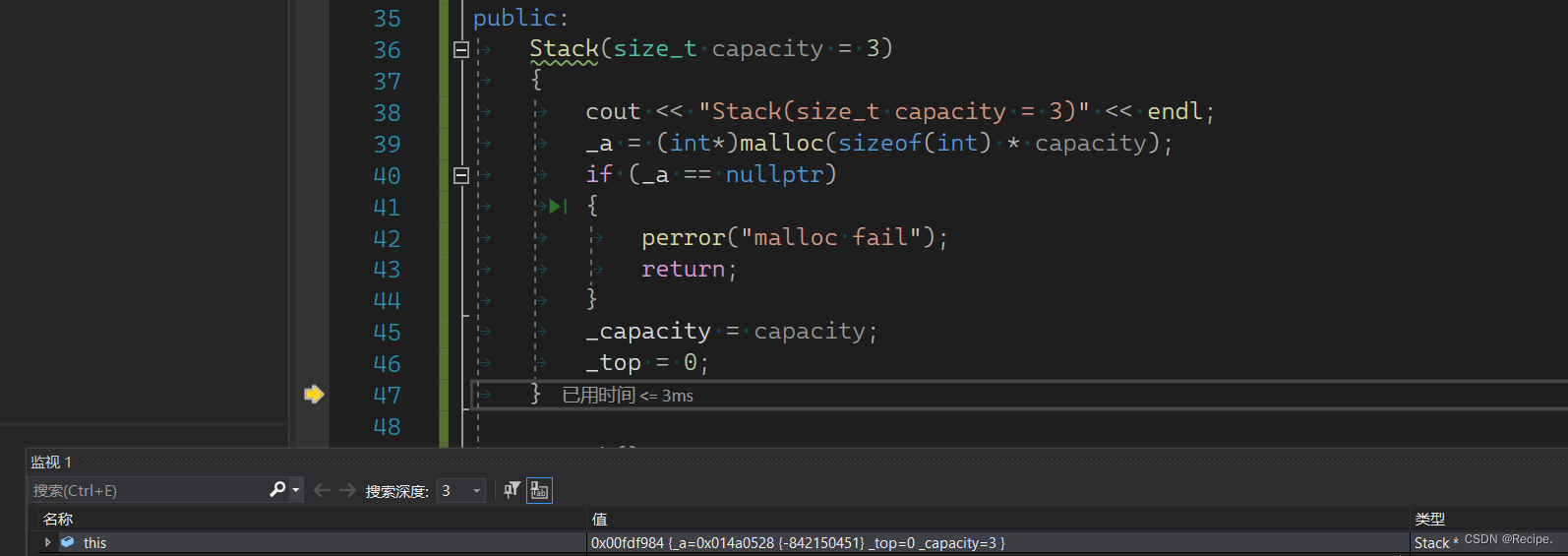


析构函数我们不写也会生成默认析构,那我们屏蔽掉我们写的析构,编译器默认生成的会不会帮栈把内存空间释放掉呢?

答案是不会的,在程序结束前的最后一刻,栈的成员变量还是构造函数初始化的值。
那么默认的析构函数有什么价值呢?
我们继续邀请队列进场
- class Stack
- {
- public:
- Stack(size_t capacity = 3)
- {
- cout << "Stack(size_t capacity = 3)" << endl;
- _a = (int*)malloc(sizeof(int) * capacity);
- if (_a == nullptr)
- {
- perror("malloc fail");
- return;
- }
- _capacity = capacity;
- _top = 0;
- }
- ~Stack()
- {
- cout << "~Stack()" << endl;
- free(_a);
- _a = nullptr;
- _top = _capacity = 0;
- }
- private:
- int* _a;
- int _top;
- int _capacity;
- };
- //
- class Myqueque
- {
- Stack _push;
- Stack _pop;
- int _sz=0;
- };
- int main()
- {
- Myqueque qq;
- return 0;
- }

队列又赚麻了, 躺着赚钱,又是间接调用栈的析构完成自己的析构,这就是默认析构的价值。
Ps:如果类中没有申请资源时,析构函数可以不写,直接使用编译器生成的默认析构函数,比如Date类;有资源申请时,一定要写,否则会造成资源泄漏,比如Stack类。
-
相关阅读:
全是模板的数据分析工具有哪些?
规范你的Typescript注释,一步一步教你生成API文档
夭寿啦!我的网站被攻击了了735200次还没崩
kubebuilder的安装与基本使用
9.21
vue3中使用插件vite-plugin-svg-icons
CF981G Magic multisets
数据结构之队列
elasticsearch 1.5 + mysql安装配置与简单使用
Redis-数据结构-String
- 原文地址:https://blog.csdn.net/weixin_74795859/article/details/134093102
