-
图 拓扑排序 leecode 207 Course Schedule
207. Course Schedule
https://leetcode.com/problems/course-schedule/
There are a total of n courses you have to take, labeled from
0ton-1.Some courses may have prerequisites, for example to take course 0 you have to first take course 1, which is expressed as a pair:
[0,1]Given the total number of courses and a list of prerequisite pairs, is it possible for you to finish all courses?
Approach 1 : DFS topological sorting
class Solution { private: vector<vector<int>> edges; vector<int> visited; // 0-no 1-visisting 2-visted public: bool dfs_isCycle(int u) { if(1 == visited[u]) return true; if(2 == visited[u]) return false; visited[u] = 1; for (int v: edges[u]) { if (dfs_isCycle(v)) { return true; } } visited[u] = 2; return false; } bool canFinish(int numCourses, vector<vector<int>>& prerequisites) { edges.resize(numCourses); visited.resize(numCourses); for (const auto& info: prerequisites) { edges[info[1]].push_back(info[0]); } for (int i = 0; i < numCourses; ++i) { if (dfs_isCycle(i)) { return false; } } return true; } }; ```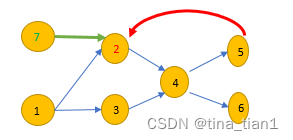 Explanation:__ Q: How to distinguish the node that has been traversed from that is been traversing? A: Set note state * **$\textcolor{Green}{Waiting} $** * **$\textcolor{Red}{Running} $** * **$\textcolor{Black}{Over} $** ```java class Solution { enum State { Waiting, Running, Over, } public boolean canFinish(int numCourses, int[][] prerequisites) { State[] mark = new State[numCourses]; List<Integer>[] graph = new List[numCourses]; for (int i = 0; i < numCourses; i++) { graph[i] = new ArrayList<Integer>(); mark[i] = State.Waiting; } constructGraph(prerequisites, graph); for (int i = 0; i < numCourses; i++) { if (mark[i] == State.Over) continue; if (dfsHasCycle(graph, mark, i)) return false; } return true; } void constructGraph(int[][] pre, List<Integer>[] graph) { int n = graph.length; List<Integer> arr; for (int i = 0; i < pre.length; i++) { arr = graph[pre[i][1]]; arr.add(pre[i][0]); } } boolean dfsHasCycle(List<Integer>[] graph, State[] mark, int cur) { boolean ret; int to; mark[cur] = State.Running; List<Integer> arr = graph[cur]; for (int i = 0; i < arr.size(); i++) { to = arr.get(i); if (mark[to] == State.Running) return true; if (mark[to] == State.Waiting) { ret = dfsHasCycle(graph, mark, to); if (ret) return true; } } mark[cur] = State.Over; return false; } }- 1
- 2
- 3
- 4
- 5
- 6
- 7
- 8
- 9
- 10
- 11
- 12
- 13
- 14
- 15
- 16
- 17
- 18
- 19
- 20
- 21
- 22
- 23
- 24
- 25
- 26
- 27
- 28
- 29
- 30
- 31
- 32
- 33
- 34
- 35
- 36
- 37
- 38
- 39
- 40
- 41
- 42
- 43
- 44
- 45
- 46
- 47
- 48
- 49
- 50
- 51
- 52
- 53
- 54
- 55
- 56
- 57
- 58
- 59
- 60
- 61
- 62
- 63
- 64
- 65
- 66
- 67
- 68
- 69
- 70
- 71
- 72
- 73
- 74
- 75
- 76
- 77
- 78
- 79
- 80
- 81
- 82
- 83
- 84
- 85
- 86
- 87
- 88
- 89
- 90
- 91
- 92
- 93
- 94
- 95
- 96
- 97
- 98
- 99
- 100
- 101
- 102
- 103
- 104
- 105
- 106
Runtime: 2 ms, faster than 99.66% of Java online submissions for Course Schedule.
Memory Usage: 51.9 MB, less than 27.69% of Java online submissions for Course Schedule.Approach 2: BFS
class Solution { public: bool canFinish(int numCourses, vector<vector<int>>& prerequisites) { vector<int> res; vector<vector<int>> graph(numCourses, vector<int>()); vector<int> deg(numCourses); for (auto& p : prerequisites) { graph[p[1]].push_back(p[0]); ++deg[p[0]]; } queue<int> q; for (int i = 0; i < numCourses; ++i) if (deg[i] == 0) q.push(i); while (!q.empty()) { auto x = q.front(); q.pop(); res.push_back(x); for (auto& neighbor : graph[x]) { if (--deg[neighbor] == 0) { q.push(neighbor); } } } return res.size() == numCourses; } };- 1
- 2
- 3
- 4
- 5
- 6
- 7
- 8
- 9
- 10
- 11
- 12
- 13
- 14
- 15
- 16
- 17
- 18
- 19
- 20
- 21
- 22
- 23
- 24
- 25
- 26
- 27
- 28
- 29
class Solution { public boolean canFinish(int numCourses, int[][] prerequisites) { char[] degree = new char[numCourses]; List<Integer> zeroList = new ArrayList<>(); List<Integer>[] graph = new List[numCourses]; for (int i = 0; i < numCourses; i++) { graph[i] = new ArrayList<Integer>(); } constructGraph(prerequisites, graph, degree, zeroList); int cur; int to; List<Integer> toList; while (!zeroList.isEmpty()) { cur = zeroList.remove(zeroList.size() - 1); toList = graph[cur]; for (int i = 0; i < toList.size(); i++) { to = toList.get(i); degree[to]--; if (degree[to] == 0) { zeroList.add(to); } } } for (int i : degree) { if (i != 0) { return false; } } return true; } void constructGraph(int[][] pre, List<Integer>[] graph, char[] degree, List<Integer> zeroList) { List<Integer> arr; for (int i = 0; i < pre.length; i++) { arr = graph[pre[i][1]]; arr.add(pre[i][0]); degree[pre[i][0]]++; } for (int i = 0; i < degree.length; i++) { if (degree[i] == 0) { zeroList.add(i); } } } }- 1
- 2
- 3
- 4
- 5
- 6
- 7
- 8
- 9
- 10
- 11
- 12
- 13
- 14
- 15
- 16
- 17
- 18
- 19
- 20
- 21
- 22
- 23
- 24
- 25
- 26
- 27
- 28
- 29
- 30
- 31
- 32
- 33
- 34
- 35
- 36
- 37
- 38
- 39
- 40
- 41
- 42
- 43
- 44
- 45
- 46
- 47
- 48
- 49
- 50
- 51
- 52
- 53
- 54
Runtime: 3 ms, faster than 90.47% of Java online submissions for Course Schedule.
Memory Usage: 47.1 MB, less than 46.16% of Java online submissions for Course Schedule.Explanation:
Iterate over nodes that Indegree == 0. and reduce indegree of the node that is directed to.
At last, once the indegree of all nodes is equal to 0, there is no cycle.
Otherwise, there is a cycle.
-
相关阅读:
Linux3._Linux环境基础开发工具使用
Openssl数据安全传输平台011:base64的使用
神经网络算法简单例子,图神经网络推荐算法
NumPy 切片和索引
jsp精品课程网站系统Myeclipse开发mysql数据库web结构java编程计算机网页项目
凯撒密码加密、解密、暴力破解(C语言实现)
「网络流浅谈」最大流的应用
【iOS】—— autoreleasePool以及总结
学习Oracle数据库的新建表的基本操作(二)
BUUCTF easyre 1
- 原文地址:https://blog.csdn.net/tina_tian1/article/details/133930511
