-
Linearization
In mathematics, linearization is finding the linear approximation to a function at a given point. The linear approximation of a function is the first order Taylor expansion around the point of interest. In the study of dynamical systems, linearization is a method for assessing the local stability of an equilibrium point of a system of nonlinear differential equations or discrete dynamical systems.[1] This method is used in fields such as engineering, physics, economics, and ecology.
1 Linearization of a function
Linearizations of a function are lines—usually lines that can be used for purposes of calculation. Linearization is an effective method for approximating the output of a function {\displaystyle y=f(x)}y=f(x) at any {\displaystyle x=a}x=a based on the value and slope of the function at {\displaystyle x=b}x=b, given that {\displaystyle f(x)}f(x) is differentiable on {\displaystyle [a,b]}[a,b] (or {\displaystyle [b,a]}[b,a]) and that {\displaystyle a}a is close to {\displaystyle b}b. In short, linearization approximates the output of a function near {\displaystyle x=a}x=a.
For example, {\displaystyle {\sqrt {4}}=2}{\sqrt {4}}=2. However, what would be a good approximation of {\displaystyle {\sqrt {4.001}}={\sqrt {4+.001}}}{\sqrt {4.001}}={\sqrt {4+.001}}?
For any given function {\displaystyle y=f(x)}y=f(x), {\displaystyle f(x)}f(x) can be approximated if it is near a known differentiable point. The most basic requisite is that {\displaystyle L_{a}(a)=f(a)}L_{a}(a)=f(a), where {\displaystyle L_{a}(x)}L_{a}(x) is the linearization of {\displaystyle f(x)}f(x) at {\displaystyle x=a}x=a. The point-slope form of an equation forms an equation of a line, given a point {\displaystyle (H,K)}(H,K) and slope {\displaystyle M}M. The general form of this equation is: {\displaystyle y-K=M(x-H)}y-K=M(x-H).
Using the point {\displaystyle (a,f(a))}(a,f(a)), {\displaystyle L_{a}(x)}L_{a}(x) becomes {\displaystyle y=f(a)+M(x-a)}y=f(a)+M(x-a). Because differentiable functions are locally linear, the best slope to substitute in would be the slope of the line tangent to {\displaystyle f(x)}f(x) at {\displaystyle x=a}x=a.
While the concept of local linearity applies the most to points arbitrarily close to {\displaystyle x=a}x=a, those relatively close work relatively well for linear approximations. The slope {\displaystyle M}M should be, most accurately, the slope of the tangent line at {\displaystyle x=a}x=a.
Visually, the accompanying diagram shows the tangent line of {\displaystyle f(x)}f(x) at {\displaystyle x}x. At {\displaystyle f(x+h)}f(x+h), where {\displaystyle h}h is any small positive or negative value, {\displaystyle f(x+h)}f(x+h) is very nearly the value of the tangent line at the point {\displaystyle (x+h,L(x+h))}(x+h,L(x+h)).
The final equation for the linearization of a function at {\displaystyle x=a}x=a is:
{\displaystyle y=(f(a)+f’(a)(x-a))}{\displaystyle y=(f(a)+f’(a)(x-a))}
For {\displaystyle x=a}x=a, {\displaystyle f(a)=f(x)}f(a)=f(x). The derivative of {\displaystyle f(x)}f(x) is {\displaystyle f’(x)}f’(x), and the slope of {\displaystyle f(x)}f(x) at {\displaystyle a}a is {\displaystyle f’(a)}f’(a).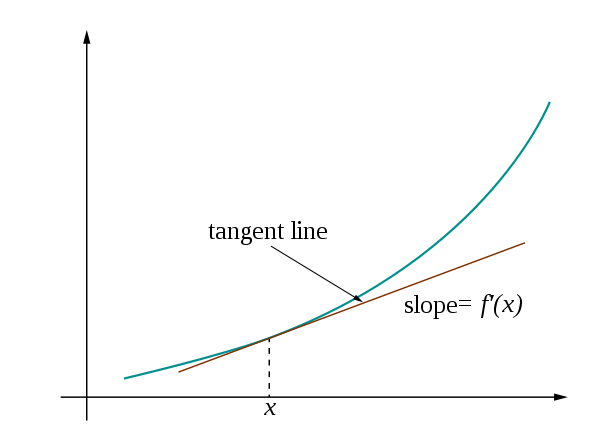
An approximation of f(x) = x2 at (x, f(x))
2 Example
To find {\displaystyle {\sqrt {4.001}}}{\sqrt {4.001}}, we can use the fact that {\displaystyle {\sqrt {4}}=2}{\sqrt {4}}=2. The linearization of {\displaystyle f(x)={\sqrt {x}}}f(x)={\sqrt {x}} at {\displaystyle x=a}x=a is {\displaystyle y={\sqrt {a}}+{\frac {1}{2{\sqrt {a}}}}(x-a)}y={\sqrt {a}}+{\frac {1}{2{\sqrt {a}}}}(x-a), because the function {\displaystyle f’(x)={\frac {1}{2{\sqrt {x}}}}}f’(x)={\frac {1}{2{\sqrt {x}}}} defines the slope of the function {\displaystyle f(x)={\sqrt {x}}}f(x)={\sqrt {x}} at {\displaystyle x}x. Substituting in {\displaystyle a=4}a=4, the linearization at 4 is {\displaystyle y=2+{\frac {x-4}{4}}}y=2+{\frac {x-4}{4}}. In this case {\displaystyle x=4.001}x=4.001, so {\displaystyle {\sqrt {4.001}}}{\sqrt {4.001}} is approximately {\displaystyle 2+{\frac {4.001-4}{4}}=2.00025}2+{\frac {4.001-4}{4}}=2.00025. The true value is close to 2.00024998, so the linearization approximation has a relative error of less than 1 millionth of a percent.
3 Linearization of a multivariable function
The equation for the linearization of a function {\displaystyle f(x,y)}f(x,y) at a point {\displaystyle p(a,b)}p(a,b) is:
{\displaystyle f(x,y)\approx f(a,b)+\left.{\frac {\partial f(x,y)}{\partial x}}\right|{a,b}(x-a)+\left.{\frac {\partial f(x,y)}{\partial y}}\right|{a,b}(y-b)}f(x,y)\approx f(a,b)+\left.{{\frac {{\partial f(x,y)}}{{\partial x}}}}\right|{{a,b}}(x-a)+\left.{{\frac {{\partial f(x,y)}}{{\partial y}}}}\right|{{a,b}}(y-b)
The general equation for the linearization of a multivariable function {\displaystyle f(\mathbf {x} )}f(\mathbf {x} ) at a point {\displaystyle \mathbf {p} }\mathbf {p} is:{\displaystyle f({\mathbf {x} })\approx f({\mathbf {p} })+\left.{\nabla f}\right|{\mathbf {p} }\cdot ({\mathbf {x} }-{\mathbf {p} })}f({{\mathbf {x}}})\approx f({{\mathbf {p}}})+\left.{\nabla f}\right|{{{\mathbf {p}}}}\cdot ({{\mathbf {x}}}-{{\mathbf {p}}})
where {\displaystyle \mathbf {x} }\mathbf {x} is the vector of variables, and {\displaystyle \mathbf {p} }\mathbf {p} is the linearization point of interest .[2]4 Uses of linearization
Linearization makes it possible to use tools for studying linear systems to analyze the behavior of a nonlinear function near a given point. The linearization of a function is the first order term of its Taylor expansion around the point of interest. For a system defined by the equation
{\displaystyle {\frac {d\mathbf {x} }{dt}}=\mathbf {F} (\mathbf {x} ,t)}{\displaystyle {\frac {d\mathbf {x} }{dt}}=\mathbf {F} (\mathbf {x} ,t)},
the linearized system can be written as{\displaystyle {\frac {d\mathbf {x} }{dt}}\approx \mathbf {F} (\mathbf {x_{0}} ,t)+D\mathbf {F} (\mathbf {x_{0}} ,t)\cdot (\mathbf {x} -\mathbf {x_{0}} )}{\displaystyle {\frac {d\mathbf {x} }{dt}}\approx \mathbf {F} (\mathbf {x_{0}} ,t)+D\mathbf {F} (\mathbf {x_{0}} ,t)\cdot (\mathbf {x} -\mathbf {x_{0}} )}
where {\displaystyle \mathbf {x_{0}} }\mathbf {x_{0}} is the point of interest and {\displaystyle D\mathbf {F} (\mathbf {x_{0}} ,t)}{\displaystyle D\mathbf {F} (\mathbf {x_{0}} ,t)} is the {\displaystyle \mathbf {x} }\mathbf {x} -Jacobian of {\displaystyle \mathbf {F} (\mathbf {x} ,t)}{\displaystyle \mathbf {F} (\mathbf {x} ,t)} evaluated at {\displaystyle \mathbf {x_{0}} }\mathbf {x_{0}} .4.1 Stability analysis
In stability analysis of autonomous systems, one can use the eigenvalues of the Jacobian matrix evaluated at a hyperbolic equilibrium point to determine the nature of that equilibrium. This is the content of the linearization theorem. For time-varying systems, the linearization requires additional justification.[3]
4.2 Microeconomics
In microeconomics, decision rules may be approximated under the state-space approach to linearization.[4] Under this approach, the Euler equations of the utility maximization problem are linearized around the stationary steady state.[4] A unique solution to the resulting system of dynamic equations then is found.[4]
4.3 Optimization
In mathematical optimization, cost functions and non-linear components within can be linearized in order to apply a linear solving method such as the Simplex algorithm. The optimized result is reached much more efficiently and is deterministic as a global optimum.
4.4 Multiphysics
In multiphysics systems—systems involving multiple physical fields that interact with one another—linearization with respect to each of the physical fields may be performed. This linearization of the system with respect to each of the fields results in a linearized monolithic equation system that can be solved using monolithic iterative solution procedures such as the Newton–Raphson method. Examples of this include MRI scanner systems which results in a system of electromagnetic, mechanical and acoustic fields.[5]
5 See also
Linear stability
Tangent stiffness matrix
Stability derivatives
Linearization theorem
Taylor approximation
Functional equation (L-function) -
相关阅读:
无线耳机哪个音质好?无线入耳式蓝牙耳机音质排行榜
Java -- 每日一问:谈谈常用的分布式ID的设计方案?Snowflake是否受冬令时切换影响?
电阻知识点
基于大数据的农产品价格信息监测分析系统
入门力扣自学笔记112 C++ (题目编号899)
Stream流总结
狂神说Go语言学习笔记(四)
html +css 练习的(太极图)
健康中国·营养先行|2022主动健康与临床营养高峰论坛圆满落幕
uniapp map polygons 区域填充色(fillColor)在ios显示正常,但在安卓手机显示是黑色的,怎么解决?
- 原文地址:https://blog.csdn.net/qq_66485519/article/details/128150607