-
驱动开发 platfrom总线驱动的三种方式
驱动的分隔与分离:
对于 Linux 这样一个成熟、庞大、复杂的操作系统,代码的重用性非常重要,在驱动程序,因为驱动程序占用了 Linux 内核代码量的大头,如果不对驱动程序加以管理,任由重复的代码肆意增加,那么用不了多久 Linux 内核的文件数量就庞大到无法接受的地步。例如:现在有三个SOC A、B 和 C上都有 MPU6050 这个 I2C 接口的六轴传感器,按照我们写裸机 I2C 驱动的时候的思路,每个平台都有一个MPU6050的驱动,那么设备端的驱动将会重复的编写好几次。显然在 Linux 驱动程序中这种写法是不推荐的,最好的做法就是每个SOC的 I2C 控制器都提供一个统一的接口 (也叫做主机驱动),每个设备的话也只提供一个驱动程序(设备驱动),每个设备通过统一的 I2C 接口驱动来访问,这样就可以大大简化驱动文件。
 当我们向系统注册一个驱动的时候,总线就会在右侧的设备中查找,看看有没有与之匹配的设备,如果有的话就将两者联系起来。同样的,当向系统中注册一个设备的时候,总线就会在左侧的驱动中查找看有没有与之匹配的设备,有的话也联系起来。在linux内核中的驱动程序都采用总线、驱动和设备这样的模式。platform 驱动就是这一思想下的产物。
总线驱动模型:

platform总线遵从总线模型,platform是linux内阁抽象出来的软件代码,没有真实的总线和它对应(不存在)
platfor总线去驱动的思想:是将设备信息和驱动进行分离。platform_device和platform_driver通过总线进行匹配,匹配成功后会执行驱动中的probe函数,在probe函数中可以获取到device中的硬件设备信息。
以下是platfrom的三种匹配方式:
一:设备名
pdrv:
- #include<linux/init.h>
- #include<linux/module.h>
- #include<linux/platform_device.h>
- #include<linux/mod_devicetable.h>
- struct resource *res;
- int irqno;
- int pdrv_probe(struct platform_device *pdev)
- {
- res=platform_get_resource(pdev,IORESOURCE_MEM,0);
- if(res==NULL)
- {
- return ENODATA;
- }
- irqno=platform_get_irq(pdev,0);
- if(irqno<0)
- {
- return ENODATA;
- }
- printk("addr:%#llx,irqno:%d\n",res->start,irqno);
- return 0;
- }
- int pdrv_remove(struct platform_device *pdev)
- {
- printk("%s:%d\n",__func__,__LINE__);
- return 0;
- }
- struct platform_driver pdrv={
- .probe=pdrv_probe,
- .remove=pdrv_remove,
- .driver={
- .name="aaaaa",
- },
- };
- module_platform_driver(pdrv);
- MODULE_LICENSE("GPL");
pdev:
- #include<linux/init.h>
- #include<linux/module.h>
- #include<linux/platform_device.h>
- struct resource res[]={
- [0]={
- .start=0x12345678,
- .end=0x12345678+49,
- .flags=IORESOURCE_MEM,
- },
- [1]={
- .start=71,
- .end=71,
- .flags=IORESOURCE_IRQ,
- },
- };
- void pdev_release(struct device *dev)
- {
- printk("%s:%d\n",__func__,__LINE__);
- }
- struct platform_device pdev=
- {
- .name="aaaaa",
- .id=PLATFORM_DEVID_AUTO,
- .dev={
- .release=pdev_release,
- },
- .resource=res,
- .num_resources=ARRAY_SIZE(res),
- };
- static int __init demo_init(void)
- {
- platform_device_register(&pdev);
- return 0;
- }
- static void __exit demo_exit(void)
- {
- platform_device_unregister(&pdev);
- }
- module_init(demo_init);
- module_exit(demo_exit);
- MODULE_LICENSE("GPL");

二:设备名列表
pdev:
- #include<linux/init.h>
- #include<linux/module.h>
- #include<linux/platform_device.h>
- struct resource res[]={
- [0]={
- .start=0x12345678,
- .end=0x12345678+49,
- .flags=IORESOURCE_MEM,
- },
- [1]={
- .start=71,
- .end=71,
- .flags=IORESOURCE_IRQ,
- },
- };
- void pdev_release(struct device *dev)
- {
- printk("%s:%d\n",__func__,__LINE__);
- }
- struct platform_device pdev=
- {
- .name="hello1",
- .id=PLATFORM_DEVID_AUTO,
- .dev={
- .release=pdev_release,
- },
- .resource=res,
- .num_resources=ARRAY_SIZE(res),
- };
- static int __init demo_init(void)
- {
- platform_device_register(&pdev);
- return 0;
- }
- static void __exit demo_exit(void)
- {
- platform_device_unregister(&pdev);
- }
- module_init(demo_init);
- module_exit(demo_exit);
- MODULE_LICENSE("GPL");
pdrv2:
- #include<linux/init.h>
- #include<linux/module.h>
- #include<linux/platform_device.h>
- #include<linux/mod_devicetable.h>
- struct resource *res;
- int irqno;
- int pdrv_probe(struct platform_device *pdev)
- {
- res=platform_get_resource(pdev,IORESOURCE_MEM,0);
- if(res==NULL)
- {
- return ENODATA;
- }
- irqno=platform_get_irq(pdev,0);
- if(irqno<0)
- {
- return ENODATA;
- }
- printk("addr:%#llx,irqno:%d\n",res->start,irqno);
- return 0;
- }
- int pdrv_remove(struct platform_device *pdev)
- {
- printk("%s:%d\n",__func__,__LINE__);
- return 0;
- }
- struct platform_device_id idtable[]={
- {"hello1",0},
- {"hello2",1},
- {"hello3",2},
- {}
- };
- struct platform_driver pdrv={
- .probe=pdrv_probe,
- .remove=pdrv_remove,
- .driver={
- .name="aaaaa",
- },
- .id_table=idtable,
- };
- MODULE_DEVICE_TABLE(platform,idtable);
- module_platform_driver(pdrv);
- MODULE_LICENSE("GPL");

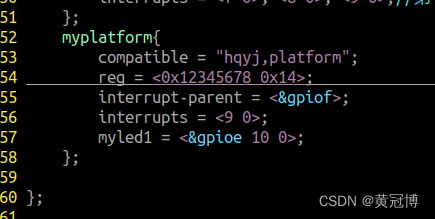
三:设备树
添加设备树节点:
pdrv3:
- #include<linux/init.h>
- #include<linux/module.h>
- #include<linux/platform_device.h>
- #include<linux/mod_devicetable.h>
- #include<linux/of.h>
- #include<linux/of_gpio.h>
- struct resource *res;
- int irqno;
- struct gpio_desc *gpiono;
- int pdrv_probe(struct platform_device *pdev)
- {
- res=platform_get_resource(pdev,IORESOURCE_MEM,0);
- if(res==NULL)
- {
- return ENODATA;
- }
- irqno=platform_get_irq(pdev,0);
- if(irqno<0)
- {
- return ENODATA;
- }
- printk("addr:%#x,irqno:%d\n",res->start,irqno);
- gpiono=gpiod_get_from_of_node(pdev->dev.of_node,"myled1",0,GPIOD_OUT_HIGH,0);
- if(IS_ERR(gpiono))
- {
- printk("获取gpio编号失败\n");
- return PTR_ERR(gpiono);
- }
- gpiod_set_value(gpiono,1);
- return 0;
- }
- int pdrv_remove(struct platform_device *pdev)
- {
- gpiod_set_value(gpiono,0);
- gpiod_put(gpiono);
- printk("%s:%d\n",__func__,__LINE__);
- return 0;
- }
- struct of_device_id oftable[]={
- {.compatible="hqyj,platform",},
- {}
- };
- struct platform_driver pdrv={
- .probe=pdrv_probe,
- .remove=pdrv_remove,
- .driver={
- .name="aaaaa",
- .of_match_table=oftable,
- },
- };
- module_platform_driver(pdrv);
- MODULE_LICENSE("GPL");


-
相关阅读:
数据结构--栈的实现
【QCustomPlot】下载
Tailwindcss Layout布局相关样式及实战案例,5万字长文,附完整源码和效果截图
Docker常见面试题集锦
501. 二叉搜索树中的众数
docker中安装并启动rabbitMQ
wxPython 之 wxAuiManage实现停靠(悬停)子窗口
OceanBase存储层代码解读(四):宏块的垃圾回收和坏块检查
uniapp+vue3+ts+vite+echarts开发图表类小程序,将echarts导入项目使用的详细步骤,耗时一天终于弄好了
Unity_建造系统及保存加载
- 原文地址:https://blog.csdn.net/brightmante/article/details/128103920
