-
LeetCode每日一题(2201. Count Artifacts That Can Be Extracted)
There is an n x n 0-indexed grid with some artifacts buried in it. You are given the integer n and a 0-indexed 2D integer array artifacts describing the positions of the rectangular artifacts where artifacts[i] = [r1i, c1i, r2i, c2i] denotes that the ith artifact is buried in the subgrid where:
- (r1i, c1i) is the coordinate of the top-left cell of the ith artifact and
- (r2i, c2i) is the coordinate of the bottom-right cell of the ith artifact.
You will excavate some cells of the grid and remove all the mud from them. If the cell has a part of an artifact buried underneath, it will be uncovered. If all the parts of an artifact are uncovered, you can extract it.
Given a 0-indexed 2D integer array dig where dig[i] = [ri, ci] indicates that you will excavate the cell (ri, ci), return the number of artifacts that you can extract.
The test cases are generated such that:
- No two artifacts overlap.
- Each artifact only covers at most 4 cells.
- The entries of dig are unique.
Example 1:
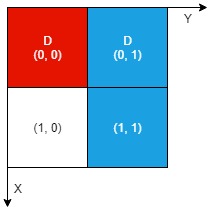
Input: n = 2, artifacts = [[0,0,0,0],[0,1,1,1]], dig = [[0,0],[0,1]]
Output: 1Explanation:
The different colors represent different artifacts. Excavated cells are labeled with a ‘D’ in the grid.
There is 1 artifact that can be extracted, namely the red artifact.
The blue artifact has one part in cell (1,1) which remains uncovered, so we cannot extract it.
Thus, we return 1.Example 2:

Input: n = 2, artifacts = [[0,0,0,0],[0,1,1,1]], dig = [[0,0],[0,1],[1,1]]
Output: 2Explanation: Both the red and blue artifacts have all parts uncovered (labeled with a ‘D’) and can be extracted, so we return 2.
Constraints:
- 1 <= n <= 1000
- 1 <= artifacts.length, dig.length <= min(n2, 105)
- artifacts[i].length == 4
- dig[i].length == 2
- 0 <= r1i, c1i, r2i, c2i, ri, ci <= n - 1
- r1i <= r2i
- c1i <= c2i
- No two artifacts will overlap.
- The number of cells covered by an artifact is at most 4.
- The entries of dig are unique.
没想到什么简单办法, 就是把 grid 根据 artifacts 画出来, grid[row][col] = i, i 为 artifacts 的 index, 同时创建一个 counts 来统计同一 artifact 所覆盖的 cell 的数量, 然后我们遍历 dig, 根据挖开的 grid 中的 i, 去 counts 中做相应的减除, 如果 counts[i] == 0 了, 那我们就可以认为 artifacts[i]所覆盖的所有 cell 都被挖开了。
impl Solution { pub fn dig_artifacts(n: i32, artifacts: Vec<Vec<i32>>, dig: Vec<Vec<i32>>) -> i32 { let mut grid = vec![vec![-1; n as usize]; n as usize]; let mut counts = vec![0; artifacts.len()]; for (i, art) in artifacts.into_iter().enumerate() { for r in art[0]..=art[2] { for c in art[1]..=art[3] { grid[r as usize][c as usize] = i as i32; counts[i] += 1; } } } let mut ans = 0; for d in dig { let i = grid[d[0] as usize][d[1] as usize]; if i >= 0 { counts[i as usize] -= 1; if counts[i as usize] == 0 { ans += 1; } } } ans } }- 1
- 2
- 3
- 4
- 5
- 6
- 7
- 8
- 9
- 10
- 11
- 12
- 13
- 14
- 15
- 16
- 17
- 18
- 19
- 20
- 21
- 22
- 23
- 24
- 25
-
相关阅读:
汽车一键启动点火开关按键一键启动按钮型号规格
温故而知新十(C++)
第七节.常用Linux命令—查找文件,软硬链接,软件安装,系统信息
尚硅谷--Linux篇
Jmeter 接口造10w条用户数据
附录10-JS正则
RPA是什么?推荐让电商运营10倍提效的自动化工具
【云原生之kubernetes实战】在k8s集群环境下部署Tomcat应用
Jmeter接口自动化生成测试报告html格式
Springboot+vue的社区医院管理系统(有报告),Javaee项目,springboot vue前后端分离项目
- 原文地址:https://blog.csdn.net/wangjun861205/article/details/127961381
