-
C++STL详解(二)vector的使用及其模拟实现
1.简介
C++ STL中的verctor好比是C语言中的数组,但是vector又具有数组没有的一些高级功能。

- vector是可变大小的顺序容器。
- 就像数组一样,vector也采用的连续存储空间来存储元素。也就是意味着可以采用下标对vector的元素进行访问,和数组一样高效。但是又不像数组,它的大小是可以动态改变的,而且它的大小会被容器自动处理。
- 本质讲,vector使用动态分配数组来存储它的元素。当新元素插入时候,这个数组需要被重新分配大小为了增加存储空间。其做法是,分配一个新的数组,然后将全部元素移到这个数组。就时间而言,这是一个相对代价高的任务,因为每当一个新的元素加入到容器的时候,vector并不会每次都重新分配大小。
- vector分配空间策略:vector会分配一些额外的空间以适应可能的增长,因为存储空间比实际需要的存储空间更大。不同的库采用不同的策略权衡空间的使用和重新分配。但是无论如何,重新分配都应该是对数增长的间隔大小,以至于在末尾插入一个元素的时候是在常数时间的复杂度完成的。
- 因此,vector占用了更多的存储空间,为了获得管理存储空间的能力,并且以一种有效的方式动态增长。
- 与其它动态序列容器相比(deques, lists and forward_lists), vector在访问元素的时候更加高效,在末尾添加和删除元素相对高效。对于其它不在末尾的删除和插入操作,效率更低。比起lists和forward_lists统一的迭代器和引用更好
2.常用接口
构造函数

alloc是空间配置器,暂时先不用理会。
如果vector的元素类型是int,默认初始化为0;如果vector元素类型为string,则默认初始化为空字符串。
vector<int> v1; vector<string> v3; vector<vector<int>>; //这里相当于二维数组int a[n][n]; vector<int> v5 = { 1,2,3,4,5 }; //列表初始化,注意使用的是花括号 vector<string> v6 = { "hi","my","name","is","lee" }; vector<int> v7(5, -1); //初始化为-1,-1,-1,-1,-1。第一个参数是数目,第二个参数是要初始化的值 vector<string> v8(3, "hi"); vector<int> v9(10); //默认初始化为0 vector<string> v10(4); //默认初始化 为空字符串- 1
- 2
- 3
- 4
- 5
- 6
- 7
- 8
- 9
利用迭代器区间初始化:

void test_vector1() { vector<int> v1; v1.push_back(1); v1.push_back(2); v1.push_back(3); v1.push_back(4); vector<double> v2; v2.push_back(1.1); v2.push_back(2.2); v2.push_back(3.3); vector<string> v3; v3.push_back("李白"); v3.push_back("杜甫"); v3.push_back("苏轼"); v3.push_back("白居易"); vector<int> v4(10, 5); // 10个5初始化v4 vector<string> v5(++v3.begin(), --v3.end()); string s = "hello world"; vector<char> v6(s.begin(), s.end()); }- 1
- 2
- 3
- 4
- 5
- 6
- 7
- 8
- 9
- 10
- 11
- 12
- 13
- 14
- 15
- 16
- 17
- 18
- 19
- 20
- 21
- 22
- 23
- 24
- 25
- 26
遍历
void test_vector2() { // 遍历 vector<int> v; v.push_back(1); v.push_back(2); v.push_back(3); v.push_back(4); // 1、下标+[] for (size_t i = 0; i < v.size(); ++i) { v[i] += 1; cout << v[i] << " "; } cout << endl; // 2.迭代器 vector<int>::iterator it = v.begin(); while (it != v.end()) { *it -= 1; cout << *it << " "; ++it; } cout << endl; // 3.范围for for (auto& e : v) { e += 1; cout << e << " "; } cout << endl; }- 1
- 2
- 3
- 4
- 5
- 6
- 7
- 8
- 9
- 10
- 11
- 12
- 13
- 14
- 15
- 16
- 17
- 18
- 19
- 20
- 21
- 22
- 23
- 24
- 25
- 26
- 27
- 28
- 29
- 30
- 31
- 32
- 33
- 34
- 35
遍历二维的:

void test_vector9() { vector<vector<int>> vv; for (size_t i = 0; i < vv.size(); ++i) { for (size_t j = 0; j < vv[i].size(); ++j) { cout << vv[i][j] << " "; } cout << endl; } }- 1
- 2
- 3
- 4
- 5
- 6
- 7
- 8
- 9
- 10
- 11
- 12

扩容机制
// 查看扩容情况 void test_vector4() { size_t sz; std::vector<int> foo; //foo.reserve(100); // 如果预知到大概插入多少数据利用reserve开好足够的空间 sz = foo.capacity(); std::cout << "making foo grow:\n"; for (int i = 0; i < 100; ++i) { foo.push_back(i); if (sz != foo.capacity()) { sz = foo.capacity(); std::cout << "capacity changed: " << sz << '\n'; } } }- 1
- 2
- 3
- 4
- 5
- 6
- 7
- 8
- 9
- 10
- 11
- 12
- 13
- 14
- 15
- 16

Linux下g++版本:

- VS用的STL是PJ版本,大约1.5倍扩容
- Linux下用的是SGI版本,大约2倍扩容
单次增容越多,插入N个值,增容次数越少,效率就越高,但是带来的空间浪费可能也就越多。
单次增容越少,空间浪费较少,但增容次数增多,降低效率。
resize:开空间+初始化。- 当所给值大于容器当前的size时,将size扩大到该值,扩大的元素为第二个所给值,若未给出,则默认为0。
- 当所给值小于容器当前的size时,将size缩小到该值。
void test_vector5() { vector<int> countV; countV.resize(10, 1); // 10个1 for (auto e : countV) { cout << e << " "; } cout << endl; countV.resize(5); // 只保留下5个1 for (auto e : countV) { cout << e << " "; } cout << endl; countV.resize(8, 10); // 5个1后面接上3个10 for (auto e : countV) { cout << e << " "; } cout << endl; countV.resize(12); // 最后补上4个0凑足12 for (auto e : countV) { cout << e << " "; } cout << endl; }- 1
- 2
- 3
- 4
- 5
- 6
- 7
- 8
- 9
- 10
- 11
- 12
- 13
- 14
- 15
- 16
- 17
- 18
- 19
- 20
- 21
- 22
- 23
- 24
- 25
- 26
- 27
- 28
- 29
- 30
- 31

缩容
一般来说,删除数据是不会主动缩容的,缩容代价也比较大。
操作系统就不接受归还一部分内存的,只能整体归还。因此缩容也就变成把要保留的内容拷贝到一个合适的新空间,再把旧的整个空间释放,还给操作系统。
void test_vector6() { std::vector<int> foo; foo.reserve(100); foo.resize(10); //原来100个空间 cout << foo.size() << endl; cout << foo.capacity() << endl; foo.shrink_to_fit(); // 把capacity缩到和size一样大 cout << foo.size() << endl; cout << foo.capacity() << endl; }- 1
- 2
- 3
- 4
- 5
- 6
- 7
- 8
- 9
- 10
- 11

shrink_to_fit()
这个函数慎用,一般来说现代计算机内存是比较充足的。
插入删除


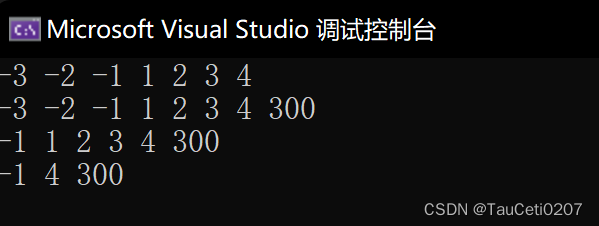
void test_vector7() { // 遍历 vector<int> v; v.push_back(1); v.push_back(2); v.push_back(3); v.push_back(4); v.insert(v.begin(), -1); v.insert(v.begin(), -2); v.insert(v.begin(), -3); for (auto e : v) { cout << e << " "; } cout << endl; v.insert(v.begin() + 7, 300); // 在任意位置插入都行 //v.insert(v.begin()+8, 300); //越界了 err for (auto e : v) { cout << e << " "; } cout << endl; v.erase(v.begin()); v.erase(v.begin()); for (auto e : v) { cout << e << " "; } cout << endl; v.erase(v.begin() + 1, v.begin() + 4); for (auto e : v) { cout << e << " "; } cout << endl; }- 1
- 2
- 3
- 4
- 5
- 6
- 7
- 8
- 9
- 10
- 11
- 12
- 13
- 14
- 15
- 16
- 17
- 18
- 19
- 20
- 21
- 22
- 23
- 24
- 25
- 26
- 27
- 28
- 29
- 30
- 31
- 32
- 33
- 34
- 35
- 36
- 37
- 38
- 39
- 40
- 41
find
vector是没有实现find的,但如果我们非要找某个位置的话,可以用算法里的
find()
注意,STL中的迭代器基本都是左闭右开区间。
// find example #include// std::cout #include // std::find #include // std::vector int main () { // using std::find with array and pointer: int myints[] = { 10, 20, 30, 40 }; int * p; p = std::find (myints, myints+4, 30); if (p != myints+4) std::cout << "Element found in myints: " << *p << '\n'; //30 else std::cout << "Element not found in myints\n"; // using std::find with vector and iterator: std::vector<int> myvector (myints,myints+4); std::vector<int>::iterator it = find (myvector.begin(), myvector.end(), 30); // 也可以用auto替换 std::vector ::iterator if (it != myvector.end()) std::cout << "Element found in myvector: " << *it << '\n'; //30 else std::cout << "Element not found in myvector\n"; return 0; }- 1
- 2
- 3
- 4
- 5
- 6
- 7
- 8
- 9
- 10
- 11
- 12
- 13
- 14
- 15
- 16
- 17
- 18
- 19
- 20
- 21
- 22
- 23
- 24
- 25
- 26
- 27
sort
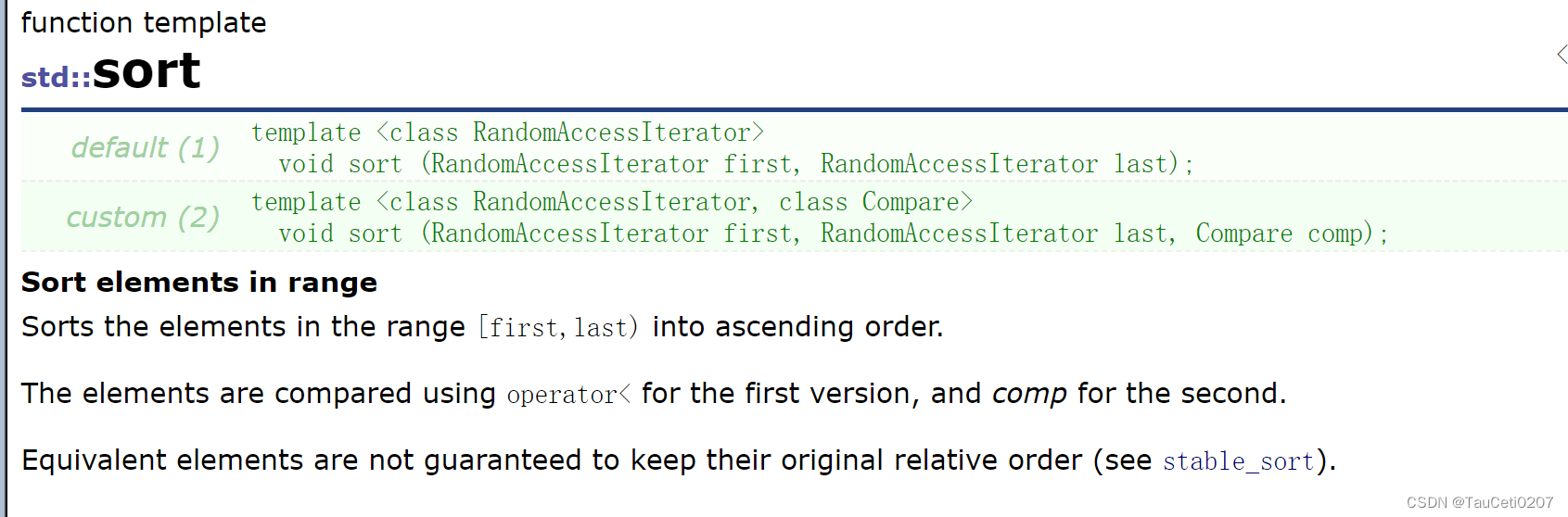
注意:默认是ascending order
// sort algorithm example #include// std::cout #include // std::sort #include // std::vector bool myfunction (int i,int j) { return (i<j); } struct myclass { bool operator() (int i,int j) { return (i<j);} } myobject; int main () { int myints[] = {32,71,12,45,26,80,53,33}; std::vector<int> myvector (myints, myints+8); // 32 71 12 45 26 80 53 33 // using default comparison (operator <): std::sort (myvector.begin(), myvector.begin()+4); //(12 32 45 71)26 80 53 33 // using function as comp std::sort (myvector.begin()+4, myvector.end(), myfunction); // 12 32 45 71(26 33 53 80) // using object as comp std::sort (myvector.begin(), myvector.end(), myobject); //(12 26 32 33 45 53 71 80) // print out content: std::cout << "myvector contains:"; for (std::vector<int>::iterator it=myvector.begin(); it!=myvector.end(); ++it) std::cout << ' ' << *it; std::cout << '\n'; return 0; } - 1
- 2
- 3
- 4
- 5
- 6
- 7
- 8
- 9
- 10
- 11
- 12
- 13
- 14
- 15
- 16
- 17
- 18
- 19
- 20
- 21
- 22
- 23
- 24
- 25
- 26
- 27
- 28
- 29
- 30
- 31
- 32
void test_vector8() { vector<int> v; v.push_back(1); v.push_back(6); v.push_back(3); v.push_back(9); v.push_back(2); v.push_back(0); v.push_back(8); for (auto e : v) { cout << e << " "; } cout << endl; //排升序 sort(v.begin(), v.end()); // 默认是小于,就是升序 for (auto e : v) { cout << e << " "; } cout << endl; // 排降序 利用仿函数 // 构造了一个匿名对象 //greaterg; //sort(v.begin(), v.end(), g); // 这样也行 sort(v.begin(), v.end(), greater<int>()); // > 就是降序 for (auto e : v) { cout << e << " "; } cout << endl; }- 1
- 2
- 3
- 4
- 5
- 6
- 7
- 8
- 9
- 10
- 11
- 12
- 13
- 14
- 15
- 16
- 17
- 18
- 19
- 20
- 21
- 22
- 23
- 24
- 25
- 26
- 27
- 28
- 29
- 30
- 31
- 32
- 33
- 34
- 35

3.vector模拟实现
SGI版本源码
欣赏一下核心框架:


构造函数
vector() :_start(nullptr) , _finish(nullptr) , _endofstorage(nullptr) {} template<class InputIterator> vector(InputIterator first, InputIterator last) : _start(nullptr) , _finish(nullptr) , _endofstorage(nullptr) { while (first != last) { push_back(*first); ++first; } } void test_yzq_vector6() { std::string s("hello"); yzq::vector<int> v; v.push_back(1); v.push_back(2); v.push_back(3); v.push_back(4); yzq::vector<int> v1(v.begin(), v.end()); for (auto e : v1) { cout << e << " "; } cout << endl; yzq::vector<char> v2(s.begin(), s.end()); for (auto e : v2) { cout << e << " "; } cout << endl; }- 1
- 2
- 3
- 4
- 5
- 6
- 7
- 8
- 9
- 10
- 11
- 12
- 13
- 14
- 15
- 16
- 17
- 18
- 19
- 20
- 21
- 22
- 23
- 24
- 25
- 26
- 27
- 28
- 29
- 30
- 31
- 32
- 33
- 34
- 35
- 36
- 37
- 38
- 39
再写一个:
vector(size_t n, const T& val = T()) : _start(nullptr) , _finish(nullptr) , _endofstorage(nullptr) { reserve(n); for (size_t i = 0; i < n; ++i) { push_back(val); } } void test_yzq_vector8() { yzq::vector<int> v(10, 2); for (auto e : v) { cout << e << " "; } cout << endl; }- 1
- 2
- 3
- 4
- 5
- 6
- 7
- 8
- 9
- 10
- 11
- 12
- 13
- 14
- 15
- 16
- 17
- 18
- 19
- 20
怎么突然编译错误了呢?

一点一点屏蔽代码,发现错误出现在调用构造函数那一行。
再测一组数据,又能正常使用了?


看一下SGI中是咋写的:
再增加一个重载,就能匹配对了。
vector(int n, const T& val = T()) : _start(nullptr) , _finish(nullptr) , _endofstorage(nullptr) { reserve(n); for (int i = 0; i < n; ++i) { push_back(val); } }- 1
- 2
- 3
- 4
- 5
- 6
- 7
- 8
- 9
- 10
- 11

深拷贝
现代写法。
void swap(vector<T>& v) { std::swap(_start, v._start); std::swap(_finish, v._finish); std::swap(_endofstorage, v._endofstorage); } vector(const vector<T>& v) : _start(nullptr) , _finish(nullptr) , _endofstorage(nullptr) { vector<T> tmp(v.begin(), v.end()); swap(tmp); //this->swap(tmp); 等价 } vector<T>& operator=(vector<T> v) { this->swap(v); return *this; } void test_yzq_vector7() { std::string s("hello"); yzq::vector<int> v; v.push_back(1); v.push_back(2); v.push_back(3); v.push_back(4); yzq::vector<int> v1(v); for (auto e : v1) { cout << e << " "; } cout << endl; yzq::vector<int> v2 = v; for (auto e : v2) { cout << e << " "; } cout << endl; }- 1
- 2
- 3
- 4
- 5
- 6
- 7
- 8
- 9
- 10
- 11
- 12
- 13
- 14
- 15
- 16
- 17
- 18
- 19
- 20
- 21
- 22
- 23
- 24
- 25
- 26
- 27
- 28
- 29
- 30
- 31
- 32
- 33
- 34
- 35
- 36
- 37
- 38
- 39
- 40
- 41
- 42
- 43
- 44
注意:

在类里面定义的时候,不加上
统一加上模板参数才好。push_back
void push_back(const T& x) { if (_finish == _endofstorage) { size_t newCapacity = capacity() == 0 ? 4 : capacity() * 2; reserve(newCapacity); } *_finish = x; ++_finish; } void pop_back() { if (_finish > _start) { --_finish; } }- 1
- 2
- 3
- 4
- 5
- 6
- 7
- 8
- 9
- 10
- 11
- 12
- 13
- 14
- 15
- 16
- 17
- 18
- 19
reserve
注意需要先保存一下size的值,中间涉及到strat的改变。
void reserve(size_t n) { size_t sz = size(); // 不考虑缩容的问题 if (n > capacity()) { T* tmp = new T[n]; if (_start) // 有数据才拷贝 { memcpy(tmp, _start, size() * sizeof(T)); //这里是浅拷贝 delete[] _start; } _start = tmp; } //_finish = _start + size(); // size()的计算出现了错误,_start已经改变了 //_endofstorage = _start + capacity(); _finish = _start + sz; _endofstorage = _start + n; }- 1
- 2
- 3
- 4
- 5
- 6
- 7
- 8
- 9
- 10
- 11
- 12
- 13
- 14
- 15
- 16
- 17
- 18
- 19
- 20
resize
C++中的内置类型也有有构造函数、析构函数的,这样才能更好的配合模板使用。

// void resize(size_t n, T val = T()) T()是生成匿名对象,调用默认构造函数 // 注意:C++的内置类型也是有默认构造函数的 int的就是0 double的就是0.0 void resize(size_t n, const T& val = T()) { // 3种情况 // 大于capacity if (n > capacity()) { reserve(n); } // 大于size小于capacity if (n > size()) { while (_finish < _start + n) { *_finish = val; ++_finish; } } else // 小于size { _finish = _start + n; } } void test_yzq_vector2() { yzq::vector<int> v1; // 更多的还是利用resize完成初始化 v1.resize(15, -2); for (auto e : v1) { cout << e << " "; } cout << endl; }- 1
- 2
- 3
- 4
- 5
- 6
- 7
- 8
- 9
- 10
- 11
- 12
- 13
- 14
- 15
- 16
- 17
- 18
- 19
- 20
- 21
- 22
- 23
- 24
- 25
- 26
- 27
- 28
- 29
- 30
- 31
- 32
- 33
- 34
- 35
insert

void insert(iterator pos, const T& x) { assert(pos >= _start && pos <= _finish); // 考虑扩容 if (_finish == _endofstorage) { size_t newCapacity = capacity() == 0 ? 4 : capacity() * 2; reserve(newCapacity); } // 挪动数据 iterator end = _finish - 1; while (end >= pos) { *(end + 1) = *end; --end; } *pos = x; ++_finish; }- 1
- 2
- 3
- 4
- 5
- 6
- 7
- 8
- 9
- 10
- 11
- 12
- 13
- 14
- 15
- 16
- 17
- 18
- 19
- 20
一顿操作猛如虎,一下就写好了,测试一下。

感觉没毛病。

欸,这是怎么回事?这就涉及迭代器失效的问题了。
迭代器失效
- 野指针失效
- 迭代器指向的意义变了


void insert(iterator pos, const T& x) { assert(pos >= _start && pos <= _finish); // 考虑扩容 // 扩容后pos失效了,利用相对距离更新pos if (_finish == _endofstorage) { size_t n = pos - _start; size_t newCapacity = capacity() == 0 ? 4 : capacity() * 2; reserve(newCapacity); pos = _start + n; } // 挪动数据 iterator end = _finish - 1; while (end >= pos) { *(end + 1) = *end; --end; } *pos = x; ++_finish; }- 1
- 2
- 3
- 4
- 5
- 6
- 7
- 8
- 9
- 10
- 11
- 12
- 13
- 14
- 15
- 16
- 17
- 18
- 19
- 20
- 21
- 22
- 23
再举个例子👇
void test_yzq_vector4() { // 在所有的偶数前面插入一个20 yzq::vector<int> v1; v1.push_back(1); v1.push_back(2); v1.push_back(3); v1.push_back(4); v1.push_back(5); v1.push_back(6); yzq::vector<int>::iterator it = v1.begin(); while (it != v1.end()) { if (*it % 2 == 0) { v1.insert(it, 20); } ++it; } for (auto e : v1) { cout << e << " "; } cout << endl; }- 1
- 2
- 3
- 4
- 5
- 6
- 7
- 8
- 9
- 10
- 11
- 12
- 13
- 14
- 15
- 16
- 17
- 18
- 19
- 20
- 21
- 22
- 23
- 24
- 25

调试一下,发现确实已经完成了插入。


但是我们insert里面不是完成了对pos的更新吗,为啥外面的it还是失效了?
因为这是值传递,形参的改变不影响实参。
那我们引用传递?不行的,加了引用,
v1.begin()返回的临时对象(具有常属性)就传不过来了。

即使用
reserve开辟足够的空间,不会发生扩容,it没有变成野指针,但是也存在问题。
尽管it++了,但指向的内容还是2,因为还在it的前面也插入了20。
it指向位置的意义发生变化,导致重复插入20,这也是迭代器失效。解决办法:
Return value:
An iterator that points to the first of the newly inserted elements.iterator insert(iterator pos, const T& x) { assert(pos >= _start && pos <= _finish); // 考虑扩容 // 扩容后pos失效了,利用相对距离更新pos if (_finish == _endofstorage) { size_t n = pos - _start; size_t newCapacity = capacity() == 0 ? 4 : capacity() * 2; reserve(newCapacity); pos = _start + n; } // 挪动数据 iterator end = _finish - 1; while (end >= pos) { *(end + 1) = *end; --end; } *pos = x; ++_finish; return pos; } void test_yzq_vector4() { // 在所有的偶数前面插入一个20 yzq::vector<int> v1; //v1.reserve(20); v1.push_back(1); v1.push_back(2); v1.push_back(3); v1.push_back(4); v1.push_back(5); v1.push_back(6); yzq::vector<int>::iterator it = v1.begin(); while (it != v1.end()) { if (*it % 2 == 0) { it = v1.insert(it, 20); ++it; } ++it; } for (auto e : v1) { cout << e << " "; } cout << endl; }- 1
- 2
- 3
- 4
- 5
- 6
- 7
- 8
- 9
- 10
- 11
- 12
- 13
- 14
- 15
- 16
- 17
- 18
- 19
- 20
- 21
- 22
- 23
- 24
- 25
- 26
- 27
- 28
- 29
- 30
- 31
- 32
- 33
- 34
- 35
- 36
- 37
- 38
- 39
- 40
- 41
- 42
- 43
- 44
- 45
- 46
- 47
- 48
- 49
- 50
- 51
- 52

不同平台对比:
看起来在这一点上,MSVC检查比g++更严格。
VS能检查出野指针问题。
erase
一般vector删除数据,都不考虑缩容的方案。
缩容方案:
size < 1/2capacity 时,可以考虑 开辟小一点新空间,拷贝过去,释放旧空间。
缩容方案是用时间来换空间,不太推荐。
实际中比较关注时间效率,现代的空间存储成本相对比较便宜。Return value:
An iterator pointing to the new location of the element that followed the last element// 要考虑到实现者有可能对erase实现缩容,而缩容开辟新空间会改变pos位置 // 因此需要返回迭代器 iterator erase(iterator pos) { // 1 2 3 4 // 1 3 4 assert(pos >= _start && pos < _finish); iterator it = pos + 1; while (it != _finish) { *(it - 1) = *it; ++it; } --_finish; return pos; } void test_yzq_vector5() { yzq::vector<int> v1; //v1.reserve(10); v1.push_back(1); v1.push_back(2); v1.push_back(3); v1.push_back(4); cout << v1.size() << " " << v1.capacity() << endl; for (auto e : v1) { cout << e << " "; } cout << endl; auto pos = find(v1.begin(), v1.end(), 2); if (pos != v1.end()) { v1.erase(pos); } cout << *pos << endl; *pos = 10; cout << *pos << endl; for (auto e : v1) { cout << e << " "; } cout << endl; cout << v1.size() << " " << v1.capacity() << endl; }- 1
- 2
- 3
- 4
- 5
- 6
- 7
- 8
- 9
- 10
- 11
- 12
- 13
- 14
- 15
- 16
- 17
- 18
- 19
- 20
- 21
- 22
- 23
- 24
- 25
- 26
- 27
- 28
- 29
- 30
- 31
- 32
- 33
- 34
- 35
- 36
- 37
- 38
- 39
- 40
- 41
- 42
- 43
- 44
- 45
- 46
erase的失效基本都是意义变了或者不再访问有效数据,除非实现erase时缩容了,才有可能出现野指针的迭代器失效。
erase(pos)以后pos就是失效的了,因为pos的意义变了。
VS会对erase的意义改变造成的失效进行强制检查,报断言错误。
而Linux下就不会检查这种迭代器失效。再来个例子:删除偶数
void test_vs_vector5() { std::vector<int> v1; v1.push_back(1); v1.push_back(2); v1.push_back(2); v1.push_back(2); v1.push_back(3); v1.push_back(4); cout << v1.size() << " " << v1.capacity() << endl; for (auto e : v1) { cout << e << " "; } cout << endl; auto it = v1.begin(); while (it != v1.end()) { if (*it % 2 == 0) { v1.erase(it); } ++it; } for (auto e : v1) { cout << e << " "; } cout << endl; }- 1
- 2
- 3
- 4
- 5
- 6
- 7
- 8
- 9
- 10
- 11
- 12
- 13
- 14
- 15
- 16
- 17
- 18
- 19
- 20
- 21
- 22
- 23
- 24
- 25
- 26
- 27
- 28
- 29
- 30

VS、Linux下均会出现错误。
正确代码:
void test_vs_vector5() { std::vector<int> v1; v1.push_back(1); v1.push_back(2); v1.push_back(2); v1.push_back(2); v1.push_back(3); v1.push_back(4); cout << v1.size() << " " << v1.capacity() << endl; for (auto e : v1) { cout << e << " "; } cout << endl; auto it = v1.begin(); while (it != v1.end()) { if (*it % 2 == 0) { it = v1.erase(it); } else { ++it; } } for (auto e : v1) { cout << e << " "; } cout << endl; cout << v1.size() << " " << v1.capacity() << endl; }- 1
- 2
- 3
- 4
- 5
- 6
- 7
- 8
- 9
- 10
- 11
- 12
- 13
- 14
- 15
- 16
- 17
- 18
- 19
- 20
- 21
- 22
- 23
- 24
- 25
- 26
- 27
- 28
- 29
- 30
- 31
- 32
- 33
- 34

总结:
erase(pos)以后,pos失效了,pos的意义发生改变,但是在不同平台下面对于访问pos反应不同。
我们用的时候一定要小心,统一以失效的角度去看待。对于
insert和erase造成的迭代器失效问题:
Linux g++平台检查佛系,基本只是依靠操作系统自身的野指针越界检查机制。
Windows下的VS系列检查更加严格,使用了一些强制检查机制,即使只是意义变了也可能会检查出来。string也是有迭代器失效的问题的,但我们用string的insert、erase基本都是用的下标版本,因此也就不关心迭代器失效问题。
更深层次深拷贝
先用std试一下:
class Solution3 { public: std::vector<vector<int>> generate(int numRows) { std::vector<vector<int>> vv; vv.resize(numRows); // 设置总共的行数,默认都初始化为0 for (size_t i = 0; i < vv.size(); ++i) { // 每一行i+1个数 vv[i].resize(i + 1); // vv[i][0] = 1, vv[i][vv[i].size()-1] = 1; vv[i].front() = 1, vv[i].back() = 1; //利用函数也行 } for (size_t i = 0; i < vv.size(); ++i) { for (size_t j = 0; j < vv[i].size(); ++j) { if (vv[i][j] == 0) { vv[i][j] = vv[i - 1][j - 1] + vv[i - 1][j]; } } } return vv; } }; void test_yzq_vector9() { std::vector<vector<int>> vv = Solution3().generate(5); for (size_t i = 0; i < vv.size(); ++i) { for (size_t j = 0; j < vv[i].size(); ++j) { cout << vv[i][j] << " "; } cout << endl; } }- 1
- 2
- 3
- 4
- 5
- 6
- 7
- 8
- 9
- 10
- 11
- 12
- 13
- 14
- 15
- 16
- 17
- 18
- 19
- 20
- 21
- 22
- 23
- 24
- 25
- 26
- 27
- 28
- 29
- 30
- 31
- 32
- 33
- 34
- 35
- 36
- 37
- 38
- 39
- 40

再换成我们自己写的:

出现了死循环。通过验证发现,函数内部是没有问题,问题出在return上面。

这是一个传值返回,会进行一次拷贝构造,再进行构造,但被编译器优化以后,直接进行构造了。

总结:
vector中,当T是涉及深拷贝的类型,如string、vector等类型时,扩容使用的memcpy拷贝数据是存在浅拷贝问题的。解决办法:
不要用memcpy一个一个拷贝数据就行。


源代码
#pragma once #include#include #include #include #include #include using namespace std; namespace yzq { template<class T> class vector { public: typedef T* iterator; typedef const T* const_iterator; vector() :_start(nullptr) , _finish(nullptr) , _endofstorage(nullptr) {} template<class InputIterator> vector(InputIterator first, InputIterator last) : _start(nullptr) , _finish(nullptr) , _endofstorage(nullptr) { while (first != last) { push_back(*first); ++first; } } vector(size_t n, const T& val = T()) : _start(nullptr) , _finish(nullptr) , _endofstorage(nullptr) { reserve(n); for (size_t i = 0; i < n; ++i) { push_back(val); } } vector(int n, const T& val = T()) : _start(nullptr) , _finish(nullptr) , _endofstorage(nullptr) { reserve(n); for (size_t i = 0; i < n; ++i) { push_back(val); } } void swap(vector<T>& v) { std::swap(_start, v._start); std::swap(_finish, v._finish); std::swap(_endofstorage, v._endofstorage); } vector(const vector<T>& v) : _start(nullptr) , _finish(nullptr) , _endofstorage(nullptr) { vector<T> tmp(v.begin(), v.end()); swap(tmp); //this->swap(tmp); 等价 } vector<T>& operator=(vector<T> v) { this->swap(v); return *this; } ~vector() { if (_start) { delete[] _start; _start = _finish = _endofstorage = nullptr; } } iterator begin() { return _start; } iterator end() { return _finish; } const_iterator begin() const { return _start; } const_iterator end() const { return _finish; } size_t size() const { return _finish - _start; } size_t capacity() const { return _endofstorage - _start; } void reserve(size_t n) { size_t sz = size(); // 不考虑缩容的问题 if (n > capacity()) { T* tmp = new T[n]; if (_start) // 有数据才拷贝 { //mcpy(tmp, _start, size() * sizeof(T)); 存在浅拷贝问题 要一个一个拷贝 for (size_t i = 0; i < size(); ++i) { tmp[i] = _start[i]; // 如果涉及深拷贝,会去调用自己的赋值重载完成深拷贝 } delete[] _start; } _start = tmp; } //_finish = _start + size(); // size()的计算出现了错误,_start已经改变了 //_endofstorage = _start + capacity(); _finish = _start + sz; _endofstorage = _start + n; } //void resize(size_t n, T val = T()) T()是生成匿名对象,调用默认构造函数 // 注意:C++的内置类型也是有默认构造函数的 int的就是0 double的就是0.0 void resize(size_t n, const T& val = T()) { // 3种情况 // 大于capacity if (n > capacity()) { reserve(n); } // 大于size小于capacity if (n > size()) { while (_finish < _start + n) { *_finish = val; ++_finish; } } else // 小于size { _finish = _start + n; } } // 传引用减少开销,不改变就加const void push_back(const T& x) { /* if (_finish == _endofstorage) { size_t newCapacity = capacity() == 0 ? 4 : capacity() * 2; reserve(newCapacity); } *_finish = x; ++_finish; */ // 复用insert insert(end(), x); } void pop_back() { /* if (_finish > _start) { --_finish; } */ //复用erase erase(end() - 1); // 不能--end() end返回的临时对象具有常性 } T& operator[](size_t pos) { assert(pos < size()); return _start[pos]; } const T& operator[](size_t pos) const { assert(pos < size()); return _start[pos]; } iterator insert(iterator pos, const T& x) { assert(pos >= _start && pos <= _finish); // 考虑扩容 // 扩容后pos失效了,利用相对距离更新pos if (_finish == _endofstorage) { size_t n = pos - _start; size_t newCapacity = capacity() == 0 ? 4 : capacity() * 2; reserve(newCapacity); pos = _start + n; } // 挪动数据 iterator end = _finish - 1; while (end >= pos) { *(end + 1) = *end; --end; } *pos = x; ++_finish; return pos; } // 要考虑到实现者有可能对erase实现缩容,而缩容开辟新空间会改变pos位置 // 因此需要返回迭代器 iterator erase(iterator pos) { assert(pos >= _start && pos < _finish); iterator it = pos + 1; while (it != _finish) { *(it - 1) = *it; ++it; } --_finish; return pos; } void clear() { _finish = _start; } private: iterator _start; iterator _finish; iterator _endofstorage; }; } - 1
- 2
- 3
- 4
- 5
- 6
- 7
- 8
- 9
- 10
- 11
- 12
- 13
- 14
- 15
- 16
- 17
- 18
- 19
- 20
- 21
- 22
- 23
- 24
- 25
- 26
- 27
- 28
- 29
- 30
- 31
- 32
- 33
- 34
- 35
- 36
- 37
- 38
- 39
- 40
- 41
- 42
- 43
- 44
- 45
- 46
- 47
- 48
- 49
- 50
- 51
- 52
- 53
- 54
- 55
- 56
- 57
- 58
- 59
- 60
- 61
- 62
- 63
- 64
- 65
- 66
- 67
- 68
- 69
- 70
- 71
- 72
- 73
- 74
- 75
- 76
- 77
- 78
- 79
- 80
- 81
- 82
- 83
- 84
- 85
- 86
- 87
- 88
- 89
- 90
- 91
- 92
- 93
- 94
- 95
- 96
- 97
- 98
- 99
- 100
- 101
- 102
- 103
- 104
- 105
- 106
- 107
- 108
- 109
- 110
- 111
- 112
- 113
- 114
- 115
- 116
- 117
- 118
- 119
- 120
- 121
- 122
- 123
- 124
- 125
- 126
- 127
- 128
- 129
- 130
- 131
- 132
- 133
- 134
- 135
- 136
- 137
- 138
- 139
- 140
- 141
- 142
- 143
- 144
- 145
- 146
- 147
- 148
- 149
- 150
- 151
- 152
- 153
- 154
- 155
- 156
- 157
- 158
- 159
- 160
- 161
- 162
- 163
- 164
- 165
- 166
- 167
- 168
- 169
- 170
- 171
- 172
- 173
- 174
- 175
- 176
- 177
- 178
- 179
- 180
- 181
- 182
- 183
- 184
- 185
- 186
- 187
- 188
- 189
- 190
- 191
- 192
- 193
- 194
- 195
- 196
- 197
- 198
- 199
- 200
- 201
- 202
- 203
- 204
- 205
- 206
- 207
- 208
- 209
- 210
- 211
- 212
- 213
- 214
- 215
- 216
- 217
- 218
- 219
- 220
- 221
- 222
- 223
- 224
- 225
- 226
- 227
- 228
- 229
- 230
- 231
- 232
- 233
- 234
- 235
- 236
- 237
- 238
- 239
- 240
- 241
- 242
- 243
- 244
- 245
- 246
- 247
- 248
- 249
- 250
- 251
- 252
- 253
- 254
- 255
- 256
- 257
- 258
- 259
- 260
- 261
- 262
- 263
- 264
- 265
- 266
- 267
尾声
🌹🌹🌹
写文不易,如果有帮助烦请点个赞~ 👍👍👍
Thanks♪(・ω・)ノ🌹🌹🌹
😘😘😘
👀👀由于笔者水平有限,在今后的博文中难免会出现错误之处,本人非常希望您如果发现错误,恳请留言批评斧正,希望和大家一起学习,一起进步ヽ( ̄ω ̄( ̄ω ̄〃)ゝ,期待您的留言评论。
附GitHub仓库链接 -
相关阅读:
文章解读与仿真程序复现思路——电网技术EI\CSCD\北大核心《适应分布式资源渗透率提高的配电网网元规划方法》
【面试题】从输入URL到游览器渲染完成,经历了什么
简单解析hyperf-TCP-RPC-Json请求的数据结构
【Spark NLP】第 5 章:处理词
离线数仓(6):数仓理论之维度模型分类
使用HTML+CSS技术制作篮球明星介绍网站
具有 1 个射频链的 OFDM-MIMO 系统的波束训练(Matlab代码实现)
JavaScript期末大作业 基于HTML+CSS+JavaScript技术制作web前端开发个人博客(48页)
使用nvm-windows在Windows下轻松管理多个Node.js版本
Excel如何给数字加双引号或者加单引号加逗号
- 原文地址:https://blog.csdn.net/a2076188013/article/details/126253679
