-
【C++】类和对象 — 日期类的实现 运算符重载 初始化列表 友元(下篇)
前言
上两篇已经讲了类和对象的基本使用和最难理解的默认成员函数,接下来将继续深入学习类和对象剩余的内容。
1. 运算符重载
1.1 运算符重载的引入:
- 内置类型,可以直接用各种运算符
- 自定义类型,不能直接用各种运算符
为了自定义类型可以自己使用各种运算符,边引入了运算符重载
C++为了增强代码的可读性引入了运算符重载,运算符重载是具有特殊函数名的函数,也具有其返回值类型,函数名字以及参数列表,其返回值类型与参数列表与普通的函数类似。
- 函数名字为:关键字operator后面接需要重载的运算符符号。
- 函数原型:返回值类型 operator操作符(参数列表)
1.2 运算符重载的使用:
#includeusing namespace std; class Date { public: Date(int year = 1, int month = 1, int day = 1) { _year = year; _month = month; _day = day; } bool operator==(Date d2) { return _year == d2._year && _month == d2._month && _day == d2._day; } private: int _year; int _month; int _day; }; int main() { Date d1(2022, 5, 16); Date d2(d1); //可以这样写 - 这样写和使用函数一样 //if (d1.operator==(d2)) //更多是下面这样用 if (d1 == d2)//编译器会处理成对应调用if (operator==(d1, d2)) { cout << "==" << endl; } return 0; } - 1
- 2
- 3
- 4
- 5
- 6
- 7
- 8
- 9
- 10
- 11
- 12
- 13
- 14
- 15
- 16
- 17
- 18
- 19
- 20
- 21
- 22
- 23
- 24
- 25
- 26
- 27
- 28
- 29
- 30
- 31
- 32
- 33
- 34
- 35
- 36
- 37
- 38
- 39
- 40
- 41
- 可以当做正常的函数使用,但是更多的时候是直接使用重载之后的运算符
- if (d1 == d2)编译器会处理成对应调用if (operator==(d1, d2))
注意:
- 不能通过连接其他符号来创建新的操作符:比如operator@
- 重载操作符必须有一个类类型参数
- 用于内置类型的运算符,其含义不能改变,例如:内置的整型+,不能改变其含义
- 作为类成员函数重载时,其形参看起来比操作数数目少1,因为成员函数的第一个参数为隐藏的this
- .* :: sizeof ?: . 注意以上5个运算符不能重载。这个经常在笔试选择题中出现。
2. 日期类的实现:
2.1 头文件:(Date.h)
#pragma once #include#include using std::cout; using std::cin; using std::endl; class Date { //友元函数 friend std::ostream& operator<<(std::ostream& out, const Date& d); friend std::istream& operator>>(std::istream& in, Date& d); public: bool isLeapYear(int year) { return (year % 4 == 0 && year % 100 != 0) || year % 400 == 0; } int GetMonthDay(int year, int month); Date(int year = 1, int month = 1, int day = 1); Date(const Date& d) { _year = d._year; _month = d._month; _day = d._day; } //传引用返回 Date& operator=(const Date& d) { //避免自己给自己赋值 if (this != &d) { _year = d._year; _month = d._month; _day = d._day; } return *this; } bool operator==(const Date& d) const; bool operator<(const Date& d) const; Date operator+(int day) const; Date& operator+=(int day); Date operator-(int day) const; Date& operator-=(int day); //C++规定有参数的是后置的,无参数的是前置的 Date& operator++() //前置 { *this += 1; return *this; } Date operator++(int i) //后置 - 不能加缺省值,因为不传参的时候分不清楚,或者不加参数只写类型 { Date tmp(*this); *this += 1; return tmp; } //d1 - d2 int operator-(const Date& d) const; //inline不支持声明和定义分别放到.h 和 .cpp //所以成员函数中要称为inline最好直接在类里面定义 //类里面定义默认是inline bool operator>(const Date& d) const { //return d < *this; return !(*this <= d); } bool operator>=(const Date& d) const { return !(*this < d); } bool operator!=(const Date& d) const { return !(d == *this); } //d1 <= d2 bool operator<=(const Date& d) const { return *this < d || *this == d; } //建议成员函数中不修改成员变量的成员函数,都可以加上const //普通对象和const对象都可以调用 void Print() const//等价于void Print(const Date* const this) - 保护指针指向的内容 { cout << _year << "-" << _month << "-" << _day << endl; } Date* operator&() { return this; } //const取地址重载,返回的是一个const Date*的指针 const Date* operator&() const { return this; } /*void operator<<(std::ostream& out) { out << _year << "-" << _month << "-" << _day << endl; }*/ /*void operator>>(std::istream& in) { }*/ private: int _year; int _month; int _day; }; - 1
- 2
- 3
- 4
- 5
- 6
- 7
- 8
- 9
- 10
- 11
- 12
- 13
- 14
- 15
- 16
- 17
- 18
- 19
- 20
- 21
- 22
- 23
- 24
- 25
- 26
- 27
- 28
- 29
- 30
- 31
- 32
- 33
- 34
- 35
- 36
- 37
- 38
- 39
- 40
- 41
- 42
- 43
- 44
- 45
- 46
- 47
- 48
- 49
- 50
- 51
- 52
- 53
- 54
- 55
- 56
- 57
- 58
- 59
- 60
- 61
- 62
- 63
- 64
- 65
- 66
- 67
- 68
- 69
- 70
- 71
- 72
- 73
- 74
- 75
- 76
- 77
- 78
- 79
- 80
- 81
- 82
- 83
- 84
- 85
- 86
- 87
- 88
- 89
- 90
- 91
- 92
- 93
- 94
- 95
- 96
- 97
- 98
- 99
- 100
- 101
- 102
- 103
- 104
- 105
- 106
- 107
- 108
- 109
- 110
- 111
- 112
- 113
- 114
- 115
- 116
- 117
- 118
- 119
- 120
- 121
- 122
- 123
- 124
- 125
- 126
- 127
- 128
- 129
- 130
- 全局函数不能在头文件定义,因为其他源文件包含时候会都展开
- 相当于一个函数在多个源文件中定义,符号表中都有函数的定义,链接的时候就冲突了
- 类里面定义的默认是内联函数是不会放到符号表中的
2.2 函数具体实现:(Date.cpp)
#include"Date.h" //成员函数在类里面声明在类外面定义了 - 也是类里面的函数 //所以是可以访问私有的,因为这也算是类里面的成员函数 //写一个小于等于或者是大于等于其他的都可以复用了 bool Date::operator<(const Date& d) const { if (_year < d._year || _year == d._year && _month < d._month || _year == d._year && _month == d._month && _day < d._day) { return true; } else { return false; } } //d1 == d2 bool Date::operator==(const Date& d) const { return _year == d._year && _month == d._month && _day == d._day; } int Date::GetMonthDay(int year, int month) { assert(year >= 0 && month > 0 && month < 13); //加上static的好是避免平凡开辟数组空间 static int monthDayArray[13] = { 0, 31, 28, 31, 30, 31, 30, 31, 31, 30, 31, 30, 31 }; if (month == 2 && isLeapYear(year)) { return 29; } else { return monthDayArray[month]; } } Date::Date(int year, int month, int day) { if (year >= 1 && month <= 12 && month >= 1 && day >= 1 && day <= GetMonthDay(year, month)) { _year = year; _month = month; _day = day; } else { cout << "日期非法" << endl; } } d1 + 100 -->d1.operator(day); d1被改变了,d1是不应该被改变的 //Date Date::operator+(int day) //{ // _day += day; // while (_day > GetMonthDay(_year, _month)) // { // _day -= GetMonthDay(_year, _month); // _month++; // if (_month == 13) // { // _year++; // _month = 1; // } // } // // return *this; //} //运用拷贝构造: Date Date::operator+(int day) const { Date ret(*this); /*ret._day += day; while (ret._day > GetMonthDay(ret._year, ret._month)) { ret._day -= GetMonthDay(ret._year, ret._month); ret._month++; if (ret._month == 13) { ret._year++; ret._month = 1; } }*/ ret += day; //出了作用域这个ret对象就不在了 return ret; } Date& Date::operator+=(int day) { if (day < 0) return *this -= -day; _day += day; while (_day > GetMonthDay(_year, _month)) { _day -= GetMonthDay(_year, _month); _month++; if (_month == 13) { _year++; _month = 1; } } return *this; }- 1
- 2
- 3
- 4
- 5
- 6
- 7
- 8
- 9
- 10
- 11
- 12
- 13
- 14
- 15
- 16
- 17
- 18
- 19
- 20
- 21
- 22
- 23
- 24
- 25
- 26
- 27
- 28
- 29
- 30
- 31
- 32
- 33
- 34
- 35
- 36
- 37
- 38
- 39
- 40
- 41
- 42
- 43
- 44
- 45
- 46
- 47
- 48
- 49
- 50
- 51
- 52
- 53
- 54
- 55
- 56
- 57
- 58
- 59
- 60
- 61
- 62
- 63
- 64
- 65
- 66
- 67
- 68
- 69
- 70
- 71
- 72
- 73
- 74
- 75
- 76
- 77
- 78
- 79
- 80
- 81
- 82
- 83
- 84
- 85
- 86
- 87
- 88
- 89
- 90
- 91
- 92
- 93
- 94
- 95
- 96
- 97
- 98
- 99
- 100
- 101
- 102
- 103
- 104
- 105
- 106
- 107
- 108
- 109
- 110
- 111
- 112
- 113
- 114
- 115
- 116
- 117
- 118
- 运算符重载加的时候,一个日期加一个日期原来的值应该不被改变
- 所以这里巧妙运用了一下拷贝构造
- 并且加等和加是可以相互复用的
Date Date::operator-(int day) const { Date ret = *this; ret -= day; return ret; } //用传值返回一定是对的,但是不一定是高效的 Date& Date::operator-=(int day) { if (day < 0) return *this += -day; _day -= day; while (_day <= 0) { _month--; if (_month == 0) { _month = 12; _year--; } _day += GetMonthDay(_year, _month); } return *this; } //d1 - d2 int Date::operator-(const Date& d) const { int flag = 1; Date max = *this; Date min = d; if (*this < d) { min = *this; max = d; flag = -1; } int n = 0; while (min != max) { n++; min++; } return n * flag; } //流插入 std::ostream& operator<<(std::ostream& out, const Date& d) { out << d._year << "-" << d._month << "-" << d._day << endl; return out; } //流提取 std::istream& operator>>(std::istream& in, Date& d) { in >> d._year >> d._month >> d._day; return in; }- 1
- 2
- 3
- 4
- 5
- 6
- 7
- 8
- 9
- 10
- 11
- 12
- 13
- 14
- 15
- 16
- 17
- 18
- 19
- 20
- 21
- 22
- 23
- 24
- 25
- 26
- 27
- 28
- 29
- 30
- 31
- 32
- 33
- 34
- 35
- 36
- 37
- 38
- 39
- 40
- 41
- 42
- 43
- 44
- 45
- 46
- 47
- 48
- 49
- 50
- 51
- 52
- 53
- 54
- 55
- 56
- 57
- 58
- 59
- 60
- 61
- 62
- 63
- 64
- 65
cout 和 cin其实是全局的对象,包含在iostream这个头文件中,库中实现的时候就将其重载了
istream和ostrem的对象,还用到了运算符重载


将cout符号重载写成全局的原因:- 因为成员函数第一个参数默认都是隐式的this指针
- 正常的流插入cout是(假设有个对象d),cout << d1;
- 而现在却是 d1 << cout,这与我们正常的使用习惯有所出入
- 所以写成全局的,在类外面实现,传两个参数实现,这样就能实现正常的使用了
能传引用的地方尽量传引用,能返回引用的地方也尽量返回引用,可以提高效率
补充:
int main() { Date d1(2022, 5, 18); //Date d2 = d1 + 15; Date d3 = d1; //这里调用的是拷贝构造,并不是赋值重载Date d3(d1) //拷贝构造是用一个对象去初始化同类型的对象 //d1 = d2;//两个已经存在的对象才是赋值 d1 += 15; d1.Print(); //d2.Print(); return 0; }- 1
- 2
- 3
- 4
- 5
- 6
- 7
- 8
- 9
- 10
- 11
- 12
- 13
Date d3 = d1; 这里并不是赋值运算符的重载,而是调用拷贝构造
拷贝构造是用一个对象初始化同类型的对象
**d1 = d2;**这才是调用负值重载,对于两个已经存在的对象才是调用赋值重载
3. const对隐式指针this的修饰:
3.1 const的普通用法:
- 误写
- 不该修改的值如果被误写的话,加上const是不能被改的,会报错
- 具有const属性的变量有可能会权限被放大

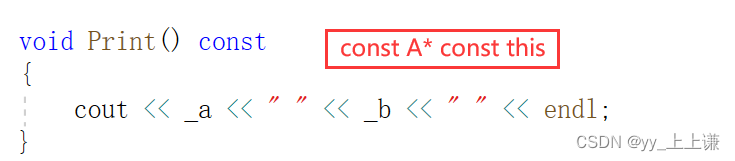
正确的做法应该是将this的指针用const修饰,但是又因为this指针是隐式的所以C++新增了一个语法就是在成员函数后面直接加上const,表示给this指针的类型修改成 :const 类类型* const this
补充:
如果声明和定义分离,那么声明和定义都要加上const。
3.2 加const的应用场景:
补充:
int a = 10; int* const pa = &a; int* pb = pa;- 1
- 2
- 3
上述写法是允许的,只是赋值。
int a = 10; const int* pa = &a; int* pb = pa;- 1
- 2
- 3
上述写法是不允许的,因为&a是int* 类型的指针,但是const int*类型的指针是不能通过指针修改指针指向的内容的,两者是有区别的。
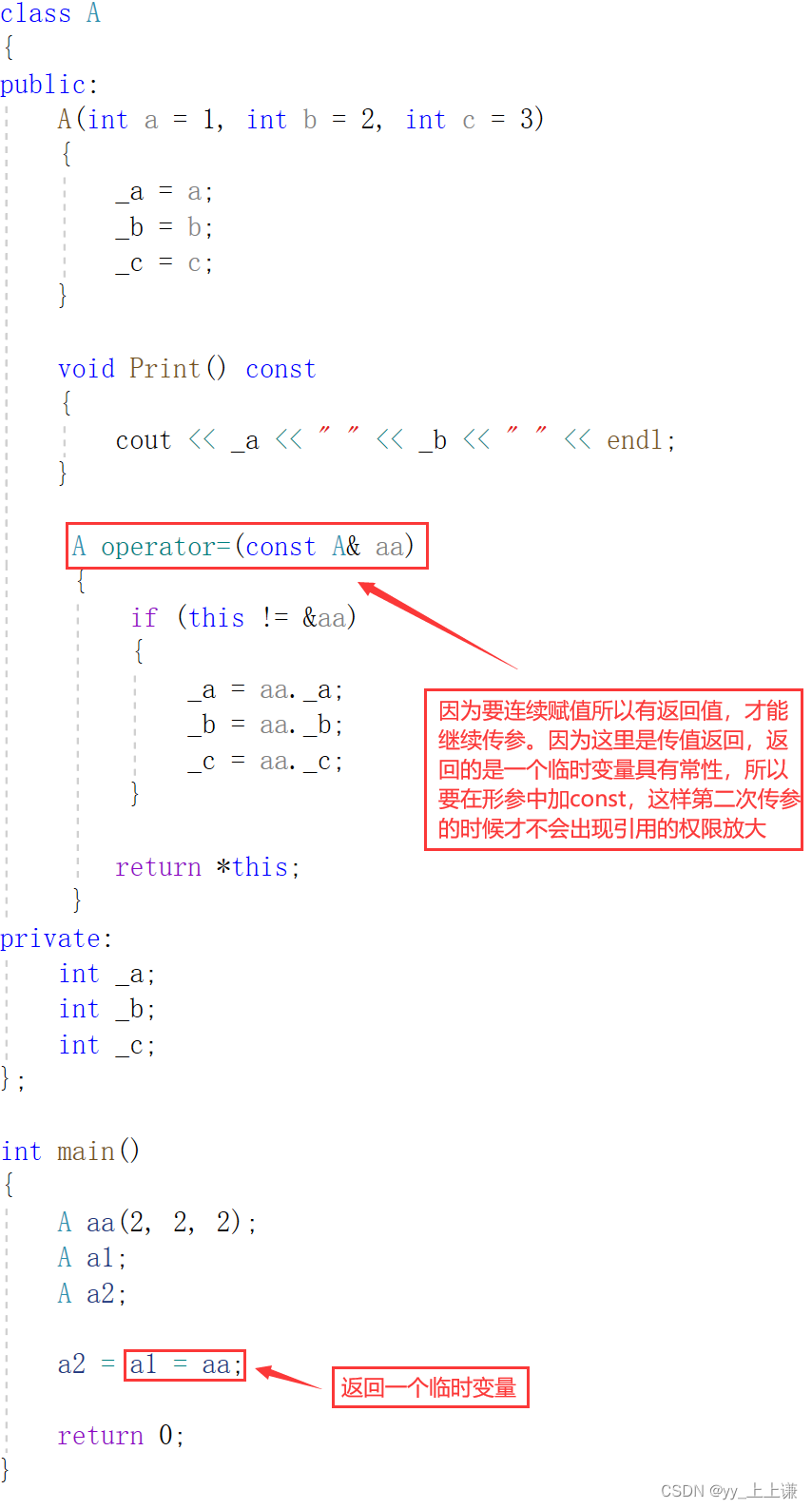

综上所述:如果传参的值是不希望被修改的就要考虑加上const加以保护,同时还要考虑连续运算符中返回值产生临时变量的问题,也是const该用到的地方。
4. 初始化列表
4.1 初始化列表的引入:
1.每一个对象都有自己的空间,成员变量是属于某个对象的,对象是整体定义的,而里面的成员变量是什么时候定义的呢?
- 成员变量是在初始化列表定义的
2.再次理解构造函数:
- 虽然上述构造函数调用之后,对象中已经有了一个初始值,但是不能将其称为对对象中成员变量的初始化。
- 构造函数体中的语句只能将其称为赋初值,而不能称作初始化。因为初始化只能初始化一次,而构造函数体内可以多次赋值。
3.必须在定义的时候初始化的值:
- 引用成员变量
- const成员变量
- 自定义类型成员(且该类没有默认构造函数时)
注意:类中包含以上成员,必须放在初始化列表位置进行初始化
初始化列表可以认为就是对象成员变量定义的地方,并且尽量要在初始化列表初始化。
4.2 初始化列表的使用:
- 初始化列表:以一个冒号开始,接着是一个以逗号分隔的数据成员列表,每个"成员变量"后面跟一个放在括号中的初始值或表达式。
int value = 1; class B { public: B(int a = 0) { _a = a; } private: int _a; }; class A { public: A() :_b(2) ,bb(1) ,_ref(value) { _a = 1; } private: //可以定义时初始化 //也可以定义时不初始化,后面再赋值修改 int _a; //下面的只能在定义的时候初始化 int& _ref; const int _b; B bb; }; int main() { A aa; return 0; }- 1
- 2
- 3
- 4
- 5
- 6
- 7
- 8
- 9
- 10
- 11
- 12
- 13
- 14
- 15
- 16
- 17
- 18
- 19
- 20
- 21
- 22
- 23
- 24
- 25
- 26
- 27
- 28
- 29
- 30
- 31
- 32
- 33
- 34
- 35
- 36
- 37
- 38
- 39
- 40
- 41
如下代码:
- 如果MyQueue这个类构造函数不写,编译器会生成一个默认构造函数
- 该默认构造对于内置类型不处理,对于自定义类型处理调用该类型的默认构造
如果写了默认构造但是却不对自定义类型处理,但是调试的过程中会发现,编译器还是对内置类型进行了处理。
为什么显式写的构造函数中没有写自定义类型的构造函数,但是还是对自定义类型进行处理了呢?- 这是因为所有的构造函数都走了一遍初始化列表
- 初始化列表显式初始化了某个成员,它就会被初始化
- 如果没有显式的写,也会被初始化
- 只是对内置类型没有值去初始化,自定义类型会去调用它的构造函数
class Stack { public: Stack(int capacity = 0) { _a = (int*)malloc(sizeof(int) * capacity); assert(_a); _top = 0; _capacity = capacity; } private: int* _a; int _top; int _capacity; }; class MyQueue { MyQueue() {} private: Stack _st1; Stack _st2; int _size = 0; //缺省值,给初始化列表用的 }; int main() { MyQueue mq; return 0; }- 1
- 2
- 3
- 4
- 5
- 6
- 7
- 8
- 9
- 10
- 11
- 12
- 13
- 14
- 15
- 16
- 17
- 18
- 19
- 20
- 21
- 22
- 23
- 24
- 25
- 26
- 27
- 28
- 29
- 30
- 31
- 32
- 33
5. static修饰成员变量和成员函数
5.1 static修饰的特性:
- 声明为static的类成员称为类的静态成员,用static修饰的成员变量,称之为静态成员变量
- 用static饰的成员函数,称之为静态成员函数
- 静态成员变量一定要在类外进行初始化
- 静态成员变量属于这个类,可以用指定类域去访问,不需要对象,也可以是属于任何一个对象
- 静态成员变量可以认为是类共享的
5.2 static在类中的应用场景:
面试题:实现一个类,计算程序中创建出了多少个类对象。
class A { public: A() { ++_scount; } A(const A& t) { ++_scount; } ~A() { --_scount; } static int GetACount() { return _scount; } private: //声明 static int _scount; }; //定义 int A::_scount = 0; int main() { cout << A::GetACount() << endl; A a1, a2; A a3(a1); cout << A::GetACount() << endl; return 0; }- 1
- 2
- 3
- 4
- 5
- 6
- 7
- 8
- 9
- 10
- 11
- 12
- 13
- 14
- 15
- 16
- 17
- 18
- 19
- 20
- 21
- 22
- 23
- 24
- 25
- 26
- 27
- 28
- 29
- 30
- 31
- 32
- 33
- 34
- 35
- 36
int A::_scount = 0:
- 在main函数之前就创建好了,生命周期是全局的
- 全局的静态,函数里面局部的静态,类里面的静态,生命周期都是全局的
只是全局的静态他的作用域是全局的,在全局任何地方都能使用
局部的静态只能在函数里面使用,类的静态,只能在类里面使用,或者说指定类域,去类域里面找可以访问。总结:
- 静态成员为所有类对象所共享,不属于某个具体的对象,存放在静态区
- 静态成员变量必须在类外定义,定义时不添加static关键字,类中只是声明
- 类静态成员即可用 类名::静态成员 或者 对象.静态成员 来访问
- 静态成员函数没有隐藏的this指针,不能访问任何非静态成员
- 静态成员也是类的成员,受public、protected、private 访问限定符的限制
6. 友元
6.1 友元的引入:
- 友元提供了一种突破封装的方式,有时提供了便利。但是友元会增加耦合度,破坏了封装,所以友元不宜多用。
- 友元分为:友元函数和友元类
- 友元函数可以直接访问类的私有成员,它是定义在类外部的普通函数,不属于任何类,但需要在类的内部声明,声明时需要加friend关键字。
6.2 友元的使用:
#includeusing namespace std; class Date { friend ostream& operator<<(ostream& _cout, const Date& d); friend istream& operator>>(istream& _cin, Date& d); public: Date(int year = 1900, int month = 1, int day = 1) : _year(year) , _month(month) , _day(day) {} private: int _year; int _month; int _day; }; ostream& operator<<(ostream& _cout, const Date& d) { _cout << d._year << "-" << d._month << "-" << d._day; return _cout; } istream& operator>>(istream& _cin, Date& d) { _cin >> d._year; _cin >> d._month; _cin >> d._day; return _cin; } int main() { Date d; cin >> d; cout << d << endl; return 0; } - 1
- 2
- 3
- 4
- 5
- 6
- 7
- 8
- 9
- 10
- 11
- 12
- 13
- 14
- 15
- 16
- 17
- 18
- 19
- 20
- 21
- 22
- 23
- 24
- 25
- 26
- 27
- 28
- 29
- 30
- 31
- 32
- 33
- 34
- 35
注意:
- 友元函数可访问类的私有和保护成员,但不是类的成员函数
- 友元函数不能用const修饰
- 友元函数可以在类定义的任何地方声明,不受类访问限定符限制
- 一个函数可以是多个类的友元函数
- 友元函数的调用与普通函数的调用原理相同
6.3 友元类:
- 友元类的所有成员函数都可以是另一个类的友元函数,都可以访问另一个类中的非公有成员。
- 友元关系是单向的,不具有交换性。
友元关系不能传递:
- 如果B是A的友元,C是B的友元,则不能说明C时A的友元。
- 友元关系不能继承,在继承位置再给大家详细介绍
-
相关阅读:
CocoaPods podfile 文件配置
CsPbI3钙钛矿量子点 CsPbI3 QDs发射波长670±10nm
40-Java方法重载、return关键字的单独使用
JavaGUI------------常用的组件(标签、按钮)
JVM 内存结构
vue之封装预约类组件
Java项目:JSP的电影院售票系统(含论文、任务书、中期检查表)
WPF Border控件 基本使用
找不到VCRUNTIME140_1.dll怎么办,VCRUNTIME140_1.dll丢失的5个解决方法
计算机竞赛 机器视觉 opencv 深度学习 驾驶人脸疲劳检测系统 -python
- 原文地址:https://blog.csdn.net/m0_63059866/article/details/126083775
