-
接口隔离原则(Interface Segregation Principle)
基本介绍:
1.客户端不应该依赖它不需要的接口,即一个类对另一个类的依赖应该建立在最小的接口上举例:

上图 类A通过接口Interface1依赖类B 类C通过Interface1依赖类D,如果Interface1对于类A和类C来说不是最小接口,那么类B和类D必须去实现他们不需要的方法按照接口隔离原则应当这样处理:
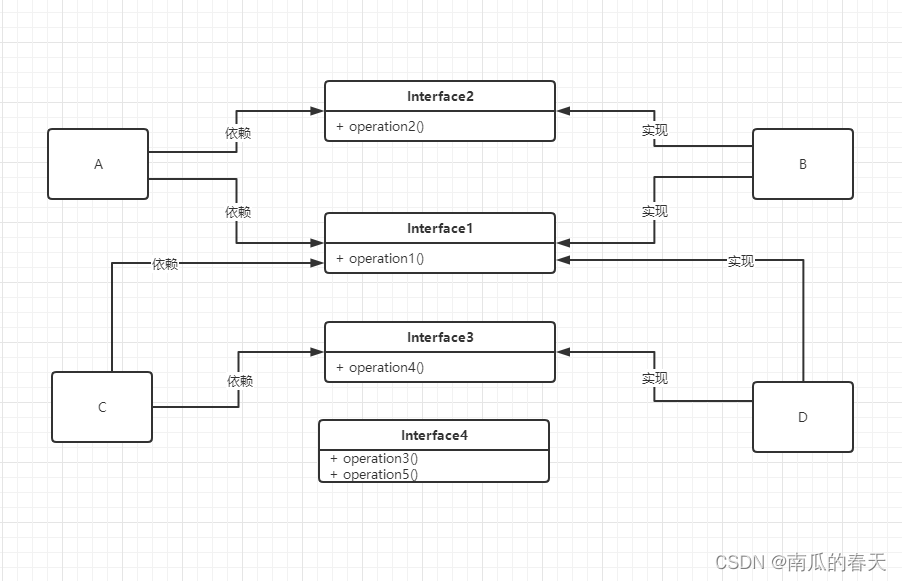
将接口Interface1拆分成独立的几个接口,类A和类C分别与他们所需要的接口建立依赖关系,也就是采用接口隔离原则package designPattern; //接口隔离 public class Segregation { } interface interface1{ public void operation1(); public void operation2(); public void operation3(); public void operation4(); public void operation5(); } class B implements interface1{ @Override public void operation1() { System.out.println(this.getClass().getSimpleName()+"operation1"); } @Override public void operation2() { System.out.println(this.getClass().getSimpleName()+"operation2"); } @Override public void operation3() { System.out.println(this.getClass().getSimpleName()+"operation3"); } @Override public void operation4() { System.out.println(this.getClass().getSimpleName()+"operation4"); } @Override public void operation5() { System.out.println(this.getClass().getSimpleName()+"operation5"); } } class D implements interface1{ @Override public void operation1() { System.out.println(this.getClass().getSimpleName()+"operation1"); } @Override public void operation2() { System.out.println(this.getClass().getSimpleName()+"operation2"); } @Override public void operation3() { System.out.println(this.getClass().getSimpleName()+"operation3"); } @Override public void operation4() { System.out.println(this.getClass().getSimpleName()+"operation4"); } @Override public void operation5() { System.out.println(this.getClass().getSimpleName()+"operation5"); } } //A类通过Interface1接口依赖B类 但是只会用到1 2方法 class A{ public void depend1(interface1 i){ i.operation1(); } public void depend2(interface1 i){ i.operation2(); } } //C通过interface1依赖D类 但是只会用1 4方法 class C{ public void depend1(interface1 i){ i.operation1(); } public void depend4(interface1 i){ i.operation4(); } }- 1
- 2
- 3
- 4
- 5
- 6
- 7
- 8
- 9
- 10
- 11
- 12
- 13
- 14
- 15
- 16
- 17
- 18
- 19
- 20
- 21
- 22
- 23
- 24
- 25
- 26
- 27
- 28
- 29
- 30
- 31
- 32
- 33
- 34
- 35
- 36
- 37
- 38
- 39
- 40
- 41
- 42
- 43
- 44
- 45
- 46
- 47
- 48
- 49
- 50
- 51
- 52
- 53
- 54
- 55
- 56
- 57
- 58
- 59
- 60
- 61
- 62
- 63
- 64
- 65
- 66
- 67
- 68
- 69
- 70
- 71
- 72
- 73
- 74
- 75
- 76
- 77
- 78
- 79
- 80
- 81
- 82
- 83
- 84
应该将Interface1分离为几个独立接口
A和C类分别与他们需要的接口建立依赖
即下图
-
相关阅读:
QT day4
一个颜值功能双在线的Zookeeper可视化工具
QML中的模板方法模式
洞察运营机会的数据分析利器
【Log4j2】开发环境配置日志策略打印完整MyBatis语句到文件
【Java+LeetCode训练】binarySearch源码解析
Qt源码解读(一)Windows消息循环和事件循环机制
关于在pyomo框架下无法调用ipopt求解器解决方法
一文详解IP地址编码定义、分类、范围、类型
ssh框架的信阳市南湾湖旅游网站的设计与开发源码
- 原文地址:https://blog.csdn.net/qq_56892136/article/details/126021733
