-
算法笔记-第五章-大整数运算
大整数运算
一:使用数组存储整数的时候,整数的高位存储在数组的高位,整数的低位存储
在数组的低位
二:把整数按照字符串读入的时候,实际是逆序存储的,就是在读入数组的首需要翻转一下比如说12345存储在数组当中应该是54321
#include<stdio.h> #include<string.h> struct bign { int d[100];//这里需要获取大整数的长度,设置一个结构通 int len; bign() { memset(d, 0, sizeof(d));//在定义结构体之后,就需要初始化结构体 int len = 0; } }; bign change(char str[])//将字符串转化成bign { bign a; a.len = strlen(str); for (int i = 0; i < a.len; i++) { a.d[i] = str[a.len - i - 1] - '0'; } return a; } bign add(bign a, bign b) { bign c; int carry = 0;//这个是进位 for (int i = 0; i < a.len || i < b.len; i++) { int t = a.d[i] + b.d[i] + carry; a.d[c.len++] = t % 10; carry = t / 10; } if (carry != 0) { c.d[c.len++] = carry; } return c; } void print(bign a) { for (int i = a.len - 1; i > +0; i--) { printf("%d", a.d[i]); } } int main() { char str1[1000], str2[1000]; scanf_s("%s%s", str1, str2); bign a = change(str1); bign b = change(str2); print(add(a, b)); return 0; }- 1
- 2
- 3
- 4
- 5
- 6
- 7
- 8
- 9
- 10
- 11
- 12
- 13
- 14
- 15
- 16
- 17
- 18
- 19
- 20
- 21
- 22
- 23
- 24
- 25
- 26
- 27
- 28
- 29
- 30
- 31
- 32
- 33
- 34
- 35
- 36
- 37
- 38
- 39
- 40
- 41
- 42
- 43
- 44
- 45
- 46
- 47
- 48
- 49
- 50
- 51
- 52
- 53
- 54
- 55
- 56
- 57
- 58
- 59
- 60
- 61
- 62
- 63
- 64
- 65
- 66
- 67
- 68
大整数比较
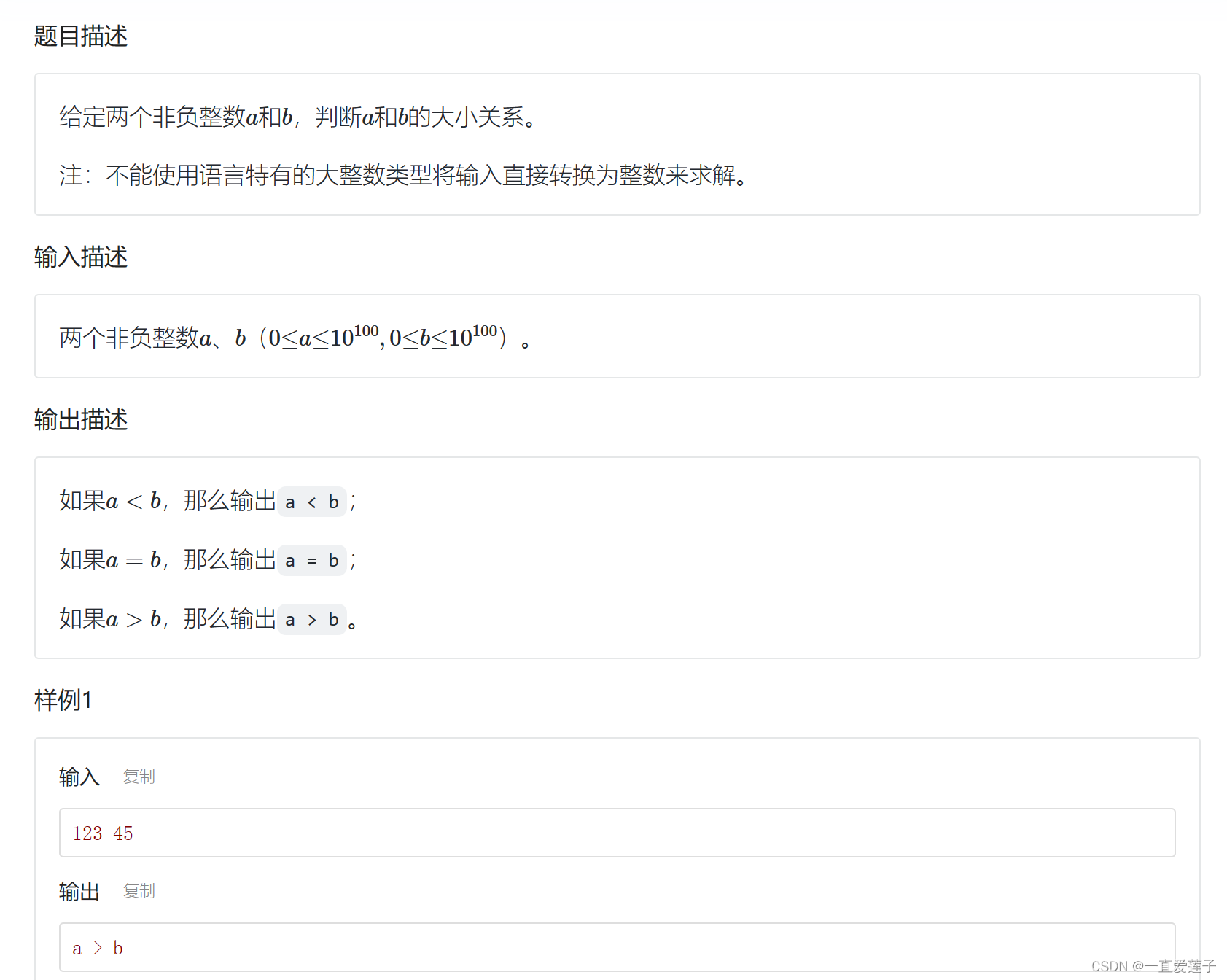

vector简单模拟大整数
typedef vector Bigint;
使用容器来存储
一个vector便可以模拟一个大整数,每位数字倒序储存在vector中
把大整数当作string输入#include <iostream> #include <vector> #include <string> #include <algorithm> using namespace std; typedef vector<int> BigInt; BigInt toBigInt(string nums) { BigInt result; for (int i = (int)nums.length() - 1; i >= 0; i--) { result.push_back(nums[i] - '0'); } return result; } int compare(BigInt a, BigInt b) { if (a.size() > b.size()) { return 1; } else if (a.size() < b.size()) { return -1; } else { for (int i =- 1
- 2
- 3
- 4
- 5
- 6
- 7
- 8
- 9
- 10
- 11
- 12
- 13
- 14
- 15
- 16
- 17
- 18
- 19
- 20
- 21
- 22
- 23
- 24
- 25
- 26
- 27
- 28
- 29
- 30
-
相关阅读:
Delphi 11.3 FMX 服务器提取数据,等待窗口
程序包com.sun.xml.internal.bind.marshaller不存在
【大语言模型基础】图解GPT原理-60行numpy实现GPT
Hudi Spark SQL源码学习总结-CTAS
怎么办理水污染防治资质,水污染防治工程设计专项乙级办理条件有哪些
open函数的应用
【每日渗透笔记】后台弱口令+未授权尝试
kubernetes 实战学习
Springboot 集成 nacos (小白已测)
barzilar_borwein算法微调函数的优化收敛
- 原文地址:https://blog.csdn.net/yihoujian_2003/article/details/134421949
