-
算法:强连通分量(SCC) Tarjan算法
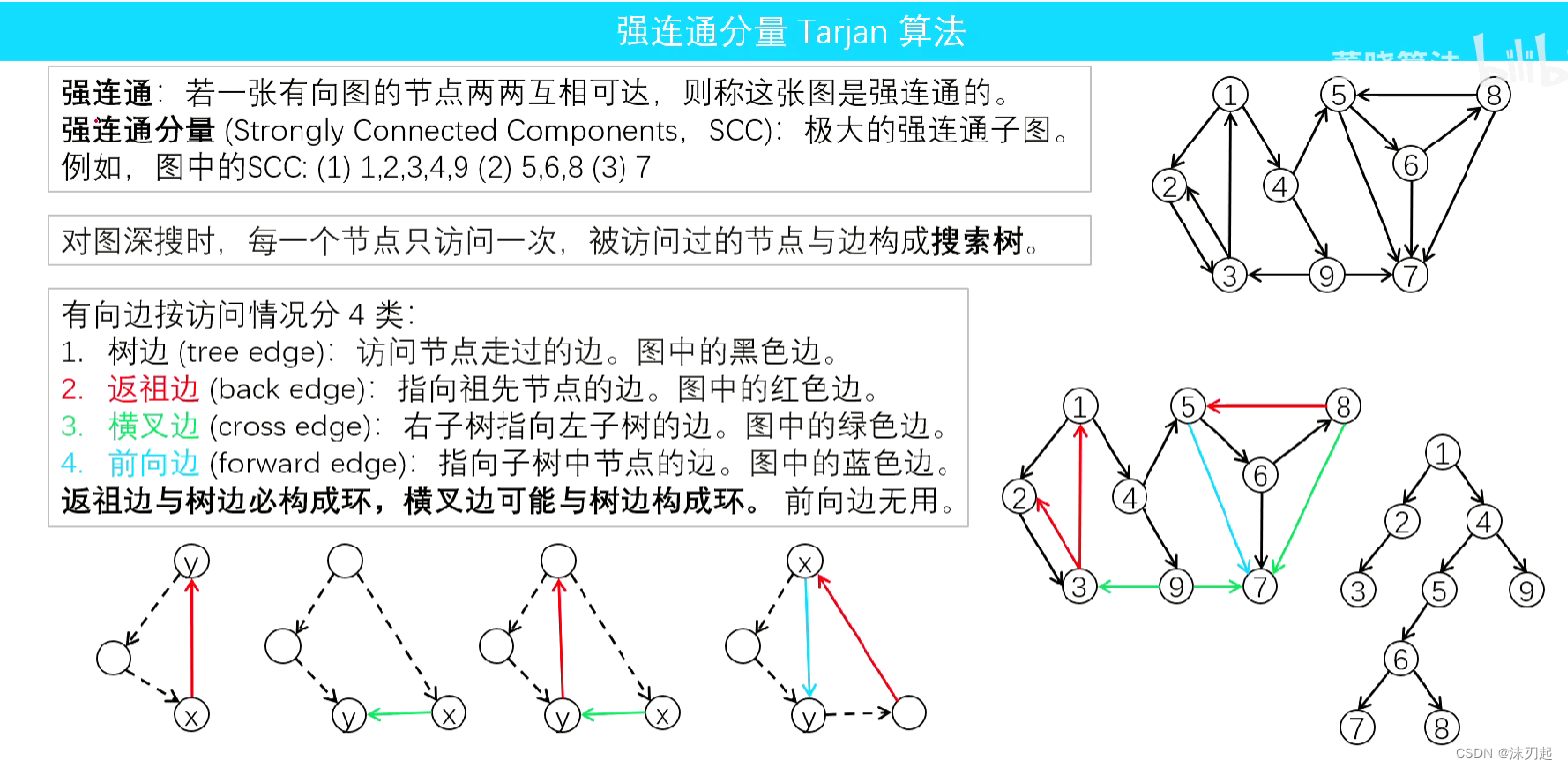
强连通分量,不能再加任何一个点了,再加一个点就不是强连通了


- vector<int>e[N];
- int dfn[N],low[N],tot;
- bool instk[N];
- int scc[N],siz[N],cnt;
- void tarjan(int x){
- //入x时,盖戳,入栈
- dfn[x]=low[x]=++tot;
- q.push(x);
- instk[x]=true;
- for(auto y:e[x]){
- if(!dfn[y]){//若y尚未访问
- tarjan(y);
- low[x]=min(low[x],low[y]);//回x时更新low
- }
- else if(instk[y]){//若y已被访问且在栈中
- low[x]=min(low[x],dfn[y]);//更新low
- }
- }
- //离x时,记录SCC
- if(dfn[x]==low[x]){//若x是SCC的根
- int y;
- cnt++;
- do{
- y=q.top();
- q.pop();
- instk[y]=false;
- scc[y]=cnt;//SCC编号
- siz[cnt]++;//SCC大小
- }while(y!=x);
- }
- }
[USACO06JAN] The Cow Prom S - 洛谷
AC代码:
- #include
- #define endl '\n'
- #define int long long
- using namespace std;
- const int N=1e4+10;
- int dfn[N],low[N],tot;
- bool instk[N];
- int siz[N],cnt;
- stack<int>q;
- vector
- int n,m;
- void tarjan(int x){
- dfn[x]=low[x]=++tot;
- q.push(x);
- instk[x]=true;
- for(auto v:e[x]){
- if(!dfn[v]){
- tarjan(v);
- low[x]=min(low[x],low[v]);
- }
- else if(instk[v]){
- low[x]=min(low[x],dfn[v]);
- }
- }
- if(dfn[x]==low[x]){
- int y;
- cnt++;
- do{
- y=q.top();
- q.pop();
- instk[y]=false;
- siz[cnt]++;
- }while(y!=x);
- }
- }
- void solve() {
- cin>>n>>m;
- while(m--){
- int a,b;
- cin>>a>>b;
- e[a].push_back(b);
- }
- for(int i=1;i<=n;i++){
- if(!dfn[i]) tarjan(i);
- }
- int ans=0;
- for(int i=1;i<=cnt;i++){
- if(siz[i]>1) ans++;
- }
- cout<}signed main() {ios::sync_with_stdio(false);cin.tie(0);cout.tie(0);int t=1;// cin>>t;while(t--) {solve();}return 0;}
Trajan SCC缩点


我们加边的时候让出度为0的点指向入度为0的点,那么只要max(din,dout)即可
AC代码:
- #include
- #define endl '\n'
- #define int long long
- using namespace std;
- const int N=1e4+10;
- int dfn[N],low[N],tot;
- bool instk[N];
- int scc[N],cnt;
- int din[N],dout[N];//SCC的入度,出度
- int n;
- vector
- stack<int>q;
- void tarjan(int x){
- dfn[x]=low[x]=++tot;
- q.push(x);
- instk[x]=true;
- for(auto v:e[x]){
- if(!dfn[v]){
- tarjan(v);
- low[x]=min(low[x],low[v]);
- }
- else if(instk[v]){
- low[x]=min(low[x],dfn[v]);
- }
- }
- if(dfn[x]==low[x]){
- int y;
- cnt++;
- do{
- y=q.top();
- q.pop();
- instk[y]=false;
- scc[y]=cnt;
- }while(y!=x);
- }
- }
- void solve() {
- cin>>n;
- for(int i=1,a;i<=n;i++){
- cin>>a;
- while(a){
- e[i].push_back(a);
- cin>>a;
- }
- }
- for(int i=1;i<=n;i++){
- if(!dfn[i]) tarjan(i);//一些点可能走不到,即图不连通
- }
- for(int x=1;x<=n;x++){//枚举n个点
- for(int y:e[x]){//枚举点x的邻边,x指向y
- if(scc[x]!=scc[y]){//如果x和y所在的强连通分量不一样,即不在同一个强连通分量之内
- din[scc[y]]++;//y所在的强连通分量的入度++
- dout[scc[x]]++;//x所在的强连通分量的出度++
- }
- }
- }
- int a=0,b=0;
- for(int i=1;i<=cnt;i++){
- if(!din[i]) a++;//a表示缩点后入度为0的个数
- if(!dout[i]) b++;//b表示缩点后出度为0的个数
- }
- cout<if(cnt==1) cout<<0<else cout<<max(a,b)<}signed main() {ios::sync_with_stdio(false);cin.tie(0);cout.tie(0);int t=1;// cin>>t;while(t--) {solve();}return 0;}
[USACO03FALL / HAOI2006] 受欢迎的牛 G - 洛谷
 AC代码:
AC代码:- #include
- #define endl '\n'
- #define int long long
- using namespace std;
- const int N=1e4+10;
- int dfn[N],low[N],tot;
- bool instk[N];
- int scc[N],siz[N];
- int cnt;
- int dout[N];
- vector
- stack<int>q;
- int n,m;
- void tarjan(int x){
- dfn[x]=low[x]=++tot;
- q.push(x);
- instk[x]=true;
- for(auto v:e[x]){
- if(!dfn[v]){
- tarjan(v);
- low[x]=min(low[x],low[v]);
- }
- else if(instk[v]){
- low[x]=min(low[x],dfn[v]);
- }
- }
- if(dfn[x]==low[x]){
- int y;
- cnt++;
- do{
- y=q.top();
- q.pop();
- instk[y]=false;
- scc[y]=cnt;
- siz[cnt]++;
- }while(y!=x);
- }
- }
- void solve() {
- cin>>n>>m;
- for(int i=0;iint a,b;cin>>a>>b;e[a].push_back(b);}for(int i=1;i<=n;i++){if(!dfn[i]) tarjan(i);}for(int x=1;x<=n;x++){for(auto y:e[x]){if(scc[x]!=scc[y]){dout[scc[x]]++;}}}int sum=0;int cnt1=0;for(int i=1;i<=cnt;i++){if(dout[i]==0){sum=siz[i];cnt1++;}}if(cnt1>1) sum=0;cout<}signed main() {ios::sync_with_stdio(false);cin.tie(0);cout.tie(0);int t=1;// cin>>t;while(t--) {solve();}return 0;}
先缩点转化成一个无环图

团号逆序是拓扑序,因为我们给强连通分量标号的时候是从1开始标的,于是团号小的在拓扑序的末端,这样从大到小枚举团号即为拓扑序,保证是线性的,这样dp的话才能满足无后效性
AC代码:
- #include
- #define endl '\n'
- #define int long long
- using namespace std;
- const int N=1e4+10;
- int dfn[N],low[N],tot;
- bool instk[N];
- int scc[N],cnt;
- int w[N],nw[N];
- int n,m;
- vector
- stack<int>q;
- int dp[N];
- void tarjan(int x){
- dfn[x]=low[x]=++tot;
- q.push(x);
- instk[x]=true;
- for(auto v:e[x]){
- if(!dfn[v]){
- tarjan(v);
- low[x]=min(low[x],low[v]);
- }
- else if(instk[v]){
- low[x]=min(low[x],dfn[v]);
- }
- }
- if(dfn[x]==low[x]){
- int y;
- cnt++;
- do{
- y=q.top();
- q.pop();
- instk[y]=false;
- scc[y]=cnt;
- }while(y!=x);
- }
- }
- void solve() {
- cin>>n>>m;
- for(int i=1;i<=n;i++) cin>>w[i];
- for(int i=0;iint a,b;cin>>a>>b;e[a].push_back(b);}for(int i=1;i<=n;i++){if(!dfn[i]) tarjan(i);}for(int x=1;x<=n;x++){nw[scc[x]]+=w[x];//新点的权值for(int y:e[x]){if(scc[x]!=scc[y]){ne[scc[x]].push_back(scc[y]);}}}//缩点后建拓扑图for(int x=cnt;x>=1;x--){if(dp[x]==0){//若x为路的起点dp[x]=nw[x];}for(auto y:ne[x]){dp[y]=max(dp[y],dp[x]+nw[y]);}}int ans=0;for(int i=1;i<=cnt;i++) ans=max(ans,dp[i]);//可能图不连通,有多个强连通分量cout<}signed main() {ios::sync_with_stdio(false);cin.tie(0);cout.tie(0);int t=1;// cin>>t;while(t--) {solve();}return 0;}
-
相关阅读:
早上空腹喝水,比不吃早餐更伤胃?起床后先做2件事
唤起testFlight、唤起AppStore
Django实现Hello World
CocosCreator接入wwise的CocosAndroid.mk
云服务器安装宝塔面板,如何对高并发大流量网站的优化方法
拿下跨界C1轮投资,本土Tier 1高阶智能驾驶系统迅速“出圈”
webpack配置自动压缩图片
基本微信小程序的外卖点餐订餐平台
Android进阶宝典 -- 手写RecyclerView分页组件
ElasticSearch学习(四):的增删改查、高亮、聚合、别名、重建索引
- 原文地址:https://blog.csdn.net/m0_74087709/article/details/133579545