-
LeetCode - Medium - 63. Unique Paths II
Topic
- Array
- Dynamic Programming
- Matrix
Description
You are given an
m x ninteger arraygrid. There is a robot initially located at the top-left corner (i.e.,grid[0][0]). The robot tries to move to the bottom-right corner (i.e.,grid[m - 1][n - 1]). The robot can only move either down or right at any point in time.An obstacle and space are marked as
1or0respectively ingrid. A path that the robot takes cannot include any square that is an obstacle.Return the number of possible unique paths that the robot can take to reach the bottom-right corner.
The testcases are generated so that the answer will be less than or equal to
2 * 109.Example 1:
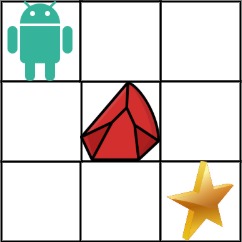
Input: obstacleGrid = [[0,0,0],[0,1,0],[0,0,0]] Output: 2 Explanation: There is one obstacle in the middle of the 3x3 grid above. There are two ways to reach the bottom-right corner: 1. Right -> Right -> Down -> Down 2. Down -> Down -> Right -> Right- 1
- 2
- 3
- 4
- 5
- 6
Example 2:

Input: obstacleGrid = [[0,1],[0,0]] Output: 1- 1
- 2
Constraints:
m == obstacleGrid.lengthn == obstacleGrid[i].length1 <= m, n <= 100obstacleGrid[i][j]is0or1.
Analysis
方法二:动态规划(一维数组)(我写的)
Submissions
public class UniquePathsII { //方法一:动态规划(二维数组) public int uniquePathsWithObstacles(int[][] obstacleGrid) { int m = obstacleGrid.length, n = obstacleGrid[0].length; int[][] dp = new int[m][n]; for (int i = 0; i < m && obstacleGrid[i][0] == 0; i++) { dp[i][0] = 1; } for (int j = 0; j < n && obstacleGrid[0][j] == 0; j++) { dp[0][j] = 1; } for (int i = 1; i < m; i++) { for (int j = 1; j < n; j++) { if (obstacleGrid[i][j] == 1) continue; dp[i][j] = dp[i - 1][j] + dp[i][j - 1]; } } return dp[m - 1][n - 1]; } //方法二:动态规划(一维数组) public int uniquePathsWithObstacles2(int[][] obstacleGrid) { int m = obstacleGrid.length, n = obstacleGrid[0].length; int[] dp = new int[n]; int firstRowBlockIndex = n, firstColBlockIndex = m; for(int i = 0; i < m; i++) { for(int j = 0; j < n; j++) { if(obstacleGrid[i][j] == 1) { if(i == 0 && firstRowBlockIndex == n) { firstRowBlockIndex = j; } if(j == 0 && firstColBlockIndex == m) { firstColBlockIndex = i; } dp[j] = 0; continue; } if(i == 0 || j == 0) { dp[j] = (i == 0 && j >= firstRowBlockIndex || j == 0 && i >= firstColBlockIndex) ? 0 : 1; }else if(j > 0){ dp[j] += dp[j - 1]; } } } return dp[n - 1]; } }- 1
- 2
- 3
- 4
- 5
- 6
- 7
- 8
- 9
- 10
- 11
- 12
- 13
- 14
- 15
- 16
- 17
- 18
- 19
- 20
- 21
- 22
- 23
- 24
- 25
- 26
- 27
- 28
- 29
- 30
- 31
- 32
- 33
- 34
- 35
- 36
- 37
- 38
- 39
- 40
- 41
- 42
- 43
- 44
- 45
- 46
- 47
- 48
- 49
- 50
- 51
- 52
- 53
- 54
- 55
- 56
- 57
- 58
Test
import static org.junit.Assert.*; import org.junit.Test; public class UniquePathsIITest { @Test public void test() { UniquePathsII uObj = new UniquePathsII(); assertEquals(2, uObj.uniquePathsWithObstacles(new int[][] {{0,0,0},{0,1,0},{0,0,0}})); assertEquals(1, uObj.uniquePathsWithObstacles(new int[][] {{0,1},{0,0}})); assertEquals(2, uObj.uniquePathsWithObstacles2(new int[][] {{0,0,0},{0,1,0},{0,0,0}})); assertEquals(1, uObj.uniquePathsWithObstacles2(new int[][] {{0,1},{0,0}})); } }- 1
- 2
- 3
- 4
- 5
- 6
- 7
- 8
- 9
- 10
- 11
- 12
- 13
- 14
- 15
- 16
- 17
-
相关阅读:
Elasticsearch的基本介绍
冥想第四百九十三天
神经网络--感知机
消息中间件篇之RabbitMQ-消息不丢失
LVGL V8.2字符串显示在Keil MDK上需要注意的事项(以小熊派为例)
漏洞复现-蓝凌LandrayOA系列
已分割的视频怎么合并
`数学` 关系relation
css盒子模型——边框 border
ios面试准备 - 网络篇
- 原文地址:https://blog.csdn.net/u011863024/article/details/128213674
