-
ShardingJdbcⅡ
序言
在前文的基础上继续梳理一下分片的相关信息.基于shardingsphere-sharding-api:jar:5.2.1的源码,感觉ShardingJdbc的版本变动频繁且比较大cuiyaonan2000@163.com
切入口是如下的内容,吐槽下官网的API文档不太够能把事情说清楚:

分片算法
从上面的自定义分片的可选类型我们就知道了,也不是完全的自定义,还是要按照官网的要求来操作的,能选择自定义分片策略只有STANDARD,COMPLEX,HINT这3中类型的自定义策略,对应到代码上就是如下的内容;

如上的接口限制了我们能够自定分片策略的范围.如下就是ShardingJdbc内置的一些分片算法了,这些算法都是实现了上面的接口cuiyaonan2000@163.com
官网也有一个列表展示了所有的内置算法类: 数据分片 :: ShardingSphere

InlineShardingAlgorithm
我们以STANDARD类型的InlineShardingAlgorithm算法为引子来看一下,它的实现.
首先它实现了StandardShardingAlgorithm接口,表示他是Standard类型的算法.
- /*
- * Licensed to the Apache Software Foundation (ASF) under one or more
- * contributor license agreements. See the NOTICE file distributed with
- * this work for additional information regarding copyright ownership.
- * The ASF licenses this file to You under the Apache License, Version 2.0
- * (the "License"); you may not use this file except in compliance with
- * the License. You may obtain a copy of the License at
- *
- * http://www.apache.org/licenses/LICENSE-2.0
- *
- * Unless required by applicable law or agreed to in writing, software
- * distributed under the License is distributed on an "AS IS" BASIS,
- * WITHOUT WARRANTIES OR CONDITIONS OF ANY KIND, either express or implied.
- * See the License for the specific language governing permissions and
- * limitations under the License.
- */
- package org.apache.shardingsphere.sharding.api.sharding.standard;
- import org.apache.shardingsphere.sharding.spi.ShardingAlgorithm;
- import java.util.Collection;
- /**
- * Standard sharding algorithm.
- *
- * @param
class type of sharding value - */
- public interface StandardShardingAlgorithm
extends Comparable> extends ShardingAlgorithm { - /**
- * Sharding.
- *
- * @param availableTargetNames available data sources or table names
- * @param shardingValue sharding value
- * @return sharding result for data source or table name
- */
- String doSharding(Collection
availableTargetNames, PreciseShardingValue ;shardingValue) - /**
- * Sharding.
- *
- * @param availableTargetNames available data sources or table names
- * @param shardingValue sharding value
- * @return sharding results for data sources or table names
- */
- Collection
doSharding(Collection availableTargetNames, RangeShardingValue ;shardingValue) - }
如上就是Standard类型的算法需要实现的接口了,通过我们小学六年级英语可以知道,这2个方法就是用来告诉程序,该选择哪个数据库或者哪个表的的主要方法cuiyaonan2000@163.com
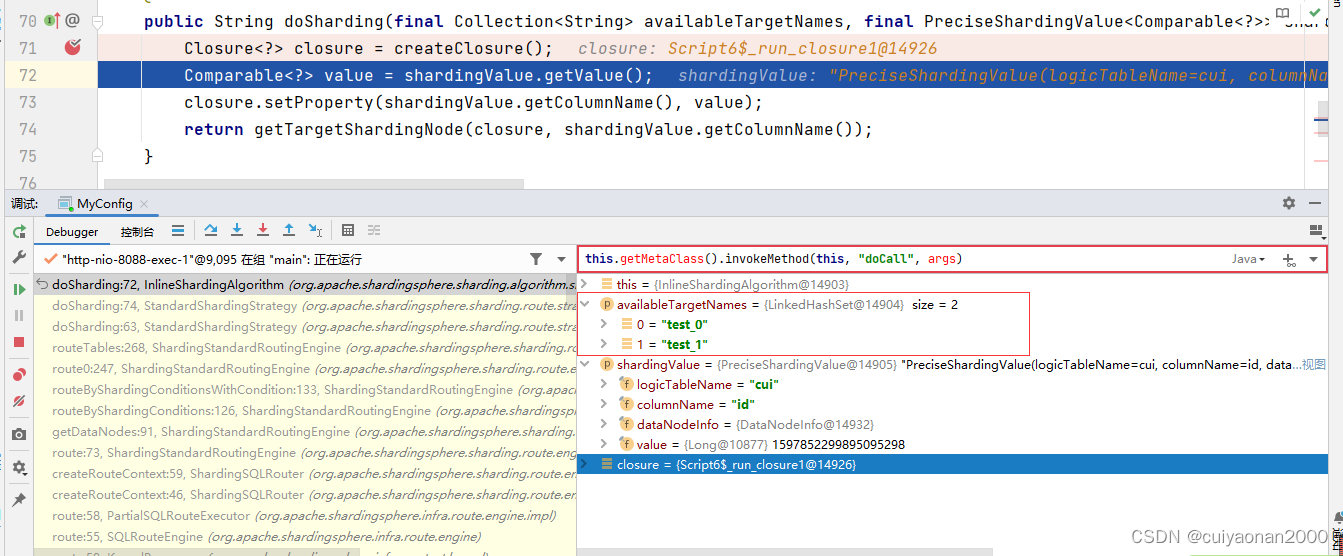
看一下示例,我们成功运行代码后打个断点看下里面的算法

由上可见:
-
availableTargetNames: 是可以选择数据库的名称,在我们配置文件设置的2个数据源m1和m2
-
shardingValue: 就是我们的分片字段信息,里面有针对逻辑表明cui,字段名称id,value:1597852299895095298是要插入的id的值.
同一个方法如上是针对分库的选择,如下分表的选择(就是同一个方法用来进行分库分表的选择)
-
相关阅读:
Hive 中的各种常用set设置
阿里云效 + jenkins配置自动构建测试环境
node.js,vue-cli,webpack-cli安装教程(集合和完善别人的文章,解决了按照他文章出现的问题的解决方法,学生必备)
ZooKeeper 8:请求处理逻辑与源码分析
Gradle系列——常用指令,修改gradle源,Wrapper包装器(源于文档7.5版本,SpringBoot使用)day1-2
转载)word输出高分辨PDF并且有链接跳转功能
货币系统(求方案数的背包)
UE4 回合游戏项目 19- 添加血量UI
10 nginx 中的 slab
开放智慧,助力学习——电大搜题,打开学无止境的新篇章
- 原文地址:https://blog.csdn.net/cuiyaonan2000/article/details/128115947