-
NNDL 作业10:第六章课后题(LSTM | GRU)
习题6-3 当使用公式(6.50)作为循环神经网络得状态更新公式时,分析其可能存在梯度爆炸的原因并给出解决办法.
令Zk= Uhk-1 + Wxk + b 为在第 k 时刻函数g(.) 的输入,在计算公式6.34中的误差项

时,梯度可能过大,从而导致梯度过大问题。
解决方法:增加门控机制,例如:使用长短期记忆神经网络。
习题6-4 推导LSTM网络中参数的梯度,并分析其避免梯度消失的效果

LSTM中通过门控机制解决梯度问题,遗忘门,输入门和输出门是非0就是1的,并且三者之间都是相加关系,梯度能够很好的在LSTM传递,减轻了梯度消失发生的概率,门为0时,上一刻的信息对当前时刻无影响,没必要接受传递更新参数了。习题6-5 推导GRU网络中参数的梯度,并分析其避免梯度消失的效果
GRU结构图:


GRU具有调节信息流动的门单元,但没有一个单独的记忆单元,GRU将输入门和遗忘门整合成一个升级门,通过门来控制梯度。这种门控的方式,让网络学会如何设置门控数值,来决定何时让梯度消失,何时保持梯度。
附加题 6-1P 什么时候应该用GRU? 什么时候用LSTM?
- GRU和LSTM的区别:
- LSTM利用输出门(output gate)可以选择性的使用细胞状态(cell state),而GRU总是不加选择的使用细胞状态
- LSTM利用更新门(update gate)可以独立控制加入多少新的“记忆”,与老“记忆”无关,而GRU对新“记忆”的加入会受老“记忆”的约束,老“记忆”留存越多新“记忆”加入越少。
- GRU的优点是其模型的简单性 ,因此更适用于构建较大的网络。它只有两个门控,从计算角度看,它的效率更高,它的可扩展性有利于构筑较大的模型;但是LSTM更加的强大和灵活,因为它具有三个门控。LSTM是经过历史检验的方法。
附加题 6-2P LSTM BP推导,并用Numpy实现
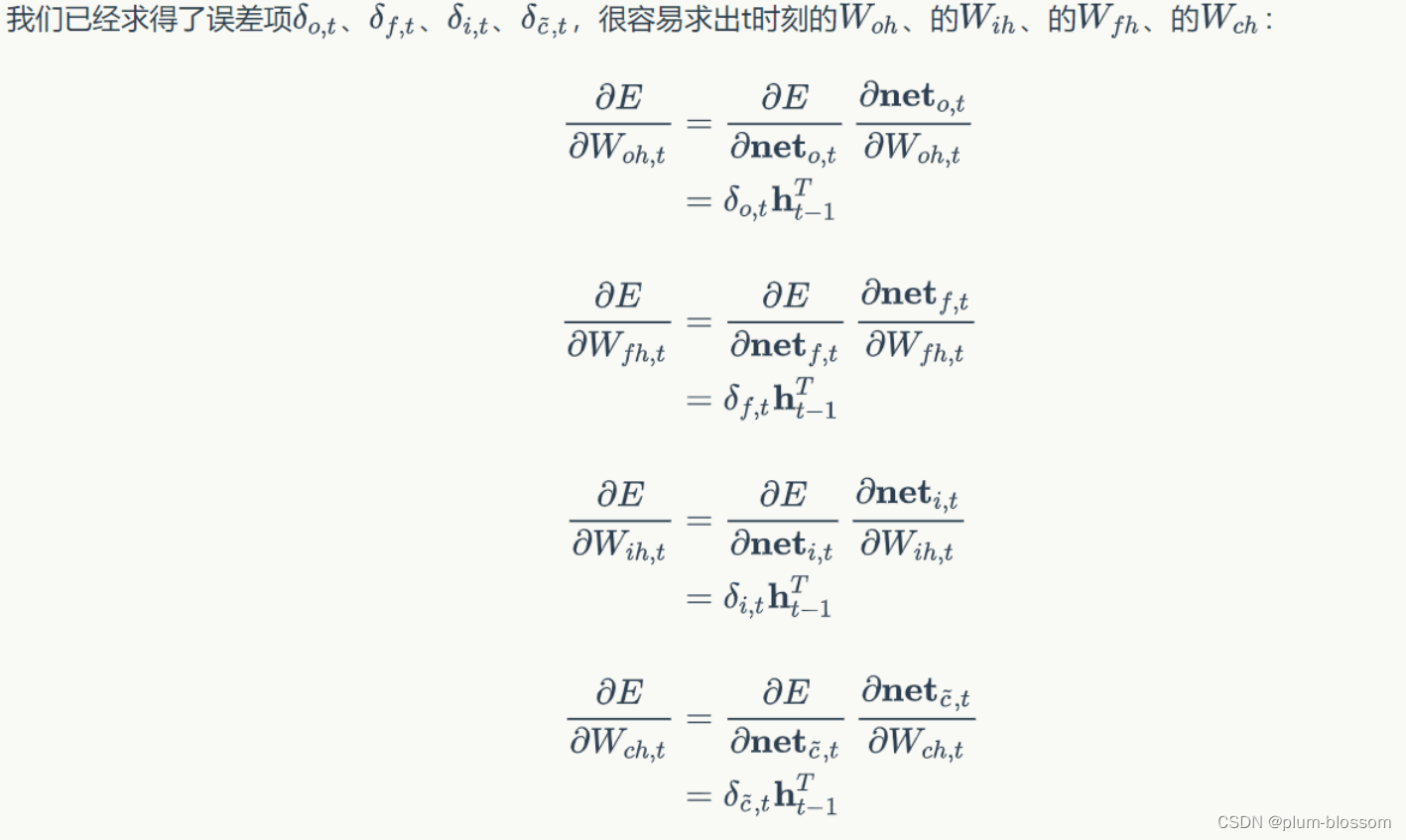
首先求出它们在t时刻的梯度,然后再求出他们最终的梯度。


import numpy as np def sigmoid(x): return 1/(1+np.exp(-x)) def softmax(x): e_x = np.exp(x-np.max(x))# 防溢出 return e_x/e_x.sum(axis=0) def LSTM_CELL_Forward(xt, h_prev, C_prev, parameters): # 获取参数字典中各个参数 Wf = parameters["Wf"] bf = parameters["bf"] Wi = parameters["Wi"] bi = parameters["bi"] Wc = parameters["Wc"] bc = parameters["bc"] Wo = parameters["Wo"] bo = parameters["bo"] Wy = parameters["Wy"] by = parameters["by"] # 获取 xt 和 Wy 的维度参数 n_x, m = xt.shape n_y, n_h = Wy.shape # 拼接 h_prev 和 xt concat = np.zeros((n_x + n_h, m)) concat[: n_h, :] = h_prev concat[n_h:, :] = xt # 计算遗忘门、输入门、记忆细胞候选值、下一时间步的记忆细胞、输出门和下一时间步的隐状态值 ft = sigmoid(np.dot(Wf, concat) + bf) it = sigmoid(np.dot(Wi, concat) + bi) cct = np.tanh(np.dot(Wc, concat) + bc) c_next = ft * C_prev + it * cct ot = sigmoid(np.dot(Wo, concat) + bo) h_next = ot * np.tanh(c_next) # LSTM单元的计算预测 yt_pred = softmax(np.dot(Wy, h_next) + by) return h_next, c_next, yt_pred np.random.seed(1) xt = np.random.randn(3,10) h_prev = np.random.randn(5,10) c_prev = np.random.randn(5,10) Wf = np.random.randn(5, 5+3) bf = np.random.randn(5,1) Wi = np.random.randn(5, 5+3) bi = np.random.randn(5,1) Wo = np.random.randn(5, 5+3) bo = np.random.randn(5,1) Wc = np.random.randn(5, 5+3) bc = np.random.randn(5,1) Wy = np.random.randn(2,5) by = np.random.randn(2,1) parameters = {"Wf": Wf, "Wi": Wi, "Wo": Wo, "Wc": Wc, "Wy": Wy, "bf": bf, "bi": bi, "bo": bo, "bc": bc, "by": by} h_next, c_next, yt = LSTM_CELL_Forward(xt, h_prev, c_prev, parameters) print("a_next[4] = ", h_next[4]) print("a_next.shape = ", c_next.shape) print("c_next[2] = ", c_next[2]) print("c_next.shape = ", c_next.shape) print("yt[1] =", yt[1]) print("yt.shape = ", yt.shape)- 1
- 2
- 3
- 4
- 5
- 6
- 7
- 8
- 9
- 10
- 11
- 12
- 13
- 14
- 15
- 16
- 17
- 18
- 19
- 20
- 21
- 22
- 23
- 24
- 25
- 26
- 27
- 28
- 29
- 30
- 31
- 32
- 33
- 34
- 35
- 36
- 37
- 38
- 39
- 40
- 41
- 42
- 43
- 44
- 45
- 46
- 47
- 48
- 49
- 50
- 51
- 52
- 53
- 54
- 55
- 56
- 57
- 58
- 59
- 60
- 61
- 62
- 63
- 64
- 65
- 66
- 67
- 68
运行结果:

参考
- GRU和LSTM的区别:
-
相关阅读:
怎么将PDF文件转换成图片呢?
管理团队相关的梳理
95-Java的对象序列化、反序列化
Git 的介绍、安装及其基本操作
OS2.3.2:进程互斥的软件实现方法
Python实现机器学习(下)— 数据预处理、模型训练和模型评估
JavaScript查找最长的公共前缀
leetcode 32. 最长有效括号
jni场景下c++代码种,编写jstring转char*
Linux常用命令——clockdiff命令
- 原文地址:https://blog.csdn.net/qq_51713698/article/details/128059972
