-
机器学习笔记 十七:基于Gini Importance、Permutation Importance、Boruta的随机森林模型重要性评估的比较
1. 随机森林模型拟合和预测性能
1.1 样本拆分
X = wine.drop('quality', axis = 1) y = wine['quality']- 1
- 2
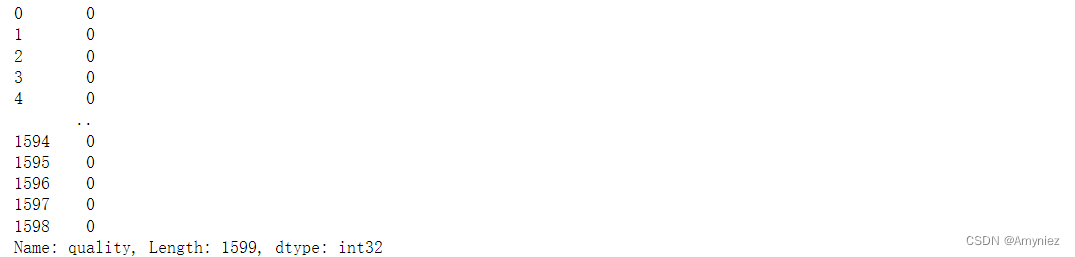
集合y:
df_train, df_test = train_test_split(wine, test_size=0.20) # random_state随机状态:保证每次分割的样本一致 df_train = df_train[list(wine.columns)] # 获取wine的列名:Index(['fixed acidity', 'volatile acidity', 'citric acid', 'residual sugar', # 'chlorides', 'free sulfur dioxide', 'total sulfur dioxide', 'density', # 'pH', 'sulphates', 'alcohol', 'quality'], df_test = df_test[list(wine.columns)] X_train, y_train = df_train.drop('quality',axis=1), df_train['quality'] X_test, y_test = df_test.drop('quality',axis=1), df_test['quality'] X_train.shape,y_train.shape,X_test.shape,y_test.shape- 1
- 2
- 3
- 4
- 5
- 6
- 7
- 8
- 9
- 10
- 11
((1279, 11), (1279,), (320, 11), (320,))
注意:
若random_state随机状态未设置,将出现下面的情况,即每次划分的结果不一致
1.2 模型拟合
参数解释:
- n_estimators : integer, optional (default=10) 整数,可选择(默认值为10)。 森林里决策树的数目。
- criterion : string, optional (default=”gini”) 字符串,可选择(默认值为“gini”)。衡量分裂质量的性能(函数)。
- min_samples_leaf : int, float, optional (default=1) 整数,浮点数,可选的(默认值为1)。需要在叶子结点上的最小样本数量:如果为int,那么考虑min_samples_leaf作为最小的数字。
- n_jobs : integer, optional (default=1) 整数,可选的(默认值为1)。用于拟合和预测的并行运行的工作(作业)数量。如果值为-1,那么工作数量被设置为核的数量。
- oob_score : bool (default=False) bool,(默认值为False)。是否使用袋外样本来估计泛化精度。
rf = RandomForestClassifier(n_estimators=200, min_samples_leaf=5, n_jobs=-1, oob_score=True, random_state=42) rf.fit(X_train, y_train)- 1
- 2
- 3
- 4
- 5
- 6
# 性能预测 print(classification_report(y_test, rf.predict(X_test)))- 1
- 2
结果显示:
precision recall f1-score support 0 0.91 0.98 0.94 281 1 0.67 0.31 0.42 39 accuracy 0.90 320 macro avg 0.79 0.64 0.68 320 weighted avg 0.88 0.90 0.88 320- 1
- 2
- 3
- 4
- 5
- 6
- 7
其中,列表最左边的一列为分类的标签名,右边support列为每个标签的出现次数。avg / total行为各列的均值(support列为总和),precision、recall、f1-score三列分别为各个类别的精确度、召回率及值。
precision: 预测的准确性,获取的所有样本中,正确样本的占比
recall: 实际样本中,有多少样本被正确的预测出来了。
F1 Score: 统计学中用来衡量二分类模型精确度的一种指标。它同时兼顾了分类模型的精确率和召回率。F1分数可以看作是模型精确率和召回率的一种加权平均,它的最大值是1,最小值是0。举例解释:
某池塘有1400条鲤鱼,300只虾,300只鳖。现在以捕鲤鱼为目的,撒网逮着了700条鲤鱼,200只虾,100只鳖。那么,这些指标分别如下:
精确率 = 700 / (700 +200 + 100) = 70%
召回率 = 700 / 1400 = 50%1.3 特征重要性
Gini Importance: feature_importances_
gini不纯度: 从一个数据集中随机选取子项,度量其被错误的划分到其他组里的概率,计算式:

因此,基尼系数可以做为熵模型的一个近似替代。基尼不纯度:
(1)基尼不纯度可以作为衡量系统混乱程度的标准;
(2)基尼不纯度越小,纯度越高,集合的有序程度越高,分类的效果越好;
(3)基尼不纯度为 0 时,表示集合类别一致;
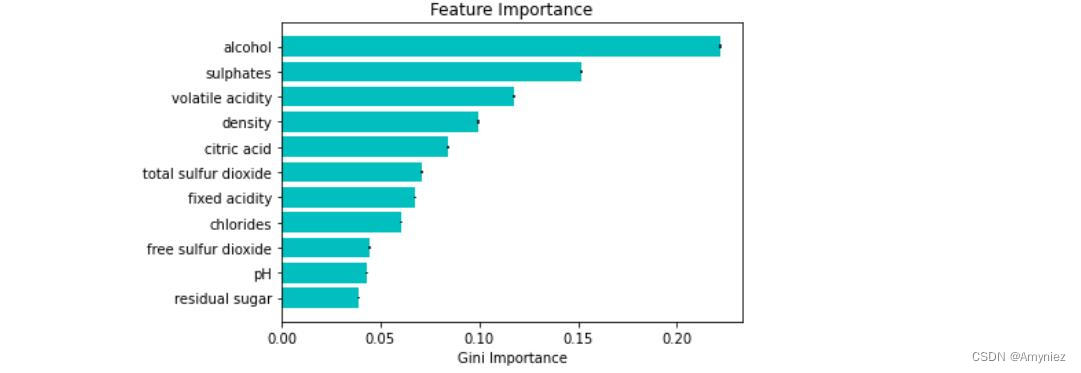
(4)在决策树中,比较基尼不纯度的大小可以选择更好的决策条件(子节点)features = np.array(X_train.columns) # gini不纯度 imps_gini=rf.feature_importances_ std_gini = np.std([tree.feature_importances_ for tree in rf.estimators_], axis=0) # 计算标准差 indices_gini = np.argsort(imps_gini) # 将imps_gini中的元素从小到大排列,提取其在排列前对应的index(索引)输出 plt.title('Feature Importance') # plt.barh():横向的柱状图,可以理解为正常柱状图旋转了90° plt.barh(range(len(indices_gini)), imps_gini[indices_gini], yerr=std_gini[indices_gini],color='c', align='center') plt.yticks(range(len(indices_gini)), features[indices_gini]) plt.xlabel('Gini Importance') plt.show()- 1
- 2
- 3
- 4
- 5
- 6
- 7
- 8
- 9
- 10
- 11
- 12
1.4 Permutation Importance(permutation_importances)
# 从相同的随机数种子出发,可以得到相同的随机数序列 np.random.seed(10) imps_perm, std_perm = permutation_importances(rf, X_train, y_train, oob_classifier_accuracy features = np.array(X_train.columns) indices_perm = np.argsort(imps_perm) plt.title('Feature Importances') plt.barh(range(len(indices_perm)), imps_perm[indices_perm], yerr=std_perm[indices_perm],color='c', align='center') plt.yticks(range(len(indices_perm)), features[indices_perm]) plt.xlabel('Permutation Importance') plt.show()- 1
- 2
- 3
- 4
- 5
- 6
- 7
- 8
- 9
- 10
- 11
- 12
- 13

1.5 Boruta
forest = RandomForestClassifier(n_estimators=200, min_samples_leaf=5, n_jobs=-1, oob_score=True, random_state=42) feat_selector = BorutaPy(forest, verbose=2,max_iter=50) np.random.seed(10) import time start = time.time() feat_selector.fit(X_train.values, y_train.values) end = time.time() print(end - start)# 获取运行时间- 1
- 2
- 3
- 4
- 5
- 6
- 7
- 8
- 9
- 10
- 11
- 12
- 13
迭代发生变化的节点:

BorutaPy finished running.Iteration: 50 / 50
Confirmed: 8
Tentative: 0
Rejected: 2
169.35201215744019print('明确的参数: \n',list(np.array(X_train.columns)[feat_selector.ranking_==1])) print('\n待定的参数: \n',list(np.array(X_train.columns)[feat_selector.ranking_==2])) print('\n拒绝的参数: \n',list(np.array(X_train.columns)[feat_selector.ranking_>=3]))- 1
- 2
- 3
明确的参数:
[‘fixed acidity’, ‘volatile acidity’, ‘citric acid’, ‘chlorides’, ‘total sulfur dioxide’, ‘density’, ‘sulphates’, ‘alcohol’]待定的参数:
[‘free sulfur dioxide’]拒绝的参数:
[‘residual sugar’, ‘pH’]
2. 特征选择和性能比较
2.1 基于基尼重要性的特征选择
删除基尼重要性小于0.05的参数(3个):‘pH’,‘residual sugar’,‘free sulfur dioxide’
X_train_gini=X_train.drop(['pH','residual sugar','free sulfur dioxide'],axis=1) X_test_gini=X_test.drop(['pH','residual sugar','free sulfur dioxide'],axis=1) rf_gini = RandomForestClassifier(n_estimators=300, # 森林里(决策)树的数目 min_samples_leaf=5, n_jobs=-1, oob_score=True, random_state=42) rf_gini.fit(X_train_gini, y_train)- 1
- 2
- 3
- 4
- 5
- 6
- 7
- 8
- 9
2.2 基于排序重要性的特征选择
删除排序重要性小于0.003的参数(6个):‘chlorides’,‘pH’,‘residual sugar’,‘fixed acidity’,‘free sulfur dioxide’,‘citric acid’
X_train_perm=X_train.drop(['chlorides','pH','residual sugar','fixed acidity','free sulfur dioxide','citric acid'],axis=1) X_test_perm=X_test.drop(['chlorides','pH','residual sugar','fixed acidity','free sulfur dioxide','citric acid'],axis=1) rf_gini = RandomForestClassifier(n_estimators=300, # 森林里(决策)树的数目 min_samples_leaf=5, n_jobs=-1, oob_score=True, random_state=42) rf_gini.fit(X_train_gini, y_train)- 1
- 2
- 3
- 4
- 5
- 6
- 7
- 8
- 9
2.3 基于Boruta的特征选择
删除Boruta的拒绝变量(2个):‘residual sugar’, ‘pH’
X_train_boruta=X_train.drop(['pH','residual sugar'],axis=1) X_test_boruta=X_test.drop(['pH','residual sugar'],axis=1) rf_gini = RandomForestClassifier(n_estimators=300, # 森林里(决策)树的数目 min_samples_leaf=5, n_jobs=-1, oob_score=True, random_state=42) rf_gini.fit(X_train_gini, y_train)- 1
- 2
- 3
- 4
- 5
- 6
- 7
- 8
- 9
2.4 预测性能比较
print('**************************** 原模型 ****************************') print('\n') print(classification_report(y_test, rf.predict(X_test))) print ('\n') print('****************** 基于基尼重要性的特征选择 ******************') print('\n') print(classification_report(y_test, rf_gini.predict(X_test_gini))) print ('\n') print('****************** 基于排序重要性的特征选择 ******************') print('\n') print(classification_report(y_test, rf_perm.predict(X_test_perm))) print ('\n') print('******************** 基于Boruta的特征选择 ********************') print('\n') print(classification_report(y_test, rf_boruta.predict(X_test_boruta)))- 1
- 2
- 3
- 4
- 5
- 6
- 7
- 8
- 9
- 10
- 11
- 12
- 13
- 14
- 15
- 16
- 17
- 18
- 19
- 20
- 21
**************************** 原模型 ****************************
precision recall f1-score support 0 0.90 0.97 0.93 274 1 0.67 0.39 0.49 46 accuracy 0.88 320 macro avg 0.79 0.68 0.71 320 weighted avg 0.87 0.88 0.87 320- 1
- 2
- 3
- 4
- 5
- 6
- 7
- 8
****************** 基于基尼重要性的特征选择 ******************
precision recall f1-score support 0 0.90 0.97 0.93 274 1 0.67 0.39 0.49 46 accuracy 0.88 320 macro avg 0.79 0.68 0.71 320 weighted avg 0.87 0.88 0.87 320- 1
- 2
- 3
- 4
- 5
- 6
- 7
- 8
****************** 基于排序重要性的特征选择 ******************
precision recall f1-score support 0 0.89 0.99 0.94 274 1 0.76 0.28 0.41 46 accuracy 0.88 320 macro avg 0.83 0.63 0.67 320 weighted avg 0.87 0.88 0.86 320- 1
- 2
- 3
- 4
- 5
- 6
- 7
- 8
******************** 基于Boruta的特征选择 ********************
precision recall f1-score support 0 0.90 0.97 0.93 274 1 0.67 0.39 0.49 46 accuracy 0.88 320 macro avg 0.79 0.68 0.71 320 weighted avg 0.87 0.88 0.87 320- 1
- 2
- 3
- 4
- 5
- 6
- 7
- 8
相比之下,排序重要性的特征选择方法稍好一些。基于Boruta的特征选择只删除了pH和原始模型的结果是一致的,并未对模型产生很大的影响。
-
相关阅读:
计算机毕业设计(附源码)python智能仓储进出货管理系统
物联网(IoT)的北向和南向
WPF 常用功能整合
MFC网络编程2——异步套接字
JavaScript 变量提升的作用
谢邀,ADconf安全大会
VScode SSH无法免密登录
C++ 类和对象篇(三) 空类和6个默认成员函数
python的数组:列表、数组模块array与第三方库numpy的数组
八、Docker容器的数据管理
- 原文地址:https://blog.csdn.net/amyniez/article/details/127815384