-
服务端ZMQ(一)——源码解析
服务端ZMQ(一)——源码解析
1、什么是ZeroMQ?
- 基于消息队列的多线程网络库:对套接字类型、连接处理、帧、路由底层细节进行抽象、提供跨越多种传输协议的套接字(socket library)
- 一个嵌入式库:封装了网络通信、消息队列、线程调度等功能,向上层应用提供API,应用程序通过加载库文件,调用API函数来实现高性能网络通信(简单好用的传输层)
总结:ZeroMQ在 Socket API 之上做了一层封装,将网络通讯、进程通讯和线程通讯抽象为统一的 API 接口,提供一个底层的网络通讯库
注意:普通的 socket 是端到端的(1:1的关系)ZeroMQ 却是可以N:M 的关系
/** socket 1.建立连接 销毁连接 2.制定协议 选择协议 protobuffer messagepack shrift 3.处理错误 error close 4.断线重连的问题心跳 检测 5. IO epoll 有哪些模型? 1.请求回应模型, req/rep redis 协议请求的次序跟回应的次序 2、管道模型 push/ull模型 ginx 3、监听发布模型 sub/pub 观察者模式 **/- 1
- 2
- 3
- 4
- 5
- 6
- 7
- 8
- 9
- 10
- 11
- 12
- 13
- 14
- 15
- 16

1.1、为什么用消息队列和多线程?
看到消息队列,首先想到的是异步、消峰、解耦。例子:某个功能中很多步骤需要在一个流程里面完成,例如下图支付流程被拉长了,更加耗时。

引入消息队列,就变成了下图。对于一些可以同时处理的流程用线程,线程池去处理,减少响应时间。

1.2、ZeroMQ长是什么样子 ?

ZeroMQ几乎所有IO操作都是异步的,每个
ZeroMQ IO线程都有与之绑定的Poller,Poller采用经典的Reactor模式实现,Poller根据不同的操作系统平台使用不同的网络IO模型(select、poll、epoll、devpoll、kequeue等)。主线程与I/O线程通过Mail Box传递消息来进行通信Server,在主线程创建zmq_listener,通过Mail Box发消息的形式将其绑定到I/O线程,I/O线程把zmq_listener添加到Poller中用以侦听读事件。
Client,在主线程中创建zmq_connecter,通过Mail Box发消息的形式将其绑定到I/O线程,I/O线程把zmq_connecter添加到Poller中用以侦听写事件。
Client与Server第一次通信时,会创建zmq_init来发送identity,用以进行认证。认证结束后,双方会为此次连接创建Session,以后双方就通过Session进行通信。
每个Session都会关联到相应的读/写管道, 主线程收发消息只是分别从管道中读/写数据。Session并不实际跟kernel交换I/O数据,而是通过plugin到Session中的Engine来与kernel交换I/O数据。
ZMQ性能优化的过程中发现有3个因素会对性能产生严重的影响:
- 内存分配的次数
- 系统调用的次数
- 并发模型
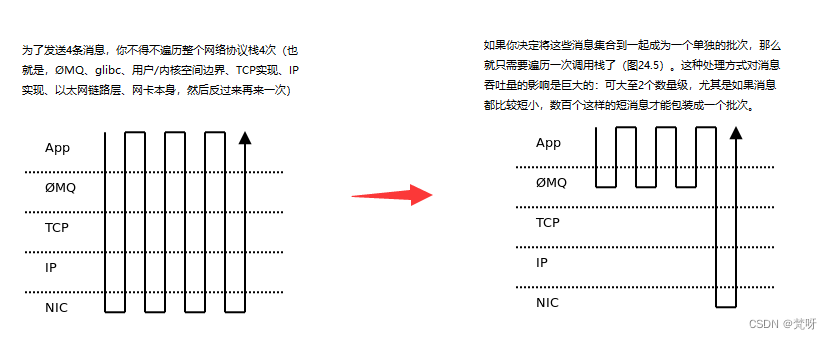
**内存分配的次数:**一条ØMQ消息由一个不透明的句柄来表示。对于非常短小的消息,其内容被直接编码到句柄中。因此,对句柄的拷贝实际上就是对消息数据的拷贝。当遇到较大的消息时,它被分配到一个单独的缓冲区内,而句柄只包含一个指向缓冲区的指针。对句柄的拷贝并不会造成对消息数据的拷贝,当消息有数兆字节长时,这么处理是很有道理的如下图。需要提醒的是,后一种情况里缓冲区是按引用计数的,因此可以做到被多个句柄引用而不必拷贝数据。

**批量处理:**在消息通信系统中,系统调用的数量太多的话会导致出现性能瓶颈。当创建高性能的应用时应该尽可能多的去避免遍历调用栈。
**并发模型:**采用一种不同的模型,目标是完全避免锁机制,并让每个线程能够全速运行。线程间的通信是通过在线程间传递异步消息(事件)来实现的。(actor模式)
无锁算法:ØMQ在pipe对象中采用无锁队列来在用户线程和ØMQ的工作者线程之间传递消息。
2、简单示例
2.1、主要的四个操作
- 创建和销毁套接字:zmq_socket(), zmq_close()
- 配置和读取套接字选项:zmq_setsockopt(), zmq_getsockopt()
- 为套接字建立连接:zmq_bind(), zmq_connect()
- 发送和接收消息:zmq_send(), zmq_recv()
2.2、HelloWorld
//client #include#include #include #include int main (void) { printf ("Connecting to hello world server…\n"); void *context = zmq_ctx_new (); //创建套接字 上下文环境 void *requester = zmq_socket (context, ZMQ_REQ); //设置套接字 ZMQ_REQ 请求回应模型 zmq_connect (requester, "tcp://localhost:5555"); //建立连接 int request_nbr; for (request_nbr = 0; request_nbr != 5; request_nbr++) { //发送消息 char buffer [5]; printf ("Sending Hello %d…\n", request_nbr); zmq_send (requester, "Hello", 5, 0); zmq_recv (requester, buffer, 5, 0); printf ("Received World %d\n", request_nbr); } zmq_close (requester); zmq_ctx_destroy (context); return 0; } - 1
- 2
- 3
- 4
- 5
- 6
- 7
- 8
- 9
- 10
- 11
- 12
- 13
- 14
- 15
- 16
- 17
- 18
- 19
- 20
- 21
- 22
- 23
- 24
- 25
- 26
- 27
//server #include#include #include #include #include int main (void) { void *context = zmq_ctx_new (); //创建套接字 上下文环境 void *responder = zmq_socket (context, ZMQ_REP); //设置套接字 ZMQ_REP 请求回应模型 int rc = zmq_bind (responder, "tcp://*:5555"); //建立连接 assert (rc == 0); while (1) { //接收消息 char buffer [5]; zmq_recv (responder, buffer, 5, 0); printf ("Received Hello\n"); sleep (1); // Do some 'work' zmq_send (responder, "World", 5, 0); } return 0; } - 1
- 2
- 3
- 4
- 5
- 6
- 7
- 8
- 9
- 10
- 11
- 12
- 13
- 14
- 15
- 16
- 17
- 18
- 19
- 20
- 21
- 22
实现效果:

2.3、与传统TCP的区别
- 使用多种协议:inproc(进程内)、ipc(进程间)、tcp、pgm(广播)、epgm;
- 连接是异步的,并由一组消息队列做缓冲;
- 连接会表现出某种消息模式,这是由创建连接的套接字类型决定的;
- 一个套接字可以有多个输入和输出连接;N:M;
- ZMQ没有提供类似accept()的函数,因为当套接字绑定至端点时它就自动开始接受连接了;
- 应用程序无法直接和这些连接打交道,因为它们是被封装在ZMQ底层的。、
- 当客户端使用zmq_connect()时连接就已经建立了,并不要求该端点已有某个服务使用zmq_bind()进行了绑定;
3、工作流程
3.1、zmq_ctx_new
/* zmq.cpp 原文件 */ void *zmq_ctx_new (void) { //首先是初始化网络环境 ZMQ_HAVE_OPENPGM 或者 ZMQ_HAVE_WINDOWS if (!zmq::initialize_network ()) { return NULL; } // Create 0MQ context. /* ctx_t ctx.hpp源文件 zmq::ctx_t::ctx_t () : //套接字是否使用的标志 后续close 最后一个释放 _tag (ZMQ_CTX_TAG_VALUE_GOOD), //初始化信箱、zmq_ctx_term thread、reaper thread、I/O thread... _starting (true), //zmq_ctx_term 是否启用 _terminating (false), //回收线程 _reaper (NULL), //同时socket最大打开数 _max_sockets (clipped_maxsocket (ZMQ_MAX_SOCKETS_DFLT)), //同时消息的最大数 _max_msgsz (INT_MAX), //IO 线程数量 _io_thread_count (ZMQ_IO_THREADS_DFLT), // 该上下文是否永远不会终止 _blocky (true), //是否支持ipv6 _ipv6 (false), //是否使用零拷贝消息解析功能 _zero_copy (true) { #ifdef HAVE_FORK _pid = getpid (); #endif #ifdef ZMQ_HAVE_VMCI _vmci_fd = -1; _vmci_family = -1; #endif // Initialise crypto library, if needed. zmq::random_open (); #ifdef ZMQ_USE_NSS NSS_NoDB_Init (NULL); #endif #ifdef ZMQ_USE_GNUTLS gnutls_global_init (); #endif } 1、创建ctx指针 2、check_tag() --> 当前 ctx_t 的状态 _tag == ZMQ_CTX_TAG_VALUE_GOOD 3、terminate() --> _terminatin --> start () --> create socket(并注册信箱) 4、shutdown () --> _reaper(NULL) 回收线程 5、set() --> thread_ctx_t () --> 启用新线程(参数) ... */ zmq::ctx_t *ctx = new (std::nothrow) zmq::ctx_t; if (ctx) { if (!ctx->valid ()) { delete ctx; return NULL; } } return ctx; } /* 所以zmq_ctx_new 只是做了初始化工作 ctx_t提供一个start_thread后续的函数调用中进行的启动(poller_base -> start -> _ctx.start_thread | poller_set -> start -> _ctx.start_thread) */- 1
- 2
- 3
- 4
- 5
- 6
- 7
- 8
- 9
- 10
- 11
- 12
- 13
- 14
- 15
- 16
- 17
- 18
- 19
- 20
- 21
- 22
- 23
- 24
- 25
- 26
- 27
- 28
- 29
- 30
- 31
- 32
- 33
- 34
- 35
- 36
- 37
- 38
- 39
- 40
- 41
- 42
- 43
- 44
- 45
- 46
- 47
- 48
- 49
- 50
- 51
- 52
- 53
- 54
- 55
- 56
- 57
- 58
- 59
- 60
- 61
- 62
- 63
- 64
- 65
- 66
- 67
- 68
- 69
- 70
- 71
- 72
- 73
- 74
- 75
- 76
- 77
3.2、zmq_socket
//1、zmq_socket void *zmq_socket (void *ctx_, int type_) { //ctx_t检查 if (!ctx_ || !(static_cast(s); } //2、ctx_t::create_socket zmq::socket_base_t *zmq::ctx_t::create_socket (int type_) { scoped_lock_t locker (_slot_sync); // 一旦调用了zmq_ctx_term,将不能创建新套接字 if (_terminating) { errno = ETERM; return NULL; } if (unlikely (_starting)) { // start_thread 启动 if (!start ()) return NULL; } // 如果当前已达到套接字上限,返回错误 if (_empty_slots.empty ()) { errno = EMFILE; return NULL; } // 选择索引 const uint32_t slot = _empty_slots.back (); _empty_slots.pop_back (); // 生成唯一id const int sid = (static_cast (max_socket_id.add (1))) + 1; // 创建套接字,并注册在其身上的mailbox socket_base_t *s = socket_base_t::create (type_, this, slot, sid); if (!s) { _empty_slots.push_back (slot); return NULL; } _sockets.push_back (s); //该 ctx_t 上的 i_mailbox 数组 _slots[slot] = s->get_mailbox (); return s; } //3、ctx_t::start bool zmq::ctx_t::start () { //数组中的 mailboxes 进行初始化,增加回收线程 _opt_sync.lock (); const int term_and_reaper_threads_count = 2; const int mazmq = _max_sockets; const int ios = _io_thread_count; _opt_sync.unlock (); const int slot_count = mazmq + ios + term_and_reaper_threads_count; try { //vector 重设 capacity 上限 _slots.reserve (slot_count); _empty_slots.reserve (slot_count - term_and_reaper_threads_count); } catch (const std::bad_alloc &) { errno = ENOMEM; return false; } _slots.resize (term_and_reaper_threads_count); // 将关闭线程的 mailbox 绑定到 ctx 上 _slots[term_tid] = &_term_mailbox; // 创建回收线程并启动 _reaper = new (std::nothrow) reaper_t (this, reaper_tid); if (!_reaper) { errno = ENOMEM; goto fail_cleanup_slots; } if (!_reaper->get_mailbox ()->valid ()) goto fail_cleanup_reaper; _slots[reaper_tid] = _reaper->get_mailbox (); _reaper->start (); //创建指定数量的io线程启动且注册,当然包括其mailbox _slots.resize (slot_count, NULL); for (int i = term_and_reaper_threads_count; i != ios + term_and_reaper_threads_count; i++) { io_thread_t *io_thread = new (std::nothrow) io_thread_t (this, i); if (!io_thread) { errno = ENOMEM; goto fail_cleanup_reaper; } if (!io_thread->get_mailbox ()->valid ()) { delete io_thread; goto fail_cleanup_reaper; } _io_threads.push_back (io_thread); _slots[i] = io_thread->get_mailbox (); //io_thread 会使用 ctx_t 上的start_thread来启动成员函数 worker_routine ,进而启动当前平台下的io接口的 //loop(), 再接下来就是经典的 reactor 模式, 从响应的fd中,找到对应的 poll_entry_t //通过判断响应的事件来调用挂接在io_thread上的对象的 in_event 或者 out_event 函数 io_thread->start (); } // In the unused part of the slot array, create a list of empty slots. for (int32_t i = static_cast (_slots.size ()) - 1; i >= static_cast (ios) + term_and_reaper_threads_count; i--) { _empty_slots.push_back (i); } //启动完成 _starting = false; return true; fail_cleanup_reaper: _reaper->stop (); delete _reaper; _reaper = NULL; fail_cleanup_slots: _slots.clear (); return false; } //4、zmq::socket_base_t zmq::socket_base_t::socket_base_t (ctx_t *parent_, uint32_t tid_, int sid_, bool thread_safe_) : //调用 own_t 的构造函数,用于维护对象的生命周期 own_t (parent_, tid_), _sync (), _tag (0xbaddecaf), _ctx_terminated (false), _destroyed (false), _poller (NULL), _handle (static_cast - 1
- 2
- 3
- 4
- 5
- 6
- 7
- 8
- 9
- 10
- 11
- 12
- 13
- 14
- 15
- 16
- 17
- 18
- 19
- 20
- 21
- 22
- 23
- 24
- 25
- 26
- 27
- 28
- 29
- 30
- 31
- 32
- 33
- 34
- 35
- 36
- 37
- 38
- 39
- 40
- 41
- 42
- 43
- 44
- 45
- 46
- 47
- 48
- 49
- 50
- 51
- 52
- 53
- 54
- 55
- 56
- 57
- 58
- 59
- 60
- 61
- 62
- 63
- 64
- 65
- 66
- 67
- 68
- 69
- 70
- 71
- 72
- 73
- 74
- 75
- 76
- 77
- 78
- 79
- 80
- 81
- 82
- 83
- 84
- 85
- 86
- 87
- 88
- 89
- 90
- 91
- 92
- 93
- 94
- 95
- 96
- 97
- 98
- 99
- 100
- 101
- 102
- 103
- 104
- 105
- 106
- 107
- 108
- 109
- 110
- 111
- 112
- 113
- 114
- 115
- 116
- 117
- 118
- 119
- 120
- 121
- 122
- 123
- 124
- 125
- 126
- 127
- 128
- 129
- 130
- 131
- 132
- 133
- 134
- 135
- 136
- 137
- 138
- 139
- 140
- 141
- 142
- 143
- 144
- 145
- 146
- 147
- 148
- 149
- 150
- 151
- 152
- 153
- 154
- 155
- 156
- 157
- 158
- 159
- 160
- 161
- 162
- 163
- 164
- 165
- 166
- 167
- 168
- 169
- 170
- 171
- 172
- 173
- 174
- 175
- 176
- 177
- 178
3.3、zmq_bind
int zmq_bind (void *s_, const char *addr_) { //转化成socket_base_t 指针 (socket_base_t定义了很多操作) zmq::socket_base_t *s = as_socket_base_t (s_); if (!s) return -1; //进行地址的解析和绑定地址 return s->bind (addr_); } //1、zmq::socket_base_t::bind int zmq::socket_base_t::bind (const char *endpoint_uri_) { //根据线程安全拍段进行上锁准备 scoped_optional_lock_t sync_lock (_thread_safe ? &_sync : NULL); if (unlikely (_ctx_terminated)) { errno = ETERM; return -1; } // 执行可能存在的被挂起的命令 int rc = process_commands (0, false); if (unlikely (rc != 0)) { return -1; } //为分割对传入的协议和地址端口进行分片 //并对传入协议进行检查 std::string protocol; std::string address; if (parse_uri (endpoint_uri_, protocol, address) || check_protocol (protocol)) { return -1; } // ...... //以下传输方式需要在io线程中进行,所以我们选择一个io线程 io_thread_t *io_thread = choose_io_thread (options.affinity); if (!io_thread) { errno = EMTHREAD; return -1; } if (protocol == protocol_name::tcp) { //创建tcp 监听对象 tcp_listener_t *listener = new (std::nothrow) tcp_listener_t (io_thread, this, options); alloc_assert (listener); //设置地址 rc = listener->set_local_address (address.c_str ()); if (rc != 0) { LIBZMQ_DELETE (listener); event_bind_failed (make_unconnected_bind_endpoint_pair (address), zmq_errno ()); return -1; } // Save last endpoint URI listener->get_local_address (_last_endpoint); //将节点插入子树中 add_endpoint (make_unconnected_bind_endpoint_pair (_last_endpoint), static_cast(listener), NULL); options.connected = true; return 0; } // ...... zmq_assert (false); return -1; } //2、zmq::ctx_t::choose_io_thread 传入绑定的CPU下标 zmq::io_thread_t *zmq::ctx_t::choose_io_thread (uint64_t affinity_) { if (_io_threads.empty ()) return NULL; //根据cpu偏好以及当前的io压力来选择压力最小的io线程并返回 int min_load = -1; io_thread_t *selected_io_thread = NULL; for (io_threads_t::size_type i = 0, size = _io_threads.size (); i != size; i++) { if (!affinity_ || (affinity_ & (uint64_t (1) << i))) { const int load = _io_threads[i]->get_load (); if (selected_io_thread == NULL || load < min_load) { min_load = load; selected_io_thread = _io_threads[i]; } } } return selected_io_thread; } //3、zmq::socket_base_t::add_endpoint void zmq::socket_base_t::add_endpoint ( const endpoint_uri_pair_t &endpoint_pair_, own_t *endpoint_, pipe_t *pipe_) { // 将新节点插入endpoint_ launch_child (endpoint_); //插入ctx _endpoints.ZMQ_MAP_INSERT_OR_EMPLACE (endpoint_pair_.identifier (), endpoint_pipe_t (endpoint_, pipe_)); if (pipe_ != NULL) pipe_->set_endpoint_pair (endpoint_pair_); } //4、zmq::own_t::launch_child void zmq::own_t::launch_child (own_t *object_) { // 插入 object_->set_owner (this); // 向object_所属的io线程发送plug消息,在执行process_plug send_plug (object_); // 设置object_归属权 send_own (this, object_); } /* zmq 在进行bind操作后,并不是马上绑定上的,虽然时间很短但其实是一个异步的流程 tcp_listener_t 在plug初始化过程中,首先加入到当前的socket_base_t, 然后向tcp_listener_t发起一个plug消息,在io_thread的mailbox中进行缓存,并再下次loop循环中进行 tcp_listener_t process_plug 为什么process_plug用消息启动:zmq开启多线程模式时,直接执行 process_plug 操作可能会不在 tcp_listener_t 所属线程中执行,也就是破坏了 actor 设计初衷(猜测) */ - 1
- 2
- 3
- 4
- 5
- 6
- 7
- 8
- 9
- 10
- 11
- 12
- 13
- 14
- 15
- 16
- 17
- 18
- 19
- 20
- 21
- 22
- 23
- 24
- 25
- 26
- 27
- 28
- 29
- 30
- 31
- 32
- 33
- 34
- 35
- 36
- 37
- 38
- 39
- 40
- 41
- 42
- 43
- 44
- 45
- 46
- 47
- 48
- 49
- 50
- 51
- 52
- 53
- 54
- 55
- 56
- 57
- 58
- 59
- 60
- 61
- 62
- 63
- 64
- 65
- 66
- 67
- 68
- 69
- 70
- 71
- 72
- 73
- 74
- 75
- 76
- 77
- 78
- 79
- 80
- 81
- 82
- 83
- 84
- 85
- 86
- 87
- 88
- 89
- 90
- 91
- 92
- 93
- 94
- 95
- 96
- 97
- 98
- 99
- 100
- 101
- 102
- 103
- 104
- 105
- 106
- 107
- 108
- 109
- 110
- 111
- 112
- 113
- 114
- 115
- 116
- 117
- 118
- 119
- 120
- 121
- 122
- 123
- 124
- 125
- 126
- 127
- 128
- 129
- 130
- 131
- 132
4、zmq_connect
int zmq_connect (void *s_, const char *addr_) { zmq::socket_base_t *s = as_socket_base_t (s_); if (!s) return -1; return s->connect (addr_); } int zmq::socket_base_t::connect (const char *endpoint_uri_) { scoped_optional_lock_t sync_lock (_thread_safe ? &_sync : NULL); return connect_internal (endpoint_uri_); } int zmq::socket_base_t::connect_internal (const char *endpoint_uri_) { if (unlikely (_ctx_terminated)) { errno = ETERM; return -1; } // 执行任何可能被挂起的命令 int rc = process_commands (0, false); if (unlikely (rc != 0)) { return -1; } // 解析 endpoint_uri_字符串 以 : // 为边界进行分别 std::string protocol; std::string address; if (parse_uri (endpoint_uri_, protocol, address) || check_protocol (protocol)) { return -1; } //...... //DEALER SUB PUB REQ 不支持对一个端点同时开启多个会话,进行判断当前会话是否存在 const bool is_single_connect = (options.type == ZMQ_DEALER || options.type == ZMQ_SUB || options.type == ZMQ_PUB || options.type == ZMQ_REQ); if (unlikely (is_single_connect)) { if (0 != _endpoints.count (endpoint_uri_)) { // There is no valid use for multiple connects for SUB-PUB nor // DEALER-ROUTER nor REQ-REP. Multiple connects produces // nonsensical results. return 0; } } //选择io线程去运行我们的会话对象 io_thread_t *io_thread = choose_io_thread (options.affinity); if (!io_thread) { errno = EMTHREAD; return -1; } address_t *paddr = new (std::nothrow) address_t (protocol, address, this->get_ctx ()); alloc_assert (paddr); // Resolve address (if needed by the protocol) if (protocol == protocol_name::tcp) { // Do some basic sanity checks on tcp:// address syntax // - hostname starts with digit or letter, with embedded '-' or '.' // - IPv6 address may contain hex chars and colons. // - IPv6 link local address may contain % followed by interface name / zone_id // (Reference: https://tools.ietf.org/html/rfc4007) // - IPv4 address may contain decimal digits and dots. // - Address must end in ":port" where port is *, or numeric // - Address may contain two parts separated by ':' // Following code is quick and dirty check to catch obvious errors, // without trying to be fully accurate. //对提供的字符串进行解析 const char *check = address.c_str (); if (isalnum (*check) || isxdigit (*check) || *check == '[' || *check == ':') { check++; while (isalnum (*check) || isxdigit (*check) || *check == '.' || *check == '-' || *check == ':' || *check == '%' || *check == ';' || *check == '[' || *check == ']' || *check == '_' || *check == '*') { check++; } } // Assume the worst, now look for success rc = -1; //检查地址是否是安全有效的 if (*check == 0) { // Do we have a valid port string? (cannot be '*' in connect check = strrchr (address.c_str (), ':'); if (check) { check++; if (*check && (isdigit (*check))) rc = 0; // Valid } } if (rc == -1) { errno = EINVAL; LIBZMQ_DELETE (paddr); return -1; } /推迟解决方案配置 paddr->resolved.tcp_addr = NULL; } #ifdef ZMQ_HAVE_WS #ifdef ZMQ_HAVE_WSS else if (protocol == protocol_name::ws || protocol == protocol_name::wss) { if (protocol == protocol_name::wss) { paddr->resolved.wss_addr = new (std::nothrow) wss_address_t (); alloc_assert (paddr->resolved.wss_addr); rc = paddr->resolved.wss_addr->resolve (address.c_str (), false, options.ipv6); } else #else else if (protocol == protocol_name::ws) { #endif { paddr->resolved.ws_addr = new (std::nothrow) ws_address_t (); alloc_assert (paddr->resolved.ws_addr); rc = paddr->resolved.ws_addr->resolve (address.c_str (), false, options.ipv6); } if (rc != 0) { LIBZMQ_DELETE (paddr); return -1; } } #endif #if defined ZMQ_HAVE_IPC else if (protocol == protocol_name::ipc) { paddr->resolved.ipc_addr = new (std::nothrow) ipc_address_t (); alloc_assert (paddr->resolved.ipc_addr); int rc = paddr->resolved.ipc_addr->resolve (address.c_str ()); if (rc != 0) { LIBZMQ_DELETE (paddr); return -1; } } #endif if (protocol == protocol_name::udp) { if (options.type != ZMQ_RADIO) { errno = ENOCOMPATPROTO; LIBZMQ_DELETE (paddr); return -1; } paddr->resolved.udp_addr = new (std::nothrow) udp_address_t (); alloc_assert (paddr->resolved.udp_addr); rc = paddr->resolved.udp_addr->resolve (address.c_str (), false, options.ipv6); if (rc != 0) { LIBZMQ_DELETE (paddr); return -1; } } // TBD - Should we check address for ZMQ_HAVE_NORM??? #ifdef ZMQ_HAVE_OPENPGM if (protocol == protocol_name::pgm || protocol == protocol_name::epgm) { struct pgm_addrinfo_t *res = NULL; uint16_t port_number = 0; int rc = pgm_socket_t::init_address (address.c_str (), &res, &port_number); if (res != NULL) pgm_freeaddrinfo (res); if (rc != 0 || port_number == 0) { return -1; } } #endif #if defined ZMQ_HAVE_TIPC else if (protocol == protocol_name::tipc) { paddr->resolved.tipc_addr = new (std::nothrow) tipc_address_t (); alloc_assert (paddr->resolved.tipc_addr); int rc = paddr->resolved.tipc_addr->resolve (address.c_str ()); if (rc != 0) { LIBZMQ_DELETE (paddr); return -1; } const sockaddr_tipc *const saddr = reinterpret_cast( paddr->resolved.tipc_addr->addr ()); // Cannot connect to random Port Identity if (saddr->addrtype == TIPC_ADDR_ID && paddr->resolved.tipc_addr->is_random ()) { LIBZMQ_DELETE (paddr); errno = EINVAL; return -1; } } #endif #if defined ZMQ_HAVE_VMCI else if (protocol == protocol_name::vmci) { paddr->resolved.vmci_addr = new (std::nothrow) vmci_address_t (this->get_ctx ()); alloc_assert (paddr->resolved.vmci_addr); int rc = paddr->resolved.vmci_addr->resolve (address.c_str ()); if (rc != 0) { LIBZMQ_DELETE (paddr); return -1; } } #endif // Create session. session_base_t *session = session_base_t::create (io_thread, true, this, options, paddr); errno_assert (session); // PGM does not support subscription forwarding; ask for all data to be // sent to this pipe. (same for NORM, currently?) #if defined ZMQ_HAVE_OPENPGM && defined ZMQ_HAVE_NORM const bool subscribe_to_all = protocol == protocol_name::pgm || protocol == protocol_name::epgm || protocol == protocol_name::norm || protocol == protocol_name::udp; #elif defined ZMQ_HAVE_OPENPGM const bool subscribe_to_all = protocol == protocol_name::pgm || protocol == protocol_name::epgm || protocol == protocol_name::udp; #elif defined ZMQ_HAVE_NORM const bool subscribe_to_all = protocol == protocol_name::norm || protocol == protocol_name::udp; #else const bool subscribe_to_all = protocol == protocol_name::udp; #endif pipe_t *newpipe = NULL; if (options.immediate != 1 || subscribe_to_all) { // Create a bi-directional pipe. object_t *parents[2] = {this, session}; pipe_t *new_pipes[2] = {NULL, NULL}; const bool conflate = get_effective_conflate_option (options); int hwms[2] = {conflate ? -1 : options.sndhwm, conflate ? -1 : options.rcvhwm}; bool conflates[2] = {conflate, conflate}; rc = pipepair (parents, new_pipes, hwms, conflates); errno_assert (rc == 0); // Attach local end of the pipe to the socket object. attach_pipe (new_pipes[0], subscribe_to_all, true); newpipe = new_pipes[0]; // Attach remote end of the pipe to the session object later on. session->attach_pipe (new_pipes[1]); } // ......... // Save last endpoint URI paddr->to_string (_last_endpoint); add_endpoint (make_unconnected_connect_endpoint_pair (endpoint_uri_), static_cast (session), newpipe); return 0; } - 1
- 2
- 3
- 4
- 5
- 6
- 7
- 8
- 9
- 10
- 11
- 12
- 13
- 14
- 15
- 16
- 17
- 18
- 19
- 20
- 21
- 22
- 23
- 24
- 25
- 26
- 27
- 28
- 29
- 30
- 31
- 32
- 33
- 34
- 35
- 36
- 37
- 38
- 39
- 40
- 41
- 42
- 43
- 44
- 45
- 46
- 47
- 48
- 49
- 50
- 51
- 52
- 53
- 54
- 55
- 56
- 57
- 58
- 59
- 60
- 61
- 62
- 63
- 64
- 65
- 66
- 67
- 68
- 69
- 70
- 71
- 72
- 73
- 74
- 75
- 76
- 77
- 78
- 79
- 80
- 81
- 82
- 83
- 84
- 85
- 86
- 87
- 88
- 89
- 90
- 91
- 92
- 93
- 94
- 95
- 96
- 97
- 98
- 99
- 100
- 101
- 102
- 103
- 104
- 105
- 106
- 107
- 108
- 109
- 110
- 111
- 112
- 113
- 114
- 115
- 116
- 117
- 118
- 119
- 120
- 121
- 122
- 123
- 124
- 125
- 126
- 127
- 128
- 129
- 130
- 131
- 132
- 133
- 134
- 135
- 136
- 137
- 138
- 139
- 140
- 141
- 142
- 143
- 144
- 145
- 146
- 147
- 148
- 149
- 150
- 151
- 152
- 153
- 154
- 155
- 156
- 157
- 158
- 159
- 160
- 161
- 162
- 163
- 164
- 165
- 166
- 167
- 168
- 169
- 170
- 171
- 172
- 173
- 174
- 175
- 176
- 177
- 178
- 179
- 180
- 181
- 182
- 183
- 184
- 185
- 186
- 187
- 188
- 189
- 190
- 191
- 192
- 193
- 194
- 195
- 196
- 197
- 198
- 199
- 200
- 201
- 202
- 203
- 204
- 205
- 206
- 207
- 208
- 209
- 210
- 211
- 212
- 213
- 214
- 215
- 216
- 217
- 218
- 219
- 220
- 221
- 222
- 223
- 224
- 225
- 226
- 227
- 228
- 229
- 230
- 231
- 232
- 233
- 234
- 235
- 236
- 237
- 238
- 239
- 240
- 241
- 242
- 243
- 244
- 245
- 246
- 247
- 248
- 249
- 250
- 251
- 252
- 253
- 254
- 255
- 256
- 257
- 258
- 259
- 260
- 261
- 262
- 263
- 264
- 265
5、zmq_recv
int zmq_recv (void *s_, void *buf_, size_t len_, int flags_) { zmq::socket_base_t *s = as_socket_base_t (s_); if (!s) return -1; //初始化 zmq_msg_t zmq_msg_t msg; int rc = zmq_msg_init (&msg); errno_assert (rc == 0); const int nbytes = s_recvmsg (s, &msg, flags_); if (unlikely (nbytes < 0)) { const int err = errno; rc = zmq_msg_close (&msg); errno_assert (rc == 0); errno = err; return -1; } // 判断是否超过给定的大小 const size_t to_copy = size_t (nbytes) < len_ ? size_t (nbytes) : len_; // We exp如果比给定的大小 大,则进行拷贝 if (to_copy) { assert (buf_); memcpy (buf_, zmq_msg_data (&msg), to_copy); } //释放消息 (当一个消息不再被使用的时候应该立刻调用zmq_msg_close()进行资源释放,否则可能引起内存泄露) rc = zmq_msg_close (&msg); errno_assert (rc == 0); return nbytes; } static int s_recvmsg (zmq::socket_base_t *s_, zmq_msg_t *msg_, int flags_) { //调用 socket_base_t 的recv函数 //以我们目前来说实际上就是调用的 rep_t 的 xrecv,在 socket_base_t 中,recv 调用的虚函数 xrecv 而 xrecv 将会被子类重写 const int rc = s_->recv (reinterpret_cast(sz < INT_MAX ? sz : INT_MAX); } - 1
- 2
- 3
- 4
- 5
- 6
- 7
- 8
- 9
- 10
- 11
- 12
- 13
- 14
- 15
- 16
- 17
- 18
- 19
- 20
- 21
- 22
- 23
- 24
- 25
- 26
- 27
- 28
- 29
- 30
- 31
- 32
- 33
- 34
- 35
- 36
- 37
- 38
- 39
- 40
- 41
- 42
- 43
- 44
- 45
- 46
- 47
- 48
- 49
4、工作流程时序图
4.1、接收端(server)

4.2、发送端(client)

4.3、zmq类层次
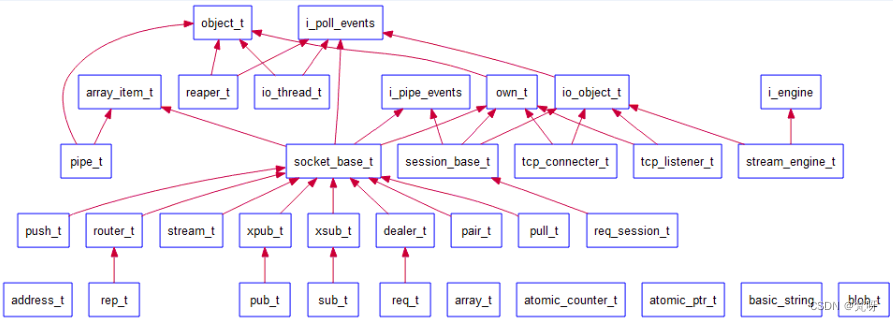
①、object_t,主要用于发送命令和处理命令,所有继承object_t的子类都具备该类的功能
②、io_thread_t,内含一个poller,可监听句柄的读、写、异常状态,继承自object_t,具有接收命令、处理命令、发送命令的功能
③、io_object_t,可以获取一个io_thread_t的poller,从而具备poller功能,所有继承自该类的子类都具有pollere功能,可监听句柄的读、写、异常状态
④、reaper_t,zmq的回收线程
⑤、own_t,zmq的对象树结点,或者说多叉树的结点,其主要用于对象的销毁,可以想到,对象的销毁就是这棵树的销毁过程,必须要使用深度优先的算法来销毁。关于zmq对象树在Internal Architecture of libzmq有详细讲解
⑥、tcp_connector_t,zmq_socket的连接器,使用她来建立tcp连接
⑦、tcp_listener_t,zmq_socket的监听器
⑧、stream_engine,负责处理io事件中的一种----网络事件,把网络字节流转换成zeromq的msg_t消息传递给session_base_t。另外一些和版本兼容相关的杂务也stream_engine处理的。stream_engine_t处理完杂务,到session_base_t就只看见msg_t了。
⑨、session_base_t,管理zmq_socket的连接和通信,主要与engine进行交换
⑩、socket_base_t,zeromq的socket,在zmq中,被当成一种特殊的”线程“,具有收发命令的功能
//参考资料 https://blog.csdn.net/tbyzs/article/category/1710475 zeromq源码分析 https://www.cnblogs.com/zengzy/category/777608.html zeromq源码学习笔记- 1
- 2
- 3
-
相关阅读:
测试工程师提升方向,提升产品思维提高测试效率......
客服支持Chatbot提供即时回答,改善用户体验
ELK入门(二)- springboot整合ES
PHP志愿者协会报名系统的设计与实现 毕业设计-附源码201524
JavaScript 工具函数大全
C# 自定义事件
vue2.x版本中computed和watch的使用入门详解-watch篇
vue设置全局变量:让你的数据无处不在!
关于sql中联接的问题
数据库 | 数据库概述、关系型数据库、非关系型数据库
- 原文地址:https://blog.csdn.net/weixin_43730892/article/details/127693541
