-
全网最全【数据结构与算法】408真题实战(含代码+详解)—— 线性表专题(持续更新...)
线性表专题
每道题目均有对应的代码,大家自行查看哦!

顺序表
ADT:SeqList
文件名:SeqList.hpp
#include#include using namespace std; // 以上是实际运行所需依赖,考试不用写 typedef int elemType; struct SeqList { elemType *data; // 利用数组存储数据元素 int curLength=0; // 当前顺序表中存储的元素个数 int maxSize; // 顺序表的初始化最大长度 SeqList(int size = 10){ maxSize = size; } }; /** * 以下为测试方法,考试不用写 */ // 初始化数据 void init(SeqList *seqlist) { seqlist->data = new elemType[seqlist->maxSize]; for (int i = 1; i < 10; i++) { seqlist->data[i - 1] = i; seqlist->curLength++; } } // 自定义初始化数据 void initByCustom(SeqList *seqlist) { seqlist->data = new elemType[seqlist->maxSize]; elemType value; cout << "\ninput the SeqList's data (the maxSize is " << seqlist->maxSize <<"):"<< endl; for (int i = 0; i < seqlist->maxSize; i++) { cin >> value; seqlist->data[i] = value; seqlist->curLength++; } } // 输出结果 void output(SeqList *seqlist) { cout << "\nThe SeqList's data is: " << endl; for (int i = 0; i < seqlist->curLength; i++) { cout << seqlist->data[i] << " "; } cout << endl; } - 1
- 2
- 3
- 4
- 5
- 6
- 7
- 8
- 9
- 10
- 11
- 12
- 13
- 14
- 15
- 16
- 17
- 18
- 19
- 20
- 21
- 22
- 23
- 24
- 25
- 26
- 27
- 28
- 29
- 30
- 31
- 32
- 33
- 34
- 35
- 36
- 37
- 38
- 39
- 40
- 41
- 42
- 43
- 44
- 45
- 46
- 47
- 48
- 49
- 50
- 51
- 52
- 53
- 54
- 55
- 56
- 57
真题实战
2010年统考真题
1、题目详情

2、代码实现
文件名:SeqList_2010.cpp
#include "SeqList.hpp" void reverse(SeqList *seqlist,int begin,int end) { elemType temp; while (end>begin) { temp = seqlist->data[begin]; seqlist->data[begin] = seqlist->data[end]; seqlist->data[end] = temp; begin++; end--; } } void _2010(SeqList *seqlist, int p) { reverse(seqlist, 0, seqlist->curLength - 1); reverse(seqlist, 0, seqlist->curLength - p - 1); reverse(seqlist, p+1, seqlist->curLength - 1); } int main() { SeqList *seqlist = new SeqList(); init(seqlist); output(seqlist); _2010(seqlist, 4); cout << "\nAfter rotating 4 bits to the left" << endl; output(seqlist); cout<< "\n==============================End==============================" << endl; system("pause"); return 0; }- 1
- 2
- 3
- 4
- 5
- 6
- 7
- 8
- 9
- 10
- 11
- 12
- 13
- 14
- 15
- 16
- 17
- 18
- 19
- 20
- 21
- 22
- 23
- 24
- 25
- 26
- 27
- 28
- 29
- 30
- 31
- 32
- 33
- 34
运行结果:

3、答案解析

2011年统考真题
1、题目详情

2、代码实现
文件名:SeqList_2011.cpp
#include "SeqList.hpp" elemType _2011(SeqList *s1, SeqList *s2) { elemType result; for (int i = 0,j=0,count=0; count< s1->curLength; count++) { if(s1->data[i]<=s2->data[j]) result = s1->data[i++]; else result = s2->data[j++]; } return result; } int main() { SeqList *s1 = new SeqList(5); SeqList *s2 = new SeqList(5); initByCustom(s1); cout << "--------------------------" << endl; initByCustom(s2); cout << "\nThe median of S1 and S2 is " << _2011(s1, s2) << endl; cout << "\n==============================End==============================" << endl; system("pause"); return 0; }- 1
- 2
- 3
- 4
- 5
- 6
- 7
- 8
- 9
- 10
- 11
- 12
- 13
- 14
- 15
- 16
- 17
- 18
- 19
- 20
- 21
- 22
- 23
- 24
- 25
- 26
- 27
- 28
- 29
运行结果:


3、答案解析
首先给出我自己的思路(也就是官方的另解):
-
两个等长序列的中位数就是他们合在一起形成的有序序列(不使用排序算法,直接通过指针对比+最小值的记录即可)的中位数,因此通过L(s1/s2的长度)次循环,依次对比并记录两个数组的最小值,则最终记录的结果就是他们的中位数。
-
我这个算法的时间复杂度为O(L),空间复杂度为O(1)
以下是官方解析:

2013年统考真题
1、题目详情

2、代码实现
文件名:SeqList_2013.cpp
注:用排序的方法大家可以看排序专题学习后自己实现(对比暴力算法的代码会多一点点,考试时用的话,要保证不要写错哦),最优解法大家可以看答案解析(比较难想,考试实在想不出就暴力吧),这里我写的是传统暴力解法:
#include "SeqList.hpp" int _2013(SeqList *seqlist) { int maxCount = 0,count=0; elemType result; for (int i = 0; i < seqlist->curLength; i++) { count = 0; for (int j = 0; j < seqlist->curLength; j++) { if (seqlist->data[i] == seqlist->data[j]) count++; } if (count>=maxCount){ maxCount = count; result = seqlist->data[i]; } } // cout << "maxCount is: " << maxCount << endl; // cout << "result is: " << result << endl; if (maxCount > seqlist->curLength / 2) return result; else return -1; } int main() { SeqList *seqlist = new SeqList(8); initByCustom(seqlist); // output(seqlist); int result = _2013(seqlist); if (result == -1) cout << "Main element not found!" << endl; else cout << "The main element is: " << result << endl; cout << "\n==============================End==============================" << endl; system("pause"); return 0; }- 1
- 2
- 3
- 4
- 5
- 6
- 7
- 8
- 9
- 10
- 11
- 12
- 13
- 14
- 15
- 16
- 17
- 18
- 19
- 20
- 21
- 22
- 23
- 24
- 25
- 26
- 27
- 28
- 29
- 30
- 31
- 32
- 33
- 34
- 35
- 36
- 37
- 38
- 39
- 40
- 41
- 42
- 43
- 44
- 45
- 46
运行结果:
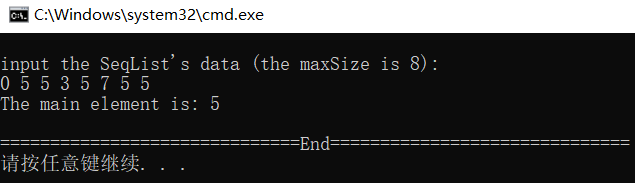

3、答案解析

2018年统考真题
1、题目详情

2、代码实现
我的方法是通过快排,将数组排好序后,依次查找最小正整数是否存在,时间复杂度为O(nlogn),空间复杂度为O(logn)。
文件名:SeqList_2018.cpp
#include "SeqList.hpp" int partition(int *arr, int low, int high) { int pivot = arr[low]; while (low < high) { while (low < high && arr[high] >= pivot) high--; arr[low] = arr[high]; while (low < high && arr[low] <= pivot) low++; arr[high] = arr[low]; } arr[low] = pivot; return low; } // 快速排序 void quick_sort(int *arr, int low, int high) { if (low < high) { int p = partition(arr, low, high); quick_sort(arr, low, p - 1); quick_sort(arr, p + 1, high); } } int _2018(SeqList *seqlist) { quick_sort(seqlist->data, 0, seqlist->curLength - 1); int j = 0; while (seqlist->data[j] <= 0 && j < seqlist->curLength-1) j++; if(j==seqlist->curLength) return 1; int i; for (i = 1; j < seqlist->curLength; j++) { if(seqlist->data[j]>i) return i; if (seqlist->data[j] == i) i++; } return i; } int main() { SeqList *seqlist = new SeqList(5); initByCustom(seqlist); cout << "The minimum positive number that does not appear is: " << _2018(seqlist) << endl; cout << "\n==============================End==============================" << endl; system("pause"); return 0; }- 1
- 2
- 3
- 4
- 5
- 6
- 7
- 8
- 9
- 10
- 11
- 12
- 13
- 14
- 15
- 16
- 17
- 18
- 19
- 20
- 21
- 22
- 23
- 24
- 25
- 26
- 27
- 28
- 29
- 30
- 31
- 32
- 33
- 34
- 35
- 36
- 37
- 38
- 39
- 40
- 41
- 42
- 43
- 44
- 45
- 46
- 47
- 48
- 49
- 50
- 51
- 52
- 53
- 54
- 55
- 56
- 57
- 58
- 59
运行结果:


3、答案解析

2020年统考真题
1、题目详情

2、代码实现
暴力O(n^3)在考试实在不会就写吧,其实也行,毕竟这题还是挺难的/(ㄒoㄒ)/~~,暴力解法太简单了,这里就略了,大家可以自己实战一下,这里还是给出答案版代码:
文件名:SeqList_2020.cpp
#include "SeqList.hpp" #define INT_MAX 0x7fffffff int abs_(int a){ if(a<0) return -a; else return a; } bool xls_min(int a,int b,int c){ if(a<=b&&a<=c) return true; return false; } int _2020(SeqList *A, SeqList *B, SeqList *C ){ int i = 0, j = 0, k = 0, D_min = INT_MAX, D; while (i<A->curLength&&j<B->curLength&&k<C->curLength&&D_min>0){ D = abs_(A->data[i] - B->data[j]) + abs_(B->data[j] - C->data[k]) + abs_(C->data[k] - A->data[i]); if (D<D_min) D_min = D; if (xls_min(A->data[i], B->data[j], C->data[k])) i++; else if (xls_min(B->data[j], C->data[k], A->data[i])) j++; else k++; } return D_min; } int main() { SeqList *A = new SeqList(3); initByCustom(A); SeqList *B = new SeqList(4); initByCustom(B); SeqList *C = new SeqList(5); initByCustom(C); cout << "\nThe minimum distance of a triple is: " << _2020(A,B,C) << endl; cout << "\n==============================End==============================" << endl; system("pause"); return 0; }- 1
- 2
- 3
- 4
- 5
- 6
- 7
- 8
- 9
- 10
- 11
- 12
- 13
- 14
- 15
- 16
- 17
- 18
- 19
- 20
- 21
- 22
- 23
- 24
- 25
- 26
- 27
- 28
- 29
- 30
- 31
- 32
- 33
- 34
- 35
- 36
- 37
- 38
- 39
- 40
- 41
- 42
- 43
- 44
- 45
- 46
- 47
运行结果:
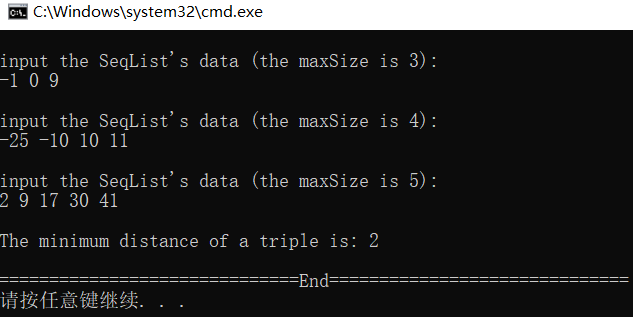
3、答案解析

顺序表习题
- 题目源于王道

链表
ADT:LinkList
文件名:LinkList.hpp
#include#include #include using namespace std; // 以上为实际运行所需依赖,考试不必填写 typedef int elemType; struct LinkNode { // 结点的数据域 elemType data; // 结点的指针域,指向后继结点 LinkNode *next; // 具有两个参数的LinkNode构造函数 LinkNode(const elemType value, LinkNode *p = NULL) { data = value; next = p; } // 具有一个参数的LinkNode构造函数 LinkNode(LinkNode *p = NULL) { next = p; } }; // 遍历单链表 void traverse(LinkNode *head) { LinkNode *p = head->next; cout << "\nYour created data is:\n"; while (p != NULL) { cout << p->data << " "; p = p->next; } cout << endl << endl; } // 带头节点的头插法初始化创建测试数据 int initNum = 10; void init(LinkNode *head) { LinkNode *p; elemType value, flag; // 系统生成测试数据 srand((unsigned)time(NULL)); for (int i = 0; i < initNum; i++) { //生成[0,100)的随机数 value = rand() % 100; p = new LinkNode(value, head->next); // 结点p插入到头结点的后面 head->next = p; } } // 尾插法自定义初始化数据 void initByCUstom(LinkNode *head) { LinkNode *tail = head, *p; elemType value, flag; cout << "input the flag to end with: " << endl; cin >> flag; cout << endl; cout << "input the LinkList's data: " << endl; while (cin >> value, value != flag) { p = new LinkNode(value); // 结点p插入到尾结点的后面 tail->next = p; tail = p; } cout << endl; } - 1
- 2
- 3
- 4
- 5
- 6
- 7
- 8
- 9
- 10
- 11
- 12
- 13
- 14
- 15
- 16
- 17
- 18
- 19
- 20
- 21
- 22
- 23
- 24
- 25
- 26
- 27
- 28
- 29
- 30
- 31
- 32
- 33
- 34
- 35
- 36
- 37
- 38
- 39
- 40
- 41
- 42
- 43
- 44
- 45
- 46
- 47
- 48
- 49
- 50
- 51
- 52
- 53
- 54
- 55
- 56
- 57
- 58
- 59
- 60
- 61
- 62
- 63
- 64
- 65
- 66
- 67
- 68
- 69
- 70
- 71
- 72
- 73
- 74
字符类型的链表测试ADT
文件名:LinkList_char.hpp
#include#include using namespace std; // 以上是实际运行所需依赖,考试不用写 typedef char elemType; struct LinkNode { // 结点的数据域 elemType data; // 结点的指针域,指向后继结点 LinkNode *next; // 具有两个参数的LinkNode构造函数 LinkNode(const elemType value, LinkNode *p = NULL) { data = value; next = p; } // 具有一个参数的LinkNode构造函数 LinkNode(LinkNode *p = NULL) { next = p; } }; /** * 以下为测试方法,考试不用写 */ // 遍历单链表 void traverse(LinkNode *head) { LinkNode *p = head->next; cout << "\nYour created data is:\n"; while (p != NULL) { cout << p->data << " "; p = p->next; } cout << endl << endl; } // 尾插法初始化数据 void initByCUstom(LinkNode *head) { LinkNode *tail = head,*p; elemType value, flag; cout << "input the flag to end with: " << endl; cin >> flag; cout << endl; cout << "input the LinkList's data: " << endl; while (cin >> value, value != flag) { p = new LinkNode(value); // 结点p插入到尾结点的后面 tail->next = p; tail = p; } cout << endl; } - 1
- 2
- 3
- 4
- 5
- 6
- 7
- 8
- 9
- 10
- 11
- 12
- 13
- 14
- 15
- 16
- 17
- 18
- 19
- 20
- 21
- 22
- 23
- 24
- 25
- 26
- 27
- 28
- 29
- 30
- 31
- 32
- 33
- 34
- 35
- 36
- 37
- 38
- 39
- 40
- 41
- 42
- 43
- 44
- 45
- 46
- 47
- 48
- 49
- 50
- 51
- 52
- 53
- 54
- 55
- 56
- 57
- 58
- 59
真题实战
2009年统考真题
1、题目详情

2、代码实现
文件名:LinkList_2009.cpp
#include "LinkList.hpp" int _2009(LinkNode *head, int k) { LinkNode *q= head->next; LinkNode *p = q; int count = 0; while (p!=NULL) { if (count<k) count++; else q = q->next; p = p->next; } if (count < k) return 0; else{ cout << q->data << endl; return 1; } } int main() { LinkNode *head = new LinkNode(); init(head); traverse(head); cout << "Find end with 3 data is: " << _2009(head, 3); cout << "\n==============================End==============================" << endl; system("pause"); return 0; }- 1
- 2
- 3
- 4
- 5
- 6
- 7
- 8
- 9
- 10
- 11
- 12
- 13
- 14
- 15
- 16
- 17
- 18
- 19
- 20
- 21
- 22
- 23
- 24
- 25
- 26
- 27
- 28
- 29
- 30
- 31
- 32
- 33
- 34
- 35
运行结果:

3、答案解析

2012年统考真题
1、题目详情

2、代码实现
文件名:LinkList_2012.cpp
#include "LinkList_char.hpp" int getLength(LinkNode *str){ LinkNode *p = str->next; int count = 0; while (p) { count++; p = p->next; } return count; } elemType _2012(LinkNode *head1, LinkNode *head2) { int len1 = getLength(head1); int len2 = getLength(head2); LinkNode *str1 = head1->next; LinkNode *str2 = head2->next; int count = 0; if (len1>len2){ while (count<len1-len2) { str1 = str1->next; count++; } }else { while (count < len2 - len1) { str2 = str2->next; count++; } } while (str1&&str2) { if(str1->data==str2->data) return str1->data; str1 = str1->next; str2 = str2->next; } return NULL; } int main() { LinkNode *str1 = new LinkNode(); initByCUstom(str1); LinkNode *str2 = new LinkNode(); initByCUstom(str2); cout << "\nThe common suffix starts with :" << _2012(str1, str2) << endl; cout << "\n==============================End==============================" << endl; system("pause"); return 0; }- 1
- 2
- 3
- 4
- 5
- 6
- 7
- 8
- 9
- 10
- 11
- 12
- 13
- 14
- 15
- 16
- 17
- 18
- 19
- 20
- 21
- 22
- 23
- 24
- 25
- 26
- 27
- 28
- 29
- 30
- 31
- 32
- 33
- 34
- 35
- 36
- 37
- 38
- 39
- 40
- 41
- 42
- 43
- 44
- 45
- 46
- 47
- 48
- 49
- 50
- 51
- 52
- 53
- 54
- 55
- 56
- 57
- 58
- 59
- 60
- 61
- 62
- 63
- 64
运行结果:

3、答案解析

2015年统考真题
1、题目详情

2、代码实现
这里我给出传统的暴力解法,利用辅助空间可以看答案解析的方法,优化还可以考虑散列表哦!
文件名:LinkList_2015.cpp
#include "LinkList.hpp" void _2015(LinkNode *head) { LinkNode *p = head->next; LinkNode *q; LinkNode *t; while (p) { elemType value = p->data; q = p; while (q->next) { if (value == q->next->data || value == (-1) * q->next->data) { t = q->next; q->next = q->next->next; delete t; } else q = q->next; } p = p->next; } } int main() { LinkNode *head = new LinkNode(); initByCUstom(head); _2015(head); cout << "\nAfter deleting nodes with equal absolute values, the data is: " << endl; traverse(head); cout << "\n==============================End==============================" << endl; system("pause"); return 0; }- 1
- 2
- 3
- 4
- 5
- 6
- 7
- 8
- 9
- 10
- 11
- 12
- 13
- 14
- 15
- 16
- 17
- 18
- 19
- 20
- 21
- 22
- 23
- 24
- 25
- 26
- 27
- 28
- 29
- 30
- 31
- 32
- 33
- 34
- 35
- 36
运行结果:

3、答案解析

2019年统考真题
1、题目详情

2、代码实现
文件名:LinkList_2019.cpp
#include "LinkList.hpp" void _2019(LinkNode *head) { LinkNode *p = head->next; LinkNode *q =p; // 找到中间位置 while (q&&q->next) { q = q->next->next; p = p->next; } LinkNode *tail = head->next; // 将链表一分为二 while (tail->next!=p) tail = tail->next; // 后半段链表进行逆置 LinkNode *head2 = new LinkNode(); while (p) { tail->next = p->next; p->next =head2->next; head2->next = p; p = tail->next; } p = head->next; // 后半段链表依次拆分节点按要求间接拼接到原来的链表后 while (p) { q = head2->next; head2->next = q->next; q->next = p->next; p->next = q; p = q->next; } // 处理奇数个数时,余留的最后一个数 if (head2->next != NULL) { q->next = head2->next; } } int main() { LinkNode *head = new LinkNode(); initByCUstom(head); _2019(head); cout << "\nThe result after rearrangement is: " << endl; traverse(head); cout << "\n==============================End==============================" << endl; system("pause"); return 0; }- 1
- 2
- 3
- 4
- 5
- 6
- 7
- 8
- 9
- 10
- 11
- 12
- 13
- 14
- 15
- 16
- 17
- 18
- 19
- 20
- 21
- 22
- 23
- 24
- 25
- 26
- 27
- 28
- 29
- 30
- 31
- 32
- 33
- 34
- 35
- 36
- 37
- 38
- 39
- 40
- 41
- 42
- 43
- 44
- 45
- 46
- 47
- 48
- 49
- 50
- 51
- 52
- 53
- 54
- 55
- 56
- 57
- 58
- 59
- 60
运行结果:


3、答案解析

链表习题
- 题目来源于王道


线性表专题训练
- 题目源于算法与数据结构考研试题精析


后续更新
等后面有时间会把上面题目的完整代码+运行示例补充更新完善,大家尽情期待!
-
相关阅读:
Python 引用不确定的函数
大数据学习(7)-hive文件格式总结
java后端接入微信小程序登录功能
Java竞赛快速输入输出,防止读取数据过慢导致超时
【C++】---了解string类
WPF 开发调试比较:Visual Studio 原生和Snoop调试控制台
VirtualBox7安装Ubuntu20及全屏、共享、粘贴板等设置
Vue自定义指令=>局部指令定义及全局指令定义
7、Netty核心模块API
FastDFS-02-JavaAPI
- 原文地址:https://blog.csdn.net/HXBest/article/details/127491201