-
JUC P3 共享模型之无锁同步,CAS,原子类,Unsafe类 基础+代码
JUC P3 共享模型之无锁同步,CAS,原子类,Unsafe类 基础+代码
教程:https://www.bilibili.com/video/BV16J411h7Rd
7. 共享模型之无锁
CAS与volatile- 原子整数
- 原子引用
- 原子累加器
Unsafe
7.1 取款问题
创建 1000 个线程修改余额。
7.1.1 上锁解决方案
public class InitTest { public static void main(String[] args) throws InterruptedException { Account account = new AccountUnsafe(10000); Account.demo(account); } } class AccountUnsafe implements Account { private Integer balance; public AccountUnsafe(Integer balance) { this.balance = balance; } @Override public Integer getBalance() { synchronized (this) { return this.balance; } } @Override public void withdraw(Integer amount) { synchronized (this) { this.balance -= amount; } } } interface Account { /** * @return 查看余额 */ Integer getBalance(); /** * @param amount 取款 */ void withdraw(Integer amount); /** * @param account 账户 * 创建 1000 个线程取款 */ static void demo(Account account) { List<Thread> ts = new ArrayList<>(); for (int i = 0; i < 1000; i++) { ts.add(new Thread(() -> { account.withdraw(10); })); } long start = System.nanoTime(); ts.forEach(Thread::start); ts.forEach(t -> { try { t.join(); } catch (InterruptedException e) { throw new RuntimeException(e); } }); System.out.println("最终余额: " + account.getBalance() + " cost: " + TimeUnit.NANOSECONDS.toMillis((System.nanoTime() - start)) + "ms"); } }- 1
- 2
- 3
- 4
- 5
- 6
- 7
- 8
- 9
- 10
- 11
- 12
- 13
- 14
- 15
- 16
- 17
- 18
- 19
- 20
- 21
- 22
- 23
- 24
- 25
- 26
- 27
- 28
- 29
- 30
- 31
- 32
- 33
- 34
- 35
- 36
- 37
- 38
- 39
- 40
- 41
- 42
- 43
- 44
- 45
- 46
- 47
- 48
- 49
- 50
- 51
- 52
- 53
- 54
- 55
- 56
- 57
- 58
- 59
- 60
- 61
- 62
- 63
- 64

7.1.2 无锁解决方案
public class InitTest { public static void main(String[] args) throws InterruptedException { Account account = new AccountCAS(10000); Account.demo(account); } } class AccountCAS implements Account { private AtomicInteger balance; public AccountCAS(Integer balance) { this.balance = new AtomicInteger(balance); } @Override public Integer getBalance() { return balance.get(); } @Override public void withdraw(Integer amount) { while (true) { // 获取余额的最新值 int latest = balance.get(); // 修改余额 int next = latest - amount; // 同步余额 if (balance.compareAndSet(latest, next)) { break; } } } } interface Account { /** * @return 查看余额 */ Integer getBalance(); /** * @param amount 取款 */ void withdraw(Integer amount); /** * @param account 账户 * 创建 1000 个线程取款 */ static void demo(Account account) { List<Thread> ts = new ArrayList<>(); for (int i = 0; i < 1000; i++) { ts.add(new Thread(() -> { account.withdraw(10); })); } long start = System.nanoTime(); ts.forEach(Thread::start); ts.forEach(t -> { try { t.join(); } catch (InterruptedException e) { throw new RuntimeException(e); } }); System.out.println("最终余额: " + account.getBalance() + " cost: " + TimeUnit.NANOSECONDS.toMillis((System.nanoTime() - start)) + "ms"); } }- 1
- 2
- 3
- 4
- 5
- 6
- 7
- 8
- 9
- 10
- 11
- 12
- 13
- 14
- 15
- 16
- 17
- 18
- 19
- 20
- 21
- 22
- 23
- 24
- 25
- 26
- 27
- 28
- 29
- 30
- 31
- 32
- 33
- 34
- 35
- 36
- 37
- 38
- 39
- 40
- 41
- 42
- 43
- 44
- 45
- 46
- 47
- 48
- 49
- 50
- 51
- 52
- 53
- 54
- 55
- 56
- 57
- 58
- 59
- 60
- 61
- 62
- 63
- 64
- 65
- 66
- 67
- 68
- 69

稍微快一丢丢。
7.2 CAS 与 volatile
AtomicInteger的解决方案中没有使用锁来保护共享变量的线程安全,那么它是怎么实现的线程安全?public void withdraw(Integer amount) { while (true) { int latest = balance.get(); int next = latest - amount; if (balance.compareAndSet(latest, next)) { break; } } }- 1
- 2
- 3
- 4
- 5
- 6
- 7
- 8
- 9
关键在于
compareAndSet,简称 CAS(Compare And Swap),它必须是原子操作。AtomicInteger源码中使用volatile关键字修饰变量保证变量可见性:

Note:
CAS 的原子性是由操作系统保证的,操作系统中有 CAS 原语为什么无锁效率高
- 无锁状态下,即使重试失败,线程始终在运行,没有停歇,而
synchronized会让线程在没有获得锁的时候发生上下文切换,进入阻塞。
Note:
打个比喻:无锁状态下相当于线程都在高速上,一旦发生上下文切换,就好比赛车要减速,等待唤醒又要重新打火,启动加速,代价比较大。- 无锁状态下,线程要保持运行需要得到 CPU 支持,虽然不会进入阻塞,但是会因为没有得到时间片,一直处于就绪状态,还是会导致上下文切换
CAS 特点
结合
CAS和volatile可以实现无锁并发,适用于线程数较少、多核 CPU 的情景下。CAS是基于乐观锁的思想:不怕别的线程修改共享变量,若其他线程进行修改,当前线程会再重新尝试修改一下synchronized是基于悲观锁的思想:防止别的线程来修改共享变量,当前线程上了锁,其他线程无法进入
CAS 体现的是无锁并发、无阻塞并发:
- 因为没有 synchronized,因此线程不会陷入阻塞,这是效率提升的因素之一
- 但是如果竞争激烈,重试会频繁发生,反而效率会受到影响
7.3 原子整数

7.3.1 常用方法
AtomicInteger i = new AtomicInteger(0); // 默认就是 0 i.compareAndSet(0, 1); // 先看是不是 0, 若是 0, 则修改为 1 log.debug("compareAndSet(0, 1) 之后的值: {}", i); log.debug("自增并获取值: {}", i.incrementAndGet()); // ++i log.debug("自减并获取值: {}", i.decrementAndGet()); // --i log.debug("先获取后自增: {}", i.getAndIncrement()); // i++ log.debug("先获取后自减: {}", i.getAndDecrement()); // i-- log.debug("先加再取值: {}", i.addAndGet(5)); log.debug("先取值再加: {}", i.getAndAdd(5));- 1
- 2
- 3
- 4
- 5
- 6
- 7
- 8
- 9
- 10
- 11
- 12
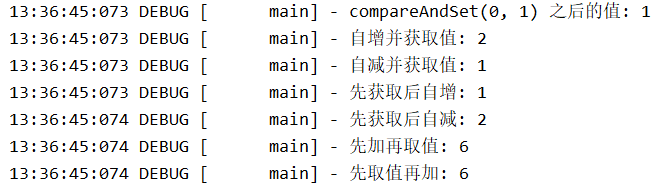
简化取款操作
public void withdraw(Integer amount) { /* while (true) { int latest = balance.get(); int next = latest - amount; if (balance.compareAndSet(latest, next)) { break; } } */ balance.getAndAdd(-1 * amount); }- 1
- 2
- 3
- 4
- 5
- 6
- 7
- 8
- 9
- 10
- 11
- 12
7.3.2 自定义修改
AtomicInteger i = new AtomicInteger(0); // 默认就是 0 log.debug("自定义先修改, 然后返回: {}", i.updateAndGet(x -> x - 50)); log.debug("自定义先返回, 然后修改: {}", i.getAndUpdate(x -> x * 20)); log.debug("查看当前值: {}", i);- 1
- 2
- 3
- 4

仿照着实现updateAndGet功能:public class InitTest { public static void main(String[] args) throws InterruptedException { AtomicInteger i = new AtomicInteger(5); // 默认就是 0 // log.debug("自定义先修改, 然后返回: {}", i.updateAndGet(x -> x * 20)); log.debug("自定义先修改, 然后返回: {}", updateAndGet(i, x -> x * 20)); log.debug("当前值: {}", i); } public static int updateAndGet(AtomicInteger i, IntUnaryOperator operator) { int prev, next; do { prev = i.get(); next = operator.applyAsInt(prev); } while (!i.compareAndSet(prev, next)); return next; } }- 1
- 2
- 3
- 4
- 5
- 6
- 7
- 8
- 9
- 10
- 11
- 12
- 13
- 14
- 15
- 16
- 17
- 18
7.4 原子引用

7.4.1 AtomicReference 修改取款问题
public class InitTest { public static void main(String[] args) throws InterruptedException { Account account = new AccountCAS(new BigDecimal("10000.0")); Account.demo(account); } } class AccountCAS implements Account { private final AtomicReference<BigDecimal> balance; public AccountCAS(BigDecimal balance) { this.balance = new AtomicReference<>(balance); } @Override public BigDecimal getBalance() { return balance.get(); } @Override public void withdraw(BigDecimal amount) { balance.updateAndGet(x -> x.subtract(amount)); } } interface Account { BigDecimal getBalance(); void withdraw(BigDecimal amount); static void demo(Account account) { List<Thread> ts = new ArrayList<>(); for (int i = 0; i < 1000; i++) { ts.add(new Thread(() -> { account.withdraw(BigDecimal.TEN); })); } long start = System.nanoTime(); ts.forEach(Thread::start); ts.forEach(t -> { try { t.join(); } catch (InterruptedException e) { throw new RuntimeException(e); } }); System.out.println("最终余额: " + account.getBalance() + " cost: " + TimeUnit.NANOSECONDS.toMillis((System.nanoTime() - start)) + "ms"); } }- 1
- 2
- 3
- 4
- 5
- 6
- 7
- 8
- 9
- 10
- 11
- 12
- 13
- 14
- 15
- 16
- 17
- 18
- 19
- 20
- 21
- 22
- 23
- 24
- 25
- 26
- 27
- 28
- 29
- 30
- 31
- 32
- 33
- 34
- 35
- 36
- 37
- 38
- 39
- 40
- 41
- 42
- 43
- 44
- 45
- 46
- 47
- 48
- 49
- 50

7.4.2 ABA 问题
如果共享变量经过修改后又恢复到原来的值,当前线程不能发现别的线程对该变量的修改过程:
String prev = ref.get(); new Thread(() -> { log.debug("change A -> B: {} ?", ref.compareAndSet("A", "B")); log.debug("change B -> A: {} ?", ref.compareAndSet("B", "A")); }, "t").start(); TimeUnit.SECONDS.sleep(1); log.debug("change A -> C: {} ?", ref.compareAndSet(prev, "C"));- 1
- 2
- 3
- 4
- 5
- 6
- 7
- 8
- 9

AtomicStampedReference 解决 ABA 问题
AtomicStampedReference可以解决上述问题,当前线程如果发现别的线程对该变量进行修改,则自己的 CAS 操作失败。通过设置一个版本号,可以追踪原子引用被修改了几次:
@Slf4j(topic = "c.InitTest") public class InitTest { static AtomicStampedReference<String> ref = new AtomicStampedReference<>("A", 0); public static void main(String[] args) throws InterruptedException { String prev = ref.getReference(); int stamp = ref.getStamp(); log.debug("当前版本号: {}", stamp); new Thread(() -> { int version = ref.getStamp(); // 四个参数分别是,旧值,新值,旧版本号,新版本号 log.debug("change A -> B: {} ?", ref.compareAndSet("A", "B", version, version + 1)); log.debug("change B -> A: {} ?", ref.compareAndSet("B", "A", version + 1, version + 2)); }, "t").start(); TimeUnit.SECONDS.sleep(1); log.debug("当前版本号: {}", ref.getStamp()); log.debug("change A -> C: {} ?", ref.compareAndSet(prev, "C", stamp, stamp + 1)); } }- 1
- 2
- 3
- 4
- 5
- 6
- 7
- 8
- 9
- 10
- 11
- 12
- 13
- 14
- 15
- 16
- 17
- 18
- 19
- 20
- 21

AtomicMarkableReference 解决 ABA 问题
有时候我们只关心变量是否被修改,并不关心被修改了多少次,就可以使用
AtomicMarkableReference来解决。@Slf4j(topic = "c.InitTest") public class InitTest { static AtomicMarkableReference<String> ref = new AtomicMarkableReference<>("A", true); public static void main(String[] args) throws InterruptedException { String prev = ref.getReference(); new Thread(() -> { // 四个参数分别是,旧值,新值,旧标记,新标记 log.debug("change A -> B ?: {}", ref.compareAndSet("A", "B", true, false)); log.debug("change B -> A ?: {}", ref.compareAndSet("B", "A", false, false)); }, "t").start(); TimeUnit.SECONDS.sleep(1); log.debug("change A -> C ?: {}", ref.compareAndSet(prev, "C", true, false)); } }- 1
- 2
- 3
- 4
- 5
- 6
- 7
- 8
- 9
- 10
- 11
- 12
- 13
- 14
- 15
- 16
- 17

7.5 原子数组

7.5.1 AtomicIntegerArray 配合 Lambda
@Slf4j(topic = "c.InitTest") public class InitTest { public static void main(String[] args) throws InterruptedException { demo( () -> new int[10], array -> array.length, (array, index) -> array[index]++, array -> System.out.println(Arrays.toString(array)) ); demo( () -> new AtomicIntegerArray(10), array -> array.length(), (array, index) -> array.getAndIncrement(index), array -> System.out.println(array) ); } /** * @param arraySupplier 无中生有, 没有参数 -> 结果 * @param lengthFun 一个参数, 一个结果, x -> 结果 ---- PS: BiFunction: 两个参数, 一个结果 (x, y) -> 结果 * @param putConsumer 一个参数没结果 void * @param printConsumer 两个参数没结果 void * @param泛型 */ private static <T> void demo(Supplier<T> arraySupplier, Function<T, Integer> lengthFun, BiConsumer<T, Integer> putConsumer, Consumer<T> printConsumer) { List<Thread> ts = new ArrayList<>(); T array = arraySupplier.get(); Integer length = lengthFun.apply(array); // 新建 length 个线程, 每个线程执行任务: 每个下标位置递增 10000 次 for (int i = 0; i < length; i++) { ts.add(new Thread(() -> { for (int j = 0; j < 10000; j++) { putConsumer.accept(array, j % length); } })); } ts.forEach(Thread::start); ts.forEach(t -> { try { t.join(); } catch (InterruptedException e) { throw new RuntimeException(e); } }); // 打印线程 printConsumer.accept(array); } }- 1
- 2
- 3
- 4
- 5
- 6
- 7
- 8
- 9
- 10
- 11
- 12
- 13
- 14
- 15
- 16
- 17
- 18
- 19
- 20
- 21
- 22
- 23
- 24
- 25
- 26
- 27
- 28
- 29
- 30
- 31
- 32
- 33
- 34
- 35
- 36
- 37
- 38
- 39
- 40
- 41
- 42
- 43
- 44
- 45
- 46
- 47
- 48
- 49
- 50
- 51
- 52
- 53
- 54
- 55

7.6 字段更新器

可以用来保护对象中属性赋值的原子性。
7.6.1 AtomicReferenceFieldUpdater
要求原子更新操作的属性必须声明为
volatile保证可见性,否则会抛出异常IllegalArgumentException: Must be volatile type:@Slf4j(topic = "c.InitTest") public class InitTest { public static void main(String[] args) throws InterruptedException { Student student = new Student(); // 参数: 类,属性类型,属性名称 AtomicReferenceFieldUpdater<Student, String> updater = AtomicReferenceFieldUpdater.newUpdater(Student.class, String.class, "name"); log.debug(student.toString()); log.debug("{}", updater.compareAndSet(student, null, "张三")); log.debug(student.toString()); } } class Student { volatile String name; @Override public String toString() { return "Student{" + "name='" + name + '\'' + '}'; } }- 1
- 2
- 3
- 4
- 5
- 6
- 7
- 8
- 9
- 10
- 11
- 12
- 13
- 14
- 15
- 16
- 17
- 18
- 19
- 20
- 21
- 22

7.7 原子累加器
为什么要使用原子累加器?原子类不已经有了
incrementAndGet方法了吗?- 从性能角度,原子累加器比普通的原子类的自增方法性能更高
7.7.1 LongAdder 和 AtomicLong 比较
LongAdder累加器在有竞争的时候设置多个累加单元,Thread-0 累加Cell[0],Thread-1 累加Cell[1]…最后将结果汇总。累加时操作不同的 Cell 变量,减少了 CAS 重试失败,从而提高性能。@Slf4j(topic = "c.InitTest") public class InitTest { public static void main(String[] args) throws InterruptedException { demo( () -> new AtomicLong(0), adder -> adder.getAndIncrement() ); demo( () -> new LongAdder(), adder -> adder.increment() ); } private static <T> void demo (Supplier<T> adderSupplier, Consumer<T> action) { T adder = adderSupplier.get(); List<Thread> ts = new ArrayList<>(); for (int i = 0; i < 4; i++) { ts.add(new Thread(() -> { for (int j = 0; j < 50_0000; j++) { action.accept(adder); } })); } long start = System.nanoTime(); ts.forEach(Thread::start); ts.forEach(t -> { try { t.join(); } catch (InterruptedException e) { throw new RuntimeException(e); } }); System.out.println("总和: " + adder + " 花费时间: " + TimeUnit.NANOSECONDS.toMillis(System.nanoTime() - start) + " ms"); } }- 1
- 2
- 3
- 4
- 5
- 6
- 7
- 8
- 9
- 10
- 11
- 12
- 13
- 14
- 15
- 16
- 17
- 18
- 19
- 20
- 21
- 22
- 23
- 24
- 25
- 26
- 27
- 28
- 29
- 30
- 31
- 32
- 33
- 34
- 35

7.7.2 原理分析
/** * Table of cells. When non-null, size is a power of 2. */ transient volatile Cell[] cells; // 累加单元数组,懒初始化 /** * Base value, used mainly when there is no contention, but also as * a fallback during table initialization races. Updated via CAS. */ transient volatile long base; // 没有竞争时,用 CAS 累加 /** * Spinlock (locked via CAS) used when resizing and/or creating Cells. */ transient volatile int cellsBusy; // 在 cells 创建或者扩容时置为 1,表示加锁- 1
- 2
- 3
- 4
- 5
- 6
- 7
- 8
- 9
- 10
- 11
- 12
- 13
CAS 锁原理
@Slf4j(topic = "c.InitTest") public class InitTest { public static void main(String[] args) throws InterruptedException { LockCas lockCas = new LockCas(); new Thread(() -> { log.debug("begin..."); lockCas.lock(); try { log.debug("lock..."); TimeUnit.SECONDS.sleep(1); } catch (InterruptedException e) { throw new RuntimeException(e); } finally { lockCas.unlock(); log.debug("unlock..."); } }).start(); new Thread(() -> { log.debug("begin..."); lockCas.lock(); try { log.debug("lock..."); } finally { lockCas.unlock(); log.debug("unlock..."); } }).start(); } } class LockCas { private AtomicInteger state = new AtomicInteger(0); public void lock() { while (true) { if (state.compareAndSet(0, 1)) { break; } } } public void unlock() { state.set(0); } }- 1
- 2
- 3
- 4
- 5
- 6
- 7
- 8
- 9
- 10
- 11
- 12
- 13
- 14
- 15
- 16
- 17
- 18
- 19
- 20
- 21
- 22
- 23
- 24
- 25
- 26
- 27
- 28
- 29
- 30
- 31
- 32
- 33
- 34
- 35
- 36
- 37
- 38
- 39
- 40
- 41
- 42
- 43
- 44
- 45
- 46
- 47

Cell 类
前情提要:
- CPU 与内存之间速度差异很大,需要靠预读数据至 Cache 提升效率。
- Cache 地单位是缓存行,每个缓存行对应一块内存,一般是
64Byte - Cache 的加入会造成数据副本产生,即同一份数据会缓存在不同核心地缓存行中,
- CPU 要保证数据一致性,若某个 CPU 核心更改了数据,其他 CPU 核心对应的整个缓存行必须失败
伪共享:因为 Cell 是数组形式的,在内存中是连续存储的,一个 Cell 为 24 字节(16 Byte 对象头 + 8 Byte value 属性),因此缓存行中可以存储 2 个 Cell 对象,这样就可能导致两个核心更新自己的 Cell 的时候让另外一个核心的缓存失效,需要重新读取内存。

@jdk.internal.vm.annotation.Contended注解的作用:- 在此注解的对象或者字段前后增加 128 Byte 大小的 Padding,让 CPU 将对象预读到不同的缓存行,这样就不会造成对象缓存行的失效。

7.8 Unsafe
7.8.1 概述
Unsafe 对象提供了底层操作内存和线程的方法。
Note:
了解更多参考:
https://tech.meituan.com/2019/02/14/talk-about-java-magic-class-unsafe.html
https://www.cnblogs.com/throwable/p/9139947.html7.8.2 使用 Unsafe 类实现 CAS 修改属性
Unsafe 不能通过
new或者Unsafe.getUnsafe获取对象,只允许启动类加载器加载的类才可以使用。但是可以通过反射获取,使用 CAS 方法修改属性值:
@Slf4j(topic = "c.InitTest") public class InitTest { public static void main(String[] args) throws NoSuchFieldException, IllegalAccessException { // 0. 通过反射获取 unsafe 对象 Field theUnsafe = Unsafe.class.getDeclaredField("theUnsafe"); theUnsafe.setAccessible(true); Unsafe unsafe = (Unsafe) theUnsafe.get(null); // 1. 获取域的偏移地址 long idOffset = unsafe.objectFieldOffset(Student.class.getDeclaredField("id")); long nameOffset = unsafe.objectFieldOffset(Student.class.getDeclaredField("name")); Student student = new Student(); // 2. 执行 CAS 操作 unsafe.compareAndSwapInt(student, idOffset, 0, 100); unsafe.compareAndSwapObject(student, nameOffset, null, "王二麻子"); log.debug(student.toString()); } } @Data class Student { volatile int id; volatile String name; }- 1
- 2
- 3
- 4
- 5
- 6
- 7
- 8
- 9
- 10
- 11
- 12
- 13
- 14
- 15
- 16
- 17
- 18
- 19
- 20
- 21
- 22
- 23
- 24
- 25
- 26
- 27
7.8.3 模拟实现原子整数类
参照 Atomic 源码实现,并测试:
public class InitTest { public static void main(String[] args) throws InterruptedException { Account account = new AccountCAS(10000); Account.demo(account); } } class AccountCAS implements Account { private MyAtomicInteger balance; public AccountCAS(Integer balance) { this.balance = new MyAtomicInteger(balance); } @Override public Integer getBalance() { return balance.get(); } @Override public void withdraw(Integer amount) { balance.addAndGet(-amount); } } interface Account { /** * @return 查看余额 */ Integer getBalance(); /** * @param amount 取款 */ void withdraw(Integer amount); /** * @param account 账户 * 创建 1000 个线程取款 */ static void demo(Account account) { List<Thread> ts = new ArrayList<>(); for (int i = 0; i < 1000; i++) { ts.add(new Thread(() -> { account.withdraw(10); })); } long start = System.nanoTime(); ts.forEach(Thread::start); ts.forEach(t -> { try { t.join(); } catch (InterruptedException e) { throw new RuntimeException(e); } }); System.out.println("最终余额: " + account.getBalance() + " cost: " + TimeUnit.NANOSECONDS.toMillis((System.nanoTime() - start)) + "ms"); } } /** * 模拟 AtomicInteger 的实现 */ class MyAtomicInteger { private volatile int value; private static final long valueOffset; private static final Unsafe UNSAFE; static { UNSAFE = UnsafeAccessor.getUnsafe(); try { valueOffset = UNSAFE.objectFieldOffset(MyAtomicInteger.class.getDeclaredField("value")); } catch (NoSuchFieldException e) { e.printStackTrace(); throw new RuntimeException(e); } } public MyAtomicInteger(int value) { this.value = value; } public final int get() { return value; } public final int addAndGet(int amount) { int prev, next; do { // Unsafe 底层就是这么写的, 可以通过类对象和偏移量获取属性值 // prev = UNSAFE.getIntVolatile(this, valueOffset); prev = value; next = prev + amount; } while (!UNSAFE.compareAndSwapInt(this, valueOffset, prev, next)); return next; // return UNSAFE.getAndAddInt(this, valueOffset, amount) + amount; } } /** * 反射获取 Unsafe 对象工具类 */ final class UnsafeAccessor { @SneakyThrows public static Unsafe getUnsafe() { Field theUnsafe = Unsafe.class.getDeclaredField("theUnsafe"); ; theUnsafe.setAccessible(true); return (Unsafe) theUnsafe.get(null); } }- 1
- 2
- 3
- 4
- 5
- 6
- 7
- 8
- 9
- 10
- 11
- 12
- 13
- 14
- 15
- 16
- 17
- 18
- 19
- 20
- 21
- 22
- 23
- 24
- 25
- 26
- 27
- 28
- 29
- 30
- 31
- 32
- 33
- 34
- 35
- 36
- 37
- 38
- 39
- 40
- 41
- 42
- 43
- 44
- 45
- 46
- 47
- 48
- 49
- 50
- 51
- 52
- 53
- 54
- 55
- 56
- 57
- 58
- 59
- 60
- 61
- 62
- 63
- 64
- 65
- 66
- 67
- 68
- 69
- 70
- 71
- 72
- 73
- 74
- 75
- 76
- 77
- 78
- 79
- 80
- 81
- 82
- 83
- 84
- 85
- 86
- 87
- 88
- 89
- 90
- 91
- 92
- 93
- 94
- 95
- 96
- 97
- 98
- 99
- 100
- 101
- 102
- 103
- 104
- 105
- 106
- 107
- 108
- 109
- 110
- 111
- 112

-
相关阅读:
SpringCloud原理-OpenFeign篇(一、Hello OpenFeign项目示例)
003 linux 自动化构建工具-make/makefile
山东大学软件学院项目实训-创新实训-网络安全靶场实验平台(十一)
【规范】看看人家Git提交描述,那叫一个规矩
官方盘点 .NET 7 新功能
Js逆向教程-09常见的加密方式
数据结构堆详解
2023-10-28 思考-精力管理-分析
HTTP攻击,该怎么防护
《数据资产管理实践白皮书》5.0版--数据资产管理发展趋势
- 原文地址:https://blog.csdn.net/qq_39906884/article/details/127509686
